STEM Activities for Kids at Home: Hands-On Ideas From Paper to 3D Printing
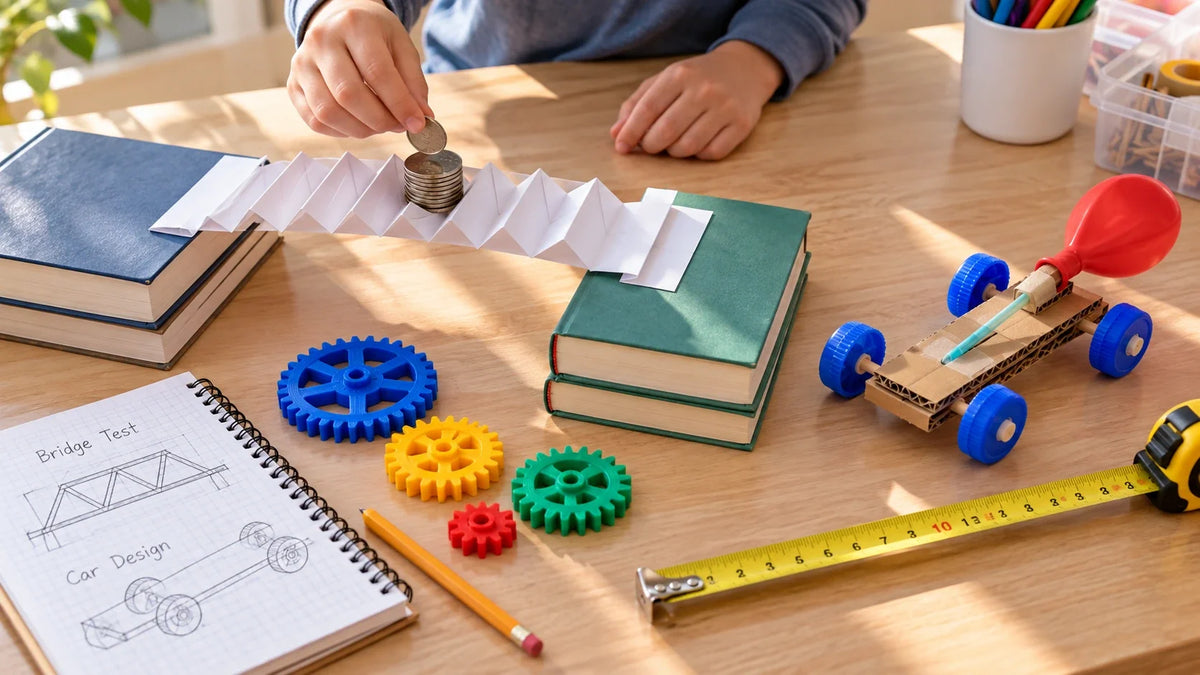
Printer paper. A roll of tape. Two books and a handful of coins.
That is enough for a real engineering test at the kitchen table. What makes it STEM is a goal you can measure and a second try that has to beat the first.
Below are 40 ideas, from paper and household scraps to digital design and 3D printing. Each one says what to measure.
Quick Picks: Where to Start Today
|
Your situation |
Start with |
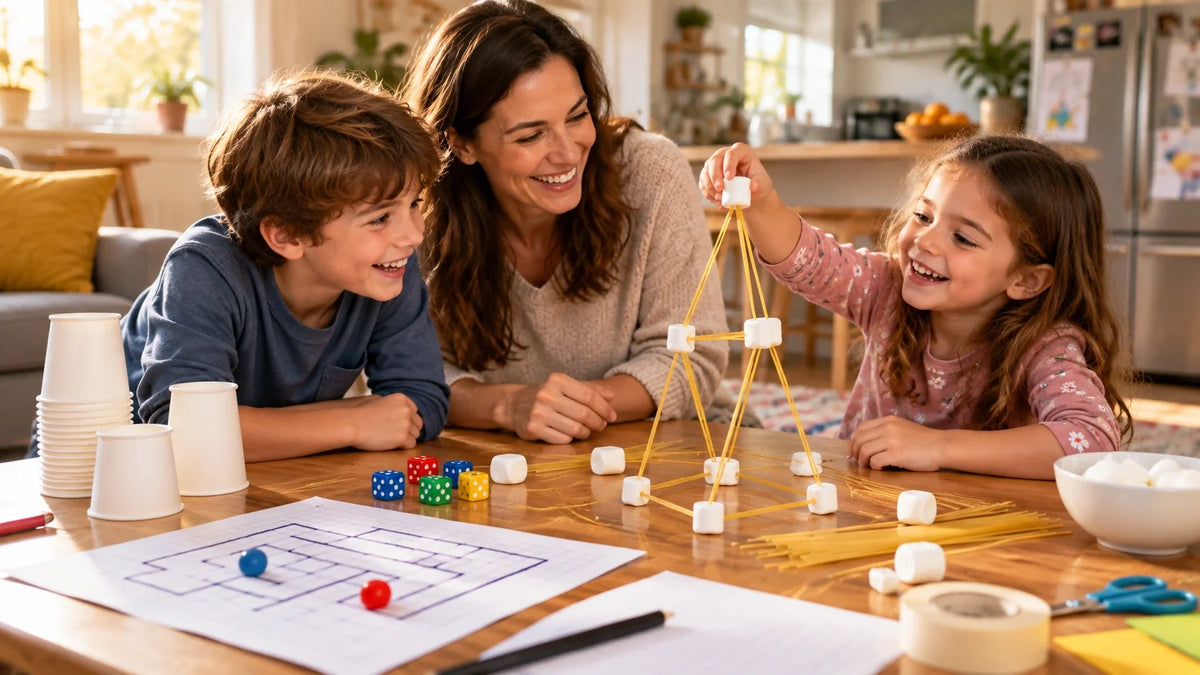
Time |
Best ages |
|
20 minutes and some paper |
Paper Bridge Challenge (#1) |
15 to 20 min |
4 and up |
|
A kid who loves anything with wheels |
Balloon Powered Car (#7) |
30 to 45 min |
5 and up |
|
No time to clean up |
Magnet Testing Challenge (#18) |
15 min |
3 and up |
|
You want a big reaction |
Baking Soda Volcano, run as a test (#20) |
20 min |
4 and up |
|
A child who likes numbers |
Measurement Scavenger Hunt (#29) |
20 min |
6 and up |
|
Paper feels too easy now |
3D Printed Bridge Challenge (#34) |
1 to 2 hrs plus print time |
8 and up |
What Are STEM Activities for Kids?
Any activity where a child tests a question or solves a problem using science, technology, engineering, or math.
Building a paper tower is a craft. Building the tallest tower that stands for 30 seconds from five sheets is a STEM challenge. Now there is a test, and it can fail.
What Does STEM Stand For?
Science, technology, engineering, and mathematics. In real projects they overlap.
|
Letter |
What your child actually does |
Example from this list |
|
Science |
Guesses, watches closely, checks the guess |
Float or Sink Experiment (#15) |
|
Technology |
Uses a tool to make something, from a timer to a design app |
Stop Motion Animation (#31) |
|
Engineering |
Designs within limits, tests, rebuilds |
Foil Boat Challenge (#10) |
|
Math |
Measures and compares numbers between versions |
Simple Gear System (#24) |
What Makes an Activity a STEM Activity?
A result you can check. Your child compares it with their guess and decides what to try next.
|
Craft version |
STEM challenge version |
|
"Make a paper boat." |
"Make a boat that carries 20 pennies." |
|
Same steps for everyone |
Child picks the design |
|
Done when it looks right |
Done when it passes the test |
|
One version |
Version 1, then 2, then 3 |
|
An adult says "great job" |
The penny count decides |
STEM vs. STEAM Activities
STEAM adds art. Designing a bridge to hold weight is STEM. Painting it or shaping the arches adds the art.
Most home projects are both.
|
QUICK TEST Can you measure the result? Height, distance, time, weight, a coin count. If yes, it is STEM. If the only goal is how it looks, add a number to beat. |
Why Hands-On STEM Learning Works at Home
Cups, cardboard, coins, water, tape. Your house is full of test material.
The Smithsonian Science Education Center's makerspace resources describe this kind of learning as observing, making, designing, and testing solutions to a problem. A kitchen table handles all four.
Failures are cheap at home.
Skills Kids Build Through STEM Activities
|
Skill |
Where it shows up |
What you might hear |
|
Prediction |
Before each test |
"The arch one will win." |
|
Measurement |
Ruler, timer, kitchen scale |
"It went 212 centimeters!" |
|
Fair testing |
One change at a time |
"Same paper. Only the wings are different." |
|
Persistence |
Right after a collapse |
"Wait, let me fix the bottom." |
|
Explaining |
Comparing two versions |
"Mine held more because the base is wider." |
The last one shows up fast. Kids happily explain why their second bridge held more coins.
Paper STEM Activities for Kids

Cheap and forgiving. Fold it, roll it, tape it. If it fails, grab another sheet.
1. Paper Bridge Challenge
Set two books 8 inches apart and span the gap with one sheet. Add coins one at a time until it sags.
Then try an accordion fold. It holds far more.
2. Paper Airplane Flight Test
Throw a paper plane three times from a taped line and average the distance. Next round, change only the wings or the nose.
3. Tallest Paper Tower
Five sheets, 12 inches of tape. Measure the height after it stands alone for 30 seconds.
Rolled tubes and wide bases usually win.
4. Paper Helicopter Experiment
Cut a strip, split the top into two blades, and fold them opposite ways. Time the fall from the same height. Then try longer blades or a paper clip.
5. Straw and Paper Rocket
Roll paper around a pencil, tape it, pinch one end, and slide it onto a straw. Blow.
Measure the landing spot. Add fins or change the angle and compare.
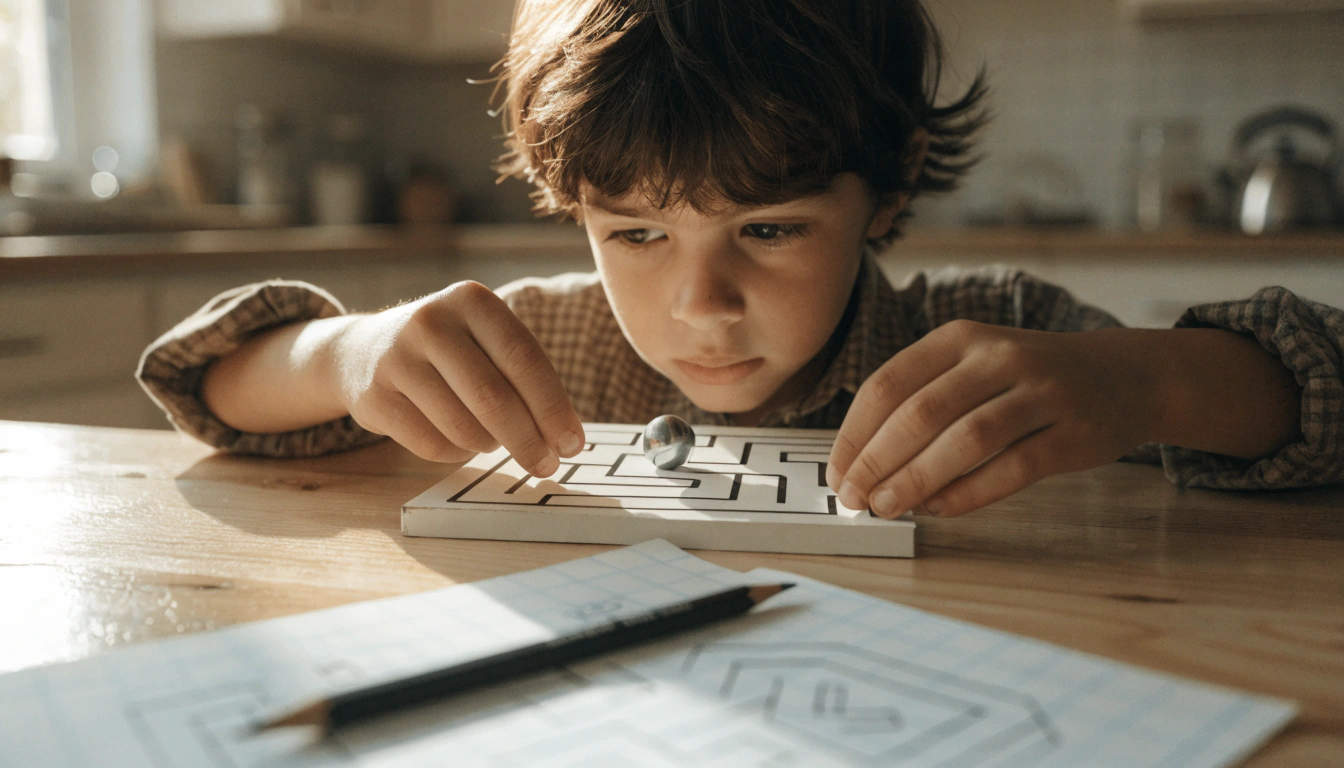
6. Paper Marble Maze
Tape folded paper walls onto cardboard. Time the marble from start to finish, then fix the corner that keeps trapping it.
|
WHY START WITH PAPER You can build five paper towers in the time it takes glue to dry on one model. Every collapse shows exactly where the next one needs help. |
STEM Activities Using Everyday Household Materials
No kit needed. Check the craft box and recycling.
7. Balloon Powered Car

Cardboard body, straw axles, bottle cap wheels. Tape a balloon on top, neck pointing back, and let go.
Measure the distance. Change one thing per run.
8. Marshmallow Tower
Twenty spaghetti sticks, ten mini marshmallows. Build tall, tap the table, and measure what survives. Triangles beat squares.
9. Cup and String Telephone
Link two paper cups with a long string knotted through the bases. One child whispers, one listens.
Compare a loose string with a tight one.
10. Foil Boat Challenge
Shape a 6 inch square of foil into a boat and add pennies until it sinks. Round two: same foil, new shape.
11. Stick Raft
Tie craft sticks or twigs together, float the raft, and add weights until it tips. Try it wider next time.
12. Homemade Catapult
Band seven craft sticks into a stack, then add a lever stick with a spoon on the end.
Launch pom poms and measure. Move the stack and compare.
|
SAFETY NOTE Aim catapults and rockets away from faces and pets. Soft ammo only, like pom poms or cotton balls. Coins, marbles, and popped balloon bits stay away from children under 3. |
Easy Science Experiments for Kids at Home
Get a written guess before every test.
Then the result means something.
13. DIY Lava Lamp
Fill a bottle mostly with oil, top with colored water, and add a piece of effervescent tablet. Time the bubbling, then try a bigger piece.
14. Mini Water Cycle
Seal a little water in a zip bag and tape it to a sunny window.
Note when droplets form. Compare with a bag in the shade.
15. Float or Sink Experiment

Sort ten water safe objects into "float" and "sink" piles, then test. Count the correct guesses.
Bonus: a clay ball sinks, but the same clay shaped as a boat floats.
16. Apple Oxidation Test
Coat three apple slices in lemon juice, water, and salt water. Leave one plain for comparison. Check the color every 30 minutes.
17. Rain Cloud in a Jar
Top a jar of water with shaving foam as the cloud. Drip colored water on it until streaks fall.
Count the drops. Remind kids it is a model.
18. Magnet Testing Challenge
Gather metal, plastic, wood, and fabric items. Predict which ones stick, test, and look for a pattern.
19. Grow Plants From Kitchen Scraps
Stand a romaine lettuce base in shallow water. New leaves appear within days.
Log the height. Compare bright light with a dim spot.
20. Baking Soda Volcano
Baking soda and vinegar in a cup, on a tray.
Measure the foam height, then change only the baking soda amount.
|
ADULT STEP With younger kids, adults handle the effervescent tablets, vinegar, and food coloring. Read the labels, work over a tray, and put everything away afterward. |
Engineering and Building STEM Activities
Pick a row. Run it twice and compare.
|
# |
Challenge |
Limit to set |
What to measure |
Redesign idea |
|
21 |
Build and Test a Bridge |
8 inch gap, 10 craft sticks, 12 inches of tape |
Coins before it sags |
Triangles under the deck |
|
22 |
Design a Wind Powered Car |
Same fan setting, same start line |
Distance in 10 seconds |
Bigger sail, or straighter wheels |
|
23 |
Build a Marble Run |
Three cardboard tubes, at least one turn |
Seconds from top to bottom |
Add a switchback to slow it |
|
24 |
Create a Simple Gear System |
Two meshing gears to start |
Small gear turns per big gear turn |
Add a third gear and guess its direction |
|
25 |
Build a Windmill |
Blades from one index card |
Rotations in 15 seconds |
Change blade angle or count |
|
26 |
Design a Weight Bearing Structure |
Holds a paperback 4 inches up |
Seconds before it sags |
Reinforce the corners |
Where it bends first is where version two needs more material.
Math and Technology STEM Activities
Math sticks when numbers solve something. Screen time counts when your child is making, not watching.
|
# |
Activity |
Materials |
Skill practiced |
Make it harder |
|
27 |
Fraction Building Challenge |
Paper circles cut into halves, thirds, quarters |
Equivalent fractions |
Write the matching equation |
|
28 |
Geometry Shape Challenge |
Straws or craft sticks and clay |
Faces, edges, vertices |
Guess the counts first |
|
29 |
Measurement Scavenger Hunt |
Ruler, tape measure, a list |
Estimating, then checking |
Switch to centimeters |
|
30 |
Number Line Game |
Painter's tape and index cards |
Adding and subtracting by walking |
Go below zero |
|
31 |
Stop Motion Animation |
Phone or tablet, small toys |
Sequencing, frame timing |
Plan a 10 second story first |
|
32 |
Design a Digital Maze or Puzzle |
Drawing, coding, or design app |
Logic, user testing |
At least 6 turns |
Let someone else test the maze or animation. Where they get stuck needs fixing.
3D Printing STEM Activities for Kids
A design on screen becomes an object your child can test and improve.
Tinkercad, a free browser app for 3D design, lets kids build from basic shapes. Younger kids can start by editing ready made models in a guided app.
A beginner 3D printer for younger kids with a fully enclosed print area, auto leveling, and one tap printing from the AOSEED app keeps the parent role small. You set up and supervise. Your child designs and tests.
|
WHERE THE PARENT STEPS IN Adults: unboxing, first setup, loading filament, and taking prints off the plate once they cool. Kids: picking, designing, testing, and deciding what to change. |
33. 3D Printed Geometry Models
Print basic solids. Younger kids count faces and edges. Older kids calculate surface area and volume.
34. 3D Printed Bridge Challenge
Print a bridge for the same gap as #1 and test it with coins. Note the filament used.
Change one thing and print version two.
35. 3D Printed Gear System
Mount two or three printed gears on pegs. Mark one tooth each, turn the first gear ten times, and count the others.
36. 3D Printed Marble Maze
Design and print a flat maze. Fix whatever path fails and reprint.
37. 3D Printed Wind Powered Car
Print a chassis and wheels, add a paper sail, and test with the same fan as #22.
The printed car does not always win.
38. 3D Printed Solar System Model
Print a Sun and planets. Real sizes and distances cannot both fit on a shelf, so choosing a scale becomes the math lesson.
39. 3D Printed Fossil or Anatomy Model
Print a skull, tooth, or fossil from a trusted museum collection. Sketch it from three sides.
Note what detail changes with print size.
40. Design and Print a Custom Puzzle
Design an interlocking puzzle. Gaps matter, since tight parts will not fit. Adjust and reprint only the failed pieces.
|
READY TO MOVE FROM PAPER MODELS TO PRINTED ONES? AOSEED BUILDS 3D PRINTERS FOR KIDS AROUND A GUIDED DESIGN APP, A STEADILY UPDATED TOY LIBRARY, AND A FULLY ENCLOSED PRINT AREA, SO THERE IS ALWAYS A NEXT PROJECT WAITING. |
From Paper to 3D Printing: How to Level Up a STEM Project
Paper tests an idea in ten minutes. Then move to the digital model.
Keep both versions to compare later.
Start With a Paper Prototype
Sketch, then build a rough paper version. It only needs to show size, shape, and whether the idea works.
Set a STEM Challenge or Problem
"Make a bridge that spans 8 inches and holds 20 coins" has a clear finish line.
Add Design Constraints
Limit materials, size, or time. Otherwise the answer is always "bigger."
Measure and Record the First Results
Test the paper version and record the number. The print has to beat it.
Recreate the Idea in a 3D Design Tool
Rebuild only what worked, using basic shapes and exact sizes.
Print and Test the New Version
Run the same test as the paper version.
A clean print is not the goal. Solving the problem is.
Compare Paper and 3D Printed Designs

Compare strength, weight, accuracy, and build time. Paper sometimes wins one.
Redesign and Improve the Project
Fix one weakness at a time, then retest.
Worked Example: One Bridge, Three Versions
|
Version |
Material |
What changed |
What to write down |
|
Version 1 |
One sheet of paper |
Flat sheet across the gap |
Coins held, where it folded |
|
Version 2 |
One sheet of paper |
Accordion folds along the length |
Coins held, compared with V1 |
|
Version 3 |
PLA print |
The accordion idea, rebuilt as a printed truss |
Coins held, grams of filament, print time |
Best STEM Activities for Kids by Age

Use age as a guide. Interest matters more.
Younger kids need short tasks and adult setup. Older kids can run the whole project.
|
Ages |
Good starting activities |
Child does |
Adult does |
Where 3D printing fits |
|
3 to 5 |
Sorting, big block towers, magnets, float or sink |
Notices, guesses, sorts |
Sets up, asks "What do you notice?" |
Adult prints big shapes to sort and count |
|
6 to 8 |
Paper airplanes, foil boats, balloon cars, marble runs |
Writes down simple numbers |
Helps measure and time |
Picks library models and personalizes them |
|
9 to 11 |
Gears, bridges, wind cars, fractions |
Plans, changes one thing at a time |
Checks safety, asks "why?" |
Edits models in a beginner design tool |
|
12 to 14 |
CAD models, gear ratios, working parts |
Runs the whole design cycle |
Advises, handles hot parts |
Designs original parts that have to fit |
STEM Activities for Ages 3 to 5
Sorting, block towers, magnets, and float or sink, with an adult close by.
Watch piece size. The CPSC small parts rule bans toys for children under 3 with choking hazard parts. Keep coins, marbles, and small prints away from toddlers.
STEM Activities for Ages 6 to 8
Start recording numbers. Airplanes, foil boats, balloon cars, and bridges work well. Change one thing per round.
STEM Activities for Ages 9 to 11
Gears, weight bearing bridges, wind cars, fractions, and simple 3D prints. Ask them to explain each redesign.
STEM Activities for Ages 12 to 14
CAD models, gear ratios, and parts that must fit together. Tighter limits, real data.
When Kids Can Start Designing Their Own STEM Projects
No set age. A five year old picks the shape. A ten year old picks the problem.
Hand over more as skills grow. Your role shifts to asking questions.
Turning STEM Into a Hobby
Hobbies that grow with a curious kid:
• Robotics and building kits
• Coding games, then small animation projects
• 3D design and printing, starting with toy tweaks and moving to original parts
• A kitchen garden with a growth log
• Backyard astronomy, paired with NASA learning resources
30 Minute STEM Activities for Busy Days
NASA JPL's STEM activities for families include several engineering and science activities that take less than 30 minutes, for kindergarten through ninth grade.
A 30 Minute Session Plan
|
Minutes |
Stage |
What happens |
|
0 to 5 |
Plan |
Say the challenge out loud, hand out materials, write one guess |
|
5 to 20 |
Build |
Version 1. It does not need to be good. |
|
20 to 25 |
Test |
Measure once or twice, write the number down |
|
25 to 30 |
Improve |
Change one thing, test again |
Quick Picks by Type
|
Type |
Pick one |
Setup time |
|
Science |
Magnet test, float or sink, apple slices |
Under 5 minutes |
|
Engineering |
Paper tower, paper bridge, foil boat |
Under 5 minutes |
|
Math |
Scavenger hunt, fraction puzzle, number line |
About 5 minutes |
|
Paper |
Airplane, helicopter, straw rocket |
Under 5 minutes |
Low Mess STEM Activities
Paper, blocks, magnets, measuring games, and digital design. Nothing to mop.
|
BUILD A STEM BOX Paper, tape, scissors, a ruler, paper clips, straws, craft sticks, and a small notebook, all in one bin. Short sessions stop losing ten minutes to hunting for the tape. |
How to Turn Any Project Into a Real STEM Challenge
A challenge gives a problem, not instructions. Use these steps with any activity.
1. Ask a question. "Which bridge shape holds the most coins?" works better than "Build a bridge."
2. Get a prediction first. Write it down. Being wrong is useful, since the evidence then changes the explanation.
3. Set limits. Ten sheets of paper and 12 inches of tape, for example.
4. Build version 1. Call it that out loud so a redesign feels normal.
5. Test it and measure. Distance, time, height, weight, or load. Test twice if you can.
6. Record the numbers. Little kids can use tally marks, drawings, or stickers.
7. Change one variable. Only the wing width. Same paper, same thrower, same line.
8. Test again. The numbers decide which version won. Not which one looks nicer.
Printable Data Log
|
Trial |
My prediction |
What I changed |
Result |
Next idea |
|
1 |
|
Nothing (baseline) |
|
|
|
2 |
|
|
|
|
|
3 |
|
|
|
|
What Supplies Do You Need for STEM Activities at Home?
Start with what you have. Add as skills grow.
|
Tier |
What to gather |
Typical cost |
Unlocks activities |
|
Starter box |
Paper, cardboard, tape, safe scissors, string, straws, craft sticks, rubber bands |
Mostly free |
#1 to #12 |
|
Measuring kit |
Ruler, tape measure, kitchen scale, timer, notebook |
Low |
Every test here |
|
Science shelf |
Baking soda, vinegar, foil, magnets, clear jars, zip bags |
Low |
#13 to #20 |
|
Digital tools |
Tablet or computer with a free beginner design app |
Often already owned |
#31, #32, design for #33 to #40 |
|
Printing |
Kid friendly 3D printer and PLA filament |
Optional |
#33 to #40 |
Paper, Cardboard, and Recycled Materials
Paper, boxes, bottle caps, and tubes become bridges, ramps, and wheels. Check recycled items for sharp edges and small parts.
Beginner Digital Design Tools
Browser design apps and guided kids' apps are enough. Skip professional software.
3D Printer and Filament
Optional. Ideas #1 to #32 need no printer. If you add one, use the recommended filament.
Safety Gear and Adult Supervision
Heat, blades, electricity, and chemicals are adult jobs. For printing, NIOSH research on 3D printer emissions points to ventilation, filtration, and lower emission filaments.
|
HOME PRINTING CHECKLIST Print in a room with fresh air. Use the filament your printer supports. Hands stay out until the print cools. Filament and tools go somewhere younger siblings cannot reach. |
When to Stick With Paper and When to Add 3D Printing
Stick with paper and household materials when:
• Your child is under 6 and still learning to guess and compare
• You only have half an hour
• The idea keeps changing every few minutes
• Several quick versions would help before picking one design
Add 3D printing when:
• Paper keeps failing because it cannot hold an exact shape
• They want parts that move, mesh, or snap together
• Measuring and redesigning already come naturally
• Your child asks to keep, play with, or gift what they made
Conclusion
STEM activities for kids can start with paper, tape, and one question. Each project gets children predicting, building, measuring, and trying again.
The same loop scales from paper to print.
Pick one activity and set one clear goal. When a paper idea is ready to become real, AOSEED's family friendly 3D printing platform pairs guided design apps with a Toy Library of ready to print projects. The X-MAKER JOY is $239, made for ages 4 to 12, with a fully enclosed print area and one tap printing.
FAQs
What Are Examples of STEM Activities?
Paper bridges, balloon cars, marble runs, float or sink tests, gear sets, measuring games, and 3D printing projects. Each one has a child test a question or solve a problem.
A child might build two bridges and count the coins each holds. NASA JPL's family activity list sorts ideas by subject with time estimates.
Practical tip: Pick an activity with a measurable result.
What Are Some Basic STEM Activities for Kids?
Paper airplanes, foil boats, paper towers, magnet tests, and measuring games. They use paper, water, magnets, and cups.
Keep one goal and few variables. Kids guess, build, and measure first. Terms like "buoyancy" come later.
Practical tip: Start with 15 to 30 minutes.
What Are Some 30-Minute STEM Activities for Elementary School Students?
Paper bridges, foil boats, paper helicopters, magnet hunts, scavenger hunts, and marshmallow towers.
Plan for five minutes, build for 15, test for five, and use the rest for one improvement. That last step makes it engineering.
Practical tip: Keep supplies in one STEM box.
What Are Some Fun and Easy STEM Projects for Kids?
Straw rockets, balloon cars, marble mazes, foil boats, and baking soda volcanoes. No special supplies needed.
Give each one a mission. A foil boat that carries 20 pennies beats "make a boat." Goals push kids to test and try again.
Practical tip: Let your child choose from two or three challenges.
What Is the Easiest STEM Project to Do?
A paper tower. A few sheets, a strip of tape, and one goal: the tallest tower that stands alone.
It works at any age. Younger kids compare heights. Older kids set limits and test folded versus rolled paper. Where it buckles shows what to fix.
Practical tip: Photograph each version.
What Are Some Popular STEM Games?
Building challenges, number line games, marble mazes, logic puzzles, and coding games. NASA Kids' Club has free games for preschool through grade 4.
Games teach more when players make choices. Give everyone the same pieces and see who builds tallest. Keeping score adds math.
Practical tip: Ask what they would change next round.
What Are Some Fun and Engaging STEM Activities for 3-Year-Olds?
Sorting big objects, stacking blocks, pouring water, finding what rolls, and trying a large magnet with an adult.
Ask short questions like "Which is taller?" Wrong answers are fine. Skip small parts, since the CPSC treats small parts as a choking hazard for children under 3.
Practical tip: Stop when curiosity turns into frustration.
What Are Some Engaging STEM Activities for 5-Year-Olds?
Paper towers, ramps, float or sink tests, big piece marble runs, shape building, and planting seeds.
Ask for a prediction first. Which car rolls farther, from the high ramp or the low one? Let your child make one design choice alone.



Further reading

Thanksgiving STEM Activities for Kids: Table Projects and Simple Engineering Challenges

Halloween STEM Activities for Kids: Spooky Builds That Teach Real Science

STEM Crafts for Kids: Build, Decorate and Test