What Materials Are Best for Kid-Friendly 3D Printing?

A few months after we got our printer, my daughter picked up a finished print and asked: 'Is this plastic safe?' I had no idea. We'd been printing dinosaurs and keychains for weeks and I'd never actually looked up what the material was made from.
That question sent me down a research rabbit hole that most parents don't go down until after they've already been printing for a while. So here's what I found — the plain version, without the chemistry jargon.
Short answer: PLA is safe, PETG and TPU are fine for specific things, and ABS and resin don't belong in a family home with kids around. The AOSEED X-MAKER JOY uses PLA specifically because of this — it's not just the default, it's a deliberate safety decision.
What Filament Actually Is
A 3D printer works by melting a thin plastic strand through a heated nozzle and laying it down layer by layer to build an object. That plastic strand is the filament. It lives on a spool, usually 1.75mm in diameter.
Different materials behave differently when heated. Some release more particles and fumes than others. That's the core safety question — not what the finished object is made of, but what happens during the printing process when the plastic gets hot.
The finished print from PLA is non-toxic. You can let your child hold it, carry it in a school bag, leave it in their bedroom. The question parents are really asking when they worry about filament is about the air quality during printing — and for PLA, that answer is genuinely reassuring.
PLA — Polylactic Acid | The Family Standard

PLA is what most family printers use and there's a straightforward reason for that. It's made from fermented plant starch — usually corn or sugarcane — which makes it biodegradable. In solid form, it's non-toxic. Finished prints are safe to handle, safe to give as gifts, safe in a child's bedroom.
During printing, PLA does release some particles and a faint sweet smell. But compared to ABS or resin, the levels are low. Research consistently puts PLA near the bottom of the emissions scale. For most families, cracking a window during longer print sessions is enough. No air purifier, no hood ventilation, no PPE.
It's also the easiest material to print reliably. It doesn't need high temperatures, sticks well to standard build plates, and doesn't warp the way ABS does. For a child who wants to print things and a parent who'd rather not troubleshoot failed prints, PLA just works.
What parents should know:
- Finished prints are non-toxic — no special precautions needed when handling
- Low emissions during printing — a cracked window is genuinely all that's needed
- Food-safe PLA variants exist (look for FDA-approved certification) for cups and containers
- Biodegradable under industrial composting conditions — better environmental profile than most plastics
- Meets toy safety standards commercially — PLA is used in children's products made by manufacturers
PETG — Polyethylene Terephthalate Glycol | Stronger Than PLA

PETG is tougher than PLA. Where PLA can crack under impact, PETG bends a little first — which makes it better for parts that get rough treatment, live outdoors, or need to survive being assembled and disassembled repeatedly.
From a safety angle, PETG is fine for family home use. It emits slightly more than PLA but far less than ABS. Same ventilation advice applies: open a window for longer sessions. Food-safe PETG exists and is genuinely what some commercial food containers are made from, though that certification doesn't automatically apply to random PETG filament from a supplier — check for it specifically if you need it.
For young children just printing animals and toys, PLA is still the right call. PETG makes sense when older kids move into mechanical builds — gears, robotic joints, outdoor clips, anything that'll take repeated stress. That's when the strength difference starts to matter.
The AOSEED X-MAKER supports PETG alongside PLA — one reason it's aimed at ages 9-16 rather than the younger range. As kids get into STEM builds and multi-part mechanisms, having PETG as an option is genuinely useful.
What parents should know:
- Safe for family home use — same ventilation approach as PLA
- Stronger and more impact-resistant — good for mechanical parts and outdoor use
- Food-safe grades exist but need to be specifically labelled as such
- Slightly harder to print than PLA — start with PLA, come back to this later
TPU — Thermoplastic Polyurethane | The Flexible One

TPU is the rubbery one. Pull a finished print and it bends. Squeeze it and it bounces back. This makes it genuinely useful for certain things: flexible phone cases, wristbands, fidget tools, soft grips on handles, anything where a child needs something that won't crack if it gets rough handling.
TPU is very safe — low emissions, non-toxic in solid form. The practical issue isn't safety at all, it's that TPU is a bit awkward to print with. The flexible strand doesn't feed through the extruder as cleanly as rigid materials do. It's not something to tackle in a first or second printing session. Come back to it once your family is comfortable with PLA and you've got a specific reason to want something flexible.
What parents should know:
- Very safe — non-toxic, low emissions, good for skin contact items
- Finished prints are flexible and durable — won't crack on impact
- More technically demanding to print — not a first-session material
- Best use cases: fidget toys, wristbands, grips, flexible mechanisms
Material Safety at a Glance

|
Material |
Safety Rating |
Emissions |
Strength |
Ease of Use |
Family Home? |
|
PLA |
Excellent |
Very Low |
Moderate |
Very Easy |
Yes |
|
PETG |
Good |
Low |
High |
Moderate |
Yes |
|
TPU |
Good |
Low |
Flexible |
Challenging |
Yes |
|
ABS |
Poor |
High (Styrene) |
High |
Hard |
No |
|
Resin (SLA) |
Very Poor |
Very High |
Very High detail |
Very Hard |
No |
ABS and Resin: Why Not at Home with Kids

ABS comes up in almost every 3D printing article aimed at hobbyists. It's a legitimate material for workshops — strong, heat-resistant, good print quality. But it emits styrene during printing. The WHO classifies styrene as a possible carcinogen. The smell is distinctive and you know immediately when someone's printing with it.
In a shared living space, a bedroom, a kitchen, anywhere children spend regular time — that's not acceptable. ABS isn't a 'slightly worse than PLA' situation. It's a different category.
Resin is even more clear-cut. Liquid resin is photosensitive and toxic before curing — gloves, goggles, dedicated ventilation, all required before you even start. Post-processing involves UV lamps and alcohol washes. Resin printing is a workshop activity for adults with appropriate safety infrastructure. Not a family kitchen activity.
⚠ THE SIMPLE RULE |
|
PLA, PETG, and TPU: safe for family use with standard room ventilation. ABS and resin: no, not in shared living spaces with children. This isn't about being overly cautious — it's about ABS emitting a substance the WHO flags as a possible carcinogen, and resin being genuinely toxic in liquid form. If a printer is marketed for kids and the recommended filament is ABS, look more carefully before buying. |
How the Printer Design Affects Air Quality

Even with PLA — a low-emission material — an open-frame printer releases particles directly into the room. An enclosed printer keeps them inside the chamber. On models with built-in filtration, those particles get processed before anything circulates.
This is one reason enclosed printers get recommended for family use even with safe materials. The enclosure isn't only about keeping small hands away from a hot nozzle. It's about keeping the print environment contained.
For most families printing PLA on an enclosed printer, the practical advice is: crack a window for sessions over an hour. That's it. You don't need an air purifier or a ventilation hood. PLA's emission profile combined with a sealed chamber means the air quality impact is minimal.
💡 VENTILATION GUIDE — WHAT ACTUALLY APPLIES |
|
PLA on enclosed printer: open a window for sessions over an hour. That's genuinely all. PLA on open-frame printer: same, but make sure the room has reasonable circulation. PETG: treat it like PLA, maybe a little more air movement. ABS: dedicated workshop with real ventilation — not shared living space. Resin: PPE, dedicated workspace, specialist ventilation — not a family home activity at all. |
What Kids Actually Make with PLA

Once you're clear that PLA is safe, the real question is just what your child wants to make. And the answer keeps expanding the longer they have a printer.
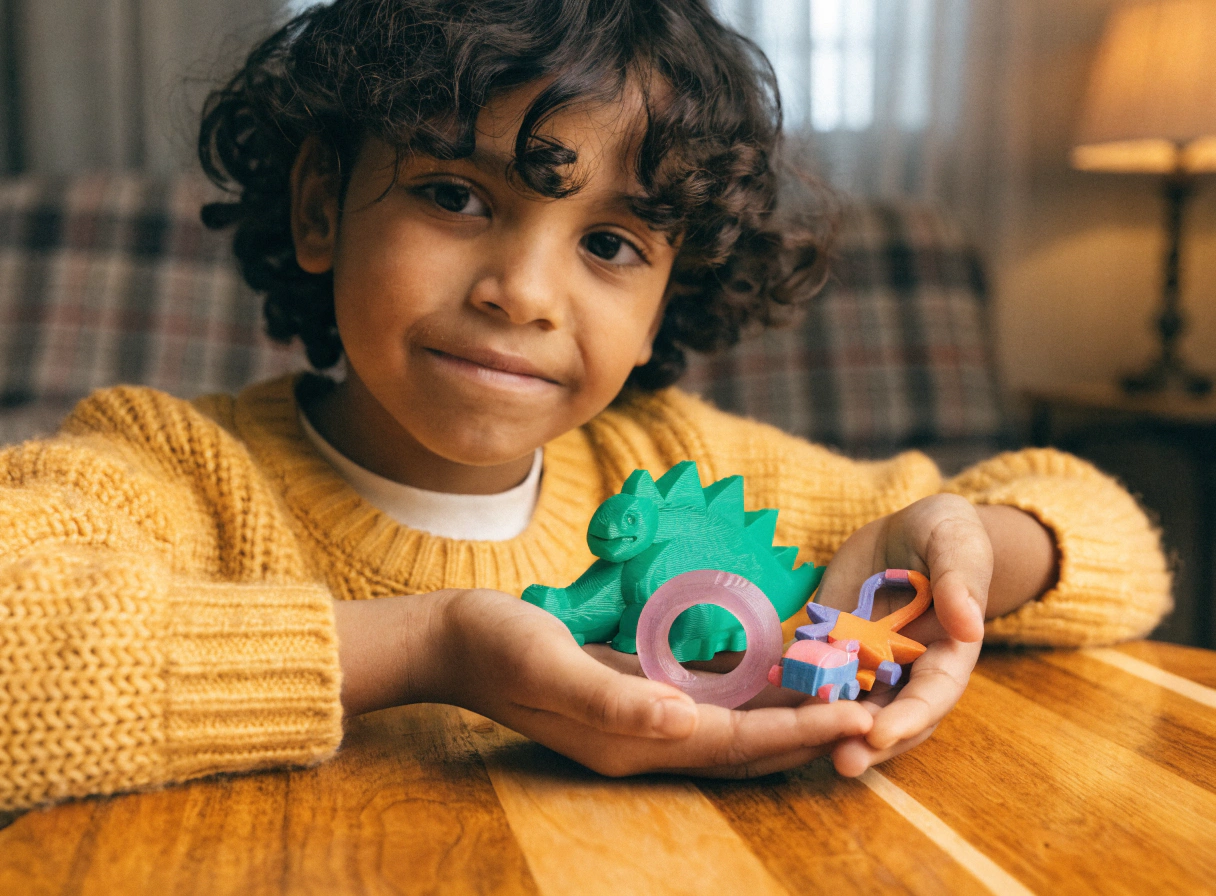
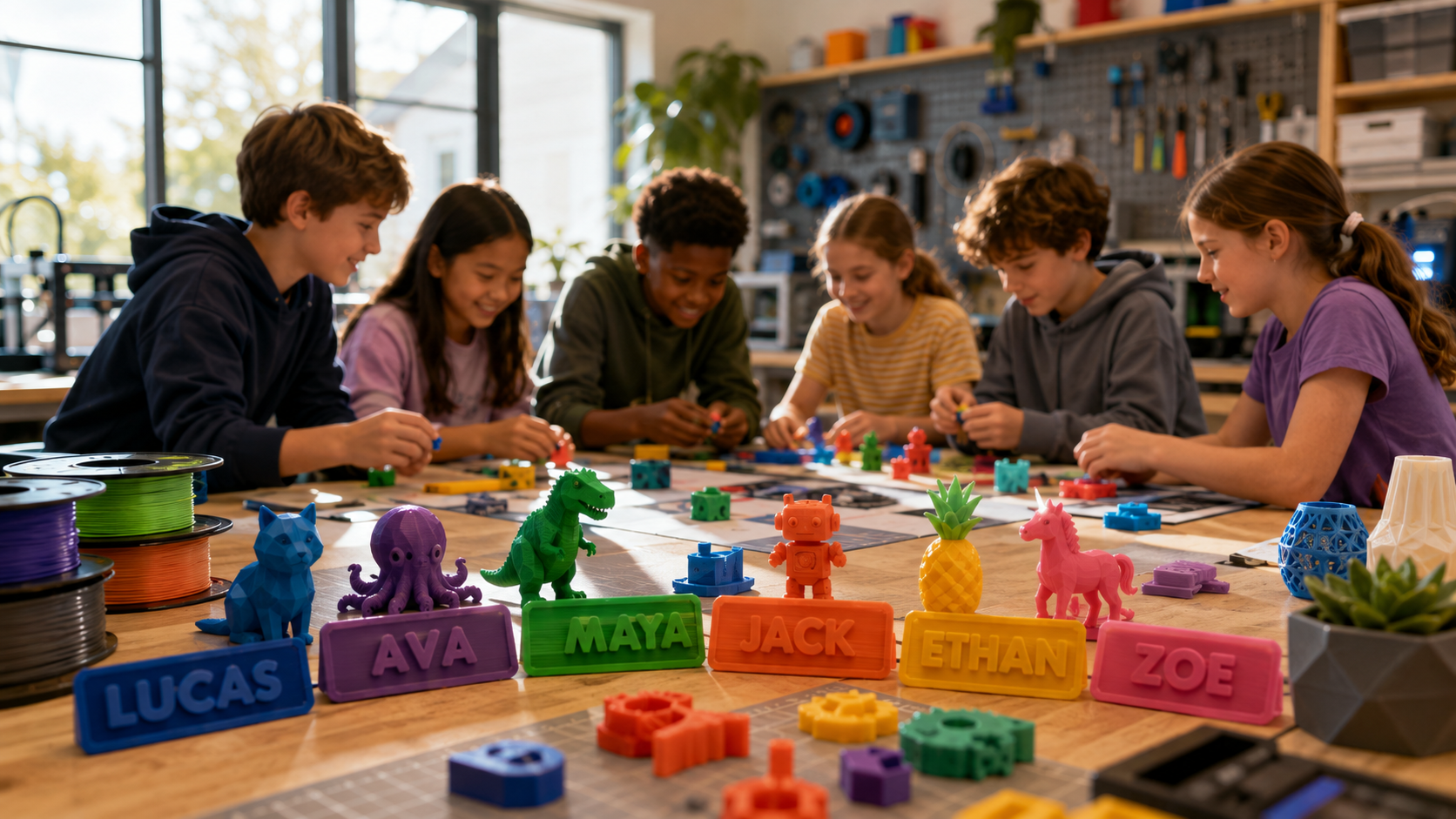
The first month is usually library prints — animals, keychains, fidget rings, small vehicles, seasonal builds. All PLA, all come off the enclosed printer safe to handle, safe to give to people, safe to leave anywhere in the house.
The AOSEED Toy Library adds new PLA-optimised models every week. Every model in there has been tested on the printer it's designed for, using default settings. A child who browses on a Saturday and taps print gets a successful result, not a troubleshooting session.
For older children the creation kit ecosystem is where PLA gets more interesting. Printed parts combine with motors and mechanisms to build things that actually work — RC cars, wind-up robots, music boxes. The parts are still PLA, still the same material, but now they're functional components rather than display pieces. That's a significant shift in what 3D printing means to a child.
A Note on AOSEED's Material Approach

Both AOSEED printers use non-toxic, eco-friendly PLA as their default material. That's not just a label — it reflects an actual design decision about what's appropriate for a family home printer. Standard 1.75mm PLA from any reputable brand works in both machines. You're not locked into expensive proprietary rolls.
If you want to compare what each printer in the AOSEED range supports in terms of materials and how the specs differ with age group, see all AOSEED 3D printers has both models side by side with current pricing.
FAQs
Is PLA material safe for kids?
Yes. PLA is made from plant starch — usually corn or sugarcane — and is non-toxic in solid form. Finished PLA prints are safe for children to handle, play with, and keep in their room. During printing, PLA releases some particles and a faint sweet smell, but emission levels are among the lowest of any 3D printing material. Good ventilation means opening a window. No specialist equipment is needed for PLA in a family home.
What is the safest 3D printer filament for kids?
PLA is the safest and most practical option for family home 3D printing. It's non-toxic, biodegradable, low-emission, and the easiest material to print reliably. PETG and TPU are also safe for specific applications — PETG for stronger functional parts, TPU for flexible objects. Resin and ABS are not appropriate for family home use with children present.
What is the least toxic 3D printing filament?
PLA consistently ranks near the top in filament emission comparisons. It's plant-derived, emits fewer VOCs than most alternatives, and doesn't produce the styrene emissions associated with ABS. PETG and TPU are also considered low-toxicity. At the other end: resin is the most toxic option for home use — it requires gloves, safety glasses, and proper ventilation even before any printing begins.
Does PLA have carcinogens?
PLA itself does not contain known carcinogens. The particles emitted during PLA printing are not classified as carcinogenic. ABS, by contrast, emits styrene during printing — a volatile compound the World Health Organization classifies as a possible carcinogen. This is one of the main reasons ABS is not appropriate for family home use with children. PLA's carcinogenic risk profile is considered acceptable for home use with standard ventilation.
What is safer, PLA or PETG?
Both are safe for family home use. PLA is simpler to print and has slightly lower emissions, making it the default recommendation for families starting out. PETG emits at a similarly low level but requires slightly higher printing temperatures and is harder to get right. For most children's projects — toys, gifts, STEM models — PLA is the right choice. PETG becomes relevant when you need stronger parts that survive impact or repeated mechanical stress.
Can you drink out of a PLA 3D-printed cup?
Standard PLA is not reliably food-safe for drinking vessels. FDM printing creates tiny gaps between layers where bacteria can grow, and most PLA filament may contain additives that aren't food-grade. Food-safe PLA exists with FDA-approved additives and specific labelling — use that version if food contact matters. For standard children's toys, decorations, and play items, this concern doesn't apply.
Can a 7-year-old use a 3D printer safely?
With the right printer, yes. A 7-year-old using a fully enclosed printer with PLA filament can participate safely. The enclosure keeps the hot nozzle inside a sealed chamber. A door-open sensor pauses the print if opened. PLA is safe during and after printing. An adult should be reachable during print sessions but doesn't need to watch every minute once the child understands the basic rules.
How should I ventilate the room during 3D printing with kids?
For PLA on an enclosed printer: open a window during printing, especially for sessions over an hour. That's it. No air purifier needed, no ventilation hood. For PLA on an open-frame printer: same thing but make sure the room has decent natural air movement. For PETG: treat it like PLA with slightly more attention to air circulation. For ABS: proper workshop ventilation required — not appropriate for shared living spaces. For resin: dedicated workspace with specialist ventilation and PPE — not a family home activity.
SOURCES
1. AOSEED Blog — 3D Printing Safety: Materials Safe for Children's Toys (May 2025)
2. 3dfidgettoy.com — Safest 3D Printing Materials for Children's Toys (Jun 2025)
3. 3DMeta Australia — Best Filament for Making Toys — PLA Safety Overview (Mar 2025)
4. Creality Blog — Is 3D Printing Toxic? Choosing Safe Filaments (Mar 2025)
5. Qidi3D Blog — Is PLA Filament for 3D Printing Toxic? (May 2024)
6. SelfCAD — Kid-Friendly Filaments That Are Easy to Use and Non-Toxic (Jun 2025)
7. Hatchbox — What Is PLA (Polylactic Acid)? — PLA Safety Explained (Accessed Apr 2026)
8. Flashforge Blog — How Kids Can Make Their Own Toys with 3D Printers (Accessed Apr 2026)
9. MatterHackers — 3D Printer Filament Comparison Guide (PLA vs PETG vs ABS) (Accessed Apr 2026)
10. Wikipedia — Health and Safety Hazards of 3D Printing (Accessed Apr 2026)



Further reading

Thanksgiving STEM Activities for Kids: Table Projects and Simple Engineering Challenges

Halloween STEM Activities for Kids: Spooky Builds That Teach Real Science

STEM Crafts for Kids: Build, Decorate and Test