


Building STEM Toys for Kids: 12 Sets That Teach Real Engineering
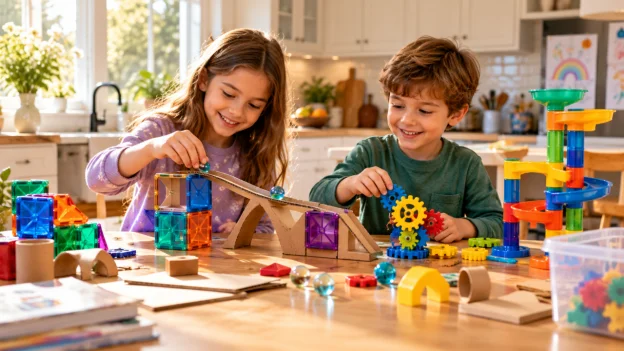
Building STEM toys for kids earn the engineering label when the finished model has to do something: balance a seesaw, turn three gears off one crank, or hold a cup of pennies across the gap between two books.
We picked 12 sets on that basis and split them by age (5 to 7, 8 to 10, 11 and up). Each pick gets its engineering idea, whether that’s levers, gears, structure,s or something close, plus a straight answer on whether the pieces come apart for new builds.
There’s a small challenge for every set, too. The last section is for the day the instructions run out: a 3D printer can replace a lost piece or make a brand new one, and that’s when construction toys for kids turn into actual design work.
All 12 Building STEM Toys in One Table
All 12, side by side. Ages come straight off the box. A couple of sets sit in an older group than their rating, because the build is harder than the number suggests.
|
Building set |
Age on box |
Engineering idea |
Reusable parts? |
|
Gears! Gears! Gears! Machines in Motion |
5+ |
Gears and rotation |
Yes |
|
Playground Engineering & Design |
5+ |
Levers and supports |
Yes |
|
Magna-Tiles Classic 100 Piece Set |
3+ |
Structures and stability |
Yes |
|
LEGO Classic Creative Vehicles |
5+ |
Wheels and axles |
Yes |
|
GraviTrax Starter Set |
8+ |
Gravity and energy |
Yes |
|
Structural Engineering: Bridges & Skyscrapers |
8+ |
Trusses and loads |
Yes, 20 models |
|
Thames & Kosmos Simple Machines |
8+ |
Levers and pulleys |
Yes, 26 models |
|
LEGO Technic NASA Artemis SLS Rocket |
9+ |
Crank-drivenn staging |
One model, Technic parts reuse |
|
LEGO Technic Bugatti Chiron Pur Sport |
9+ |
Steering and gearing |
One model, Technic parts reuse |
|
Teach Tech HydroBot Arm Kit |
12+ |
Hydraulics |
No, builds one arm |
|
ELEGOO Smart Robot Car Kit V4.0 |
12+ |
Sensors and feedback |
Partly, modules reuse |
|
UGEARS Marble Run Chain Hoist |
14+ |
Chain drive and gears |
No, one model |
What Makes a Building Toy Teach Real Engineering?
A building toy teaches engineering when kids can see why their build works and why it fails. A pile of nice pieces can’t do that on its own. A tower that leans, a car that pulls left, or a gear that slips gives a child something to fix.
The Build Has to Do Something
Stand up, roll, lift, carry, launch. When the model has a job, a failure actually tells your child something. They start asking why the wheel wobbled, instead of reaching for the next box.
Kids Test It and Change One Thing
Engineers work in a loop, and NASA’s version for teachers run:s ask, imagine, plan, create, test and improve. The last two steps repeat, sometimes a dozen times. Good kits keep every round short, a few minutes at most, so nobody quits.
The Parts Come Back Apart
Reusable pieces keep earning their shelf space. Magnetic tiles, gear sets and marble runs come back out on a rainy Saturday months later. One modekit isre different. They teach a lot during the build, and then they usually sit next to the trophies.
The Age on the Box Is About Safety
Most building sets carry a choking warning. Under the CPSC rule on small parts in children’s products, toys meant for kids under 3 can’t contain small parts, so store 5+ sets out of a toddler’s reach.
The Engineering Ideas Kids Meet in These Sets
Four ideas come up again and again in building toys. You don’t have to teach them. Knowing the words just helps you point at the right part while your child builds.
Levers: A Bar, a Pivot and a Load
A lever is a beam that turns on a pivot called the fulcrum. This lever activity from Science Buddies shows that pushing farther from the fulcrum lets you lift a heavier load. A seesaw is the easy example. A crane arm is another.
Gears: Wheels With Teeth
Mesh two gears, and they spin opposite ways every time. Put a small gear on the crank, and a big one at the other end, and the big one turns slower, with more force behind it. It’s the same reason a low bike gear makes hills easier.
The ratio between them is just a count of teeth. A gear ratio project from Science Buddies uses a 24-tooth gear and an 8-tooth gear to show a 3-to-1 ratio.
Structures: Why Triangles Hold Up
Make a square out of four straws and press on one corner. It folds into a diamond. A triangle won’t budge, since each side braces the other two. PBS Building Big has a straw shapes activity built on exactly this, and it’s why truss bridges are full of triangles.
Hydraulics: Pushing With Water
Squeeze water inside a closed tube, and the pressure spreads everywhere in it. NASA explains this as Pascal’s principle, the same idea behind car lifts and excavator arms. In a kids’ kit, one syringe pushes water into another syringe that moves a joint.
Best Building STEM Toys for Ages 5 to 7
At this ag,e the engineering has to be visible. Kids should see the gear turn or the seesaw tip without a long explanation first. Bigger pieces help too, since small fingers give up quickly on tiny pegs.
1. Gears! Gears! Gears! Machines in Motion: A Crank and 46 Gears
Learning Resources packs Gears! Gears! Gears! Machines in Motion with 116 pieces, and 46 of them are gears. There’s a crank handle, interlocking bases and axles. The booklet walks through three guided machines, then kids invent their own. Rated 5+.
Turn the crank and every gear in the chain moves. Kids notice fast that neighboring gears spin opposite ways. Pull one out and the whole machine stops, which is a good first lesson in how a drive train needs every part.

Engineering idea: gears and rotation. Reusable parts: yes. It’s an open set, and the pieces work with other Gears! Gears! Gears! sets.
First build test: make a row of three gears and put a sticker dot on each one. Turn the crank once and watch which way every dot travels. Then swap in a bigger gear and see whether it turns faster or slower.
2. Playground Engineering & Design: A Seesaw Is a Lever
The Learning Resources Playground Engineering & Design set has 104 pieces and 10 double-sided challenge cards. Kids build a twisty slide, a swing set, and a seesaw, then test them with two small play figures. Rated 5+.
The seesaw is the best engineering lesson in the box. Move the pivot toward one end, and the figures stop balancing, and kids work out why on their own. The swing set teaches something else: a wide, braced frame stands, and a skinny one tips.
Engineering idea: levers and supports. Reusable parts: yes. Every build comes apart, and the cards suggest new ones. A few connections need a firm push, so expect to help at first.
Balance challenge: one figure goes on each end. Now nudge the pivot one notch off center. Your child’s job is to level it again, and they’re allowed to move only one figure.
3. Magna-Tiles Classic 100 Piece Set: Squares, Triangles and a Lot of Towers
Fifty squares, four big squares, and 46 triangles in three shapes. That’s what comes in the Magna-Tiles Classic 100 Piece Set, and any edge sticks to any other edge. The box says ages 3 to 99. The magnets are riveted in, so they can’t work loose.Five-e andsix-year-oldss learn about structures here without hearing the word. A tall tower on a one-tile base falls over, and a wider base stands. A peaked roof of triangles holds, while a flat roof made of squares sags in the middle.

Engineering idea: structures and stability. Reusable parts: yes, completely open-ended. A 100-piece set is enough for two kids to build at the same time.
Tower contest: one rule, only the base can change. Measure each tower with a tape measure (or a stack of picture books, if the tape measure has gone missing) and stick the height on the wall with a sticky note.
4. LEGO Classic Creative Vehicles: Wheels and Axles Up Close
LEGO Classic Creative Vehicles (11036) comes with 900 pieces and 52 wheels. The instructions cover eight vehicles, including a police car, an ice cream truck, and a front loader, plus ideas for free building. Rated 5+.
For a lot of kids, this is the first realrun-inn with axles. A crooked axle and the car drifts toward the couch. A body panel rubs a tire, and it quits halfway across the floor. Five-year-olds can spot both, and they’re oddly proud of fixing them.
Engineering idea: wheels and axles. Reusable parts: yes. It’s standard LEGO, so it mixes with any bricks already in the house.
Ramp race: lean a cutting board on three or four books and send two cars down. Whichever rolls farther wins round one. For round two, trade their wheels and see if the winner changes.
Best STEM Building Toys for Ages 8 to 10
Kids in this range can compare two designs and explain why one worked better, and these four sets are built around that. If your child is 10 and bored with basic kits, our list of building toys for 10-year-olds who’ve outgrown basic sets goes deeper.
5. GraviTrax Starter Set: Gravity Does the Work
The GraviTrax Starter Set from Ravensburger is a modular marble run with 122 pieces: base plates, height tiles, curves, and a magnetic cannon. Rated 8+. Other sets in the GraviTrax line plug into the same system.
A marble only moves when the track gives it a reason to. Make the drop too gentl,e and it stalls in a curve. Too steep, and it jumps the rail. Most kids rebuild the same stretch ten or twenty times in an afternoon, a height tile here, a curve there.
Engineering idea: gravity, energy and momentum. Reusable parts: yes. Nothing about a GraviTrax layout is permanent, which is sort of the point.
Height test: build one track twice, starting four tiles high the first time and two tiles high the second. Time the marble on a phone. Then ask your child why the times differ, before anyone explains it.
6. Thames & Kosmos Bridges & Skyscrapers: Trusses, Tension and Load
The Thames & Kosmos Structural Engineering: Bridges & Skyscrapers kit comes with 323 pieces and plans for 20 models. Truss bridge, suspension bridge, arch, cantilever, and a few towers at the end. Retailers put it at 8 to 14.
Tension and compression stop being textbook words with this one. Put weight in the middle of a flat bridge and it bows. Add diagonal braces a,nd it holds. The manual even gets into thetrade-offss real engineers make between strength and cost.

Engineering idea: structures, trusses, and loads. Reusable parts: yes. All 20 models come out of the same pile of pieces.
Coin load test: two bridges, same span. Brace one with diagonals and leave the other plain. Hang a paper cup under the middle of each one. Pennies go in one at a time, and somebody writes down the count when a bridge starts to bend.
7. Thames & Kosmos Simple Machines: Six Machines and a Spring Scale
Six classic machines in one box: the lever, pulley, wheel and axle, inclined plane, screw and wedge. Thames & Kosmos Simple Machines throws in gears as well, with 132 pieces for 26 models and a spring scale to measure force. It’s rated 8+.
That spring scale is the reason to pick this kit. Lift a small weight straight up and note the reading. Now lift it through a pulley. The number goes down, and your kid has just measured mechanical advantage without anyone using the phrase.
Engineering idea: levers and pulleys, with gears as a bonus. Reusable parts: yes, the whole kit breaks down and rebuilds into any of the 26 models.
Pulley test: use one small load and lift it three ways, by hand, through one pulley and then through two. Each reading goes on a scrap of paper. Before the third pull, ask for a guess.
8. LEGO Technic NASA Artemis Space Launch System Rocket: Crank It and Watch It Stage
Built with input from NASA and ESA, the LEGO Technic NASA Artemis Space Launch System Rocket (42221) has 632 pieces and four tiny astronaut figures. Its party trick is a hand crank. Turn it, and the rocket separates in three stages, in launch order. Rated 9+.
For space kids, that crank is the whole appeal. Behind it sits a run of Technic parts that lets each stage go on cue, and a child who built it can trace the motion from the handle all the way out to the boosters.
Engineering idea: mechanisms that move in sequence. Reusable parts: it’s one model, but the Technic beams, pins and gears fit any other Technic build.
After the build: turn the crank slowly while your child calls out each stage as it separates. Then ask which part inside moved first, and go find it together.
Best Engineering Building Kits for Ages 11 and Up
Older kids are ready for builds that take a weekend, real water hydraulics and a bit of code. Some of these are one model kits, and we say so. A lot of the learning happens while they read the manual at the kitchen table.
9. LEGO Technic Bugatti Chiron Pur Sport: Steering and a W16 Engine
771 pieces, a steering knob on the roof, and a model W16 engine under a hood that really opens. That’s the LEGO Technic Bugatti Chiron Pur Sport Hypercar (42222). The box says 9+. Older kids, honestly, get more out of what’s going on inside it.
The interesting bit is the steering. Twist that little kno,b and both front wheels swing together, which tends to make a curious kid flip the car over with a flashlight to see why. A good next set for someone with a few LEGO builds behind them.
Engineering idea: steering linkages and some gearing. Reusable parts: it’s built as one car. Later on, every Technic beam and pin can go into something of their own.
Turning circle test: crank the steering hard to one side and push the car around in a loop on the kitchen floor. Lay string along the track it leaves, then measure the string.
10. Teach Tech HydroBot Arm Kit: Hydraulics You Build Yourself
The Teach Tech HydroBot Arm Kit from Elenco moves on water and syringes alone, no batteries. The base swings through 270 degrees. There’s a rotating wrist, a gripper, and a set of suction cups for smooth objects up to 50 grams. Rated 12+.
This is Pascal’s principle in your child’s hands. Press a syringe at the control end and, a foot away, a second syringe pushes a joint. Air in the line spoils it. The arm goes soft and laggy, and hunting down that bubble teaches more about hydraulics than any diagram.

Engineering idea: hydraulics, with levers at the joints. Reusable parts: no. You get one arm, and after that it’s a tool for games.
Pick and place game: line up a bottle cap, an eraser, and a crumpled paper ball. Start a timer. Each one has to land in a cereal bowl without a hand touching it.
11. ELEGOO Smart Robot Car Kit V4.0: A Robot That Reacts
An Arduino board, a sensor for obstacles, line tracking, an infrared remote and a camera that streams to a phone. That’s the ELEGOO Smart Robot Car Kit V4.0. The age on it is 12+, and ELEGOO itself suggests a beginner have a helper nearby.
Building it means a lot of small screws and careful wiring. Then comes the fun part, when the car spots a wall and swerves, or follows black tape around the kitchen. When it misses a turn, your kid opens the code, changes one number, and tries again.

Engineering idea: sensors and feedback. Reusable parts: partly. The car is one design, but its Arduino board and plug-in modules can move on to other projects.
Tape track test: run a loop of black electrical tape across a pale floor and let the car try it. Once it can do a full lap, make one bend tighter. Somewhere it will lose the line, and finding that spot is the whole exercise.
12. UGEARS Marble Run Chain Hoist: A Wooden Machine for Teens
The UGEARS Marble Run Chain Hoist is plywood, 400 parts of it, held together without glue. Woodcraft puts the build at around 7 hours. When it’s done, a hand crank pulls a wooden chain that carries marbles up, and a switch at the top picks their way down. Rated 14+.
Every gear and chain link is out in the open, so a teenager can see exactly how turning the crank becomes lift. When a tooth catches, they have to find the tight spot and fix it, and that’s where most of the patience gets built.
Engineering idea: chain drives and gears. Reusable parts: no. It’s a one model kit that becomes a working display piece.
Speed check: count the crank turns it takes to lift one marble all the way up. Then count the teeth on the gears involved, and see if your teenager can make the two numbers agree.
Reusable Parts or a One Model Kit: Which Should You Buy?
Reusable, for most families. A set that keeps working after the first build still gets played with in March, long after the birthday. One model kits still earn a spot, mostly as a big weekend project that ends up on display.
Open-ended play and replay value keep a set out of the closet. Our guide on how to judge a STEM kit’s replay value lists the questions to ask before you buy.
When Reusable Parts Matter Most
If your child builds the instruction model once and then wanders off to make their own thing, buy a system. Magnetic tiles, gear sets, marble runs, and LEGO all grow with more of the same brand, so a birthday add on really adds something.
When a One Model Kit Is Fine
Older kids who like long, careful builds often love a kit with one great model. The learning happens during the build: watching a gear train come together, or working out why a joint binds. Plan a quiet weekend for it.
Most Brands Don’t Mix
LEGO, K’NEX and Gears! Gears! Gears! Parts don’t fit each other, and GraviTrax pieces only connect to GraviTrax. So pick one main system per child and keep adding to it. A little of everything usually means nothing fits.
Choosing Construction Toys for Kids: Watch What They Build First
Watch a free Saturday. Whatever your child builds without being asked tells you more than the age on any box, though that number still matters for safety.
Kids Who Build Tall Things
Magna-Tiles from 5 to 7, then Bridges & Skyscrapers from about 8. Same idea, structures, with more math as they get older. Both are safe places to fail.
Kids Who Race Everything With Wheels
LEGO Classic vehicles first, Technic later. If there’s already a printer in the house, look at these STEM creative kits for kids who print. The printed parts turn into race cars and other toys that actually move.
Kids Who Love Taking Things Apart
Gear sets and Simple Machines come first. Around 12, the HydroBot arm or a UGEARS model gives them a real mechanism to assemble and then study.
Kids Who Want the Build to React
The ELEGOO robot car adds sensors and code. Another route is X-KIT, a robot kit that mixes modular parts with pieces kids print, so the robot’s body is something they designed.
After the Kit Is Done: 3D Print Missing or Custom Parts
Eventually the instructions run out. That’s where a 3D printer is useful. A lost crank handle can be replaced, a part the set never had can be invented, and either way your child is now the one making the engineering decisions.
|
MISSING PIECES AND NEW IDEAS Sooner or later a crank handle disappears under the couch, or your child wants a part the box never had. A kids’ 3D printer covers both. You can compare the 3D printers AOSEED makes for young builders by age and skill level. |
Replace a Simple Lost Piece
Crank handles, wheel hubs, spacers, and connectors are good first replacements. Families often find free models of common parts, or measure the old one and draw a new version. For more ideas, browse these 3D-printed toy parts and simple toys.
Fit takes a try or two. Printed pins tend to come out a hair tight or a hair loose, so the first one might need resizing and a second print. Let your child handle that adjusting. It’s the closest thing to real engineering in the whole process.
Design a Custom Part That Fits
Custom parts are where the real engineering starts. Measure the axle. Draw a wheel with a hole just a little wider. Print, test, adjust. For picking a material, our guide to PLA and PETG for moving toy parts covers which plastic holds up in gears, wheels and hinges.

A Printer Sized for Bigger STEM Builds
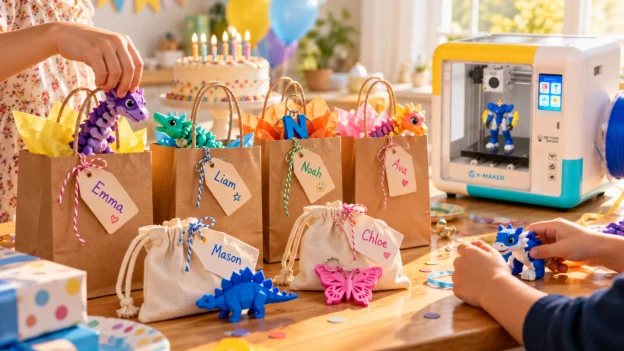
For kids 9 and up there’s the AOSEED X-MAKER, a STEM 3D printer for ages 9 to 16. It runs from a built in touchscreen or the AOSEED app, takes PLA or ABS, and has a build area roughly 6 inches square, so four wheels fit in one print.

Your child picks or designs the part and starts the print. You load the filament and, for the first few weeks, probably pop parts off the plate too. Expect to wait. A small gear can finish in under an hour. Four wheels take a few.
Weekend project: a bigger wheel for a car they already built
1. First, the axle. A ruler works, calipers are better.
2. Design a plain wheel in the AOSEED app or any beginner design tool, with a center hole a few tenths of a millimeter wider than the axle.
3. Print two in PLA and press them on. Too tight means widening the hole slightly and printing again, which happens a lot.
4. Ramp time: original wheels down first, then the new ones.
5. Pick one change, maybe a bigger diameter, and print one more pair to see if the car goes farther.
What Not to Print
Skip printed parts for anything that holds a child’s weight, carries electricity or spins fast under a motor’s full load. Keep small printed pieces away from toddlers, the same as the small parts in the kits themselves.
Final Thoughts on Building STEM Toys for Kids
The best building STEM toys for kids give a child a problem worth fixing. Start with the engineering idea your child already enjoys, whether that’s towers, wheels or machines, and choose a set from their age group.
When the instructions run out, a kids’ 3D printer gives them new parts to design and test. You can see how families design, print and play with AOSEED’s toy making 3D printers.
FAQs
What are the best building STEM toys for kids?
Depends on age. Gear sets, Magna-Tiles and LEGO Classic vehicles suit 5 to 7. From 8 to 10, GraviTrax, a bridge kit or Simple Machines. At 11 and older, LEGO Technic, the HydroBot arm or an Arduino robot car.
What’s a good engineering toy for a 5 year old?
Something with big pieces and a result they can see right away. Gears! Gears! Gears! for gears, the Playground Engineering set for its working seesaw, Magna-Tiles for towers. All three get reused for years.
Which STEM building toys teach gears and levers?
Gears first. Gears! Gears! Gears! works at 5, and LEGO Technic picks up around 9. Levers come through the Playground Engineering seesaw for little kids, then Thames & Kosmos Simple Machines from 8, which adds pulleys.
Are reusable building sets better than one model kits?
For most kids, yes. Reusable sets get rebuilt for years and grow with add on sets. One model kits like the HydroBot or a UGEARS model still teach a lot during the build, so they make good projects for older kids.
Do building toys help kids with math?
Probably, though the evidence is a link rather than proof. A study covered by the Society for Research in Child Development found 3 year olds who copied block structures well also tended to do better at early math.
What building kits are good for kids 11 and older?
Ones with real mechanisms and long builds. Think LEGO Technic with working steering, a water hydraulic arm, an Arduino robot car, or a wooden UGEARS machine. Expect two or three sittings. Most teens like that better than a 20 minute build.
Can you 3D print replacement pieces for building toys?
Simple ones, yes: hubs, crank handles, spacers, connectors. Plan on a test print before the fit is right. For parts under stress, print them more solid. Our guide to infill settings for toys explains the options.
Is it safe for kids to 3D print parts at home?
Yes, if an adult handles setup and decides where the printer goes. NIOSH, in its guide to safe 3D printing, recommends good airflow and some distance between printers and people. Parts come off warm, so let them cool first.




Further reading

3D Printed Puzzles for Kids by Age: 9 Projects From Shape Boards to Puzzle Boxes

15 Easy STEM Activities for Kids Using Things You Already Have

Is a 3D Printer a Good Gift for a Kid? A 10 Point Christmas Checklist for Age, Cost, and Space


