Easy 3D Printed Toys Kids Can Build and Play With
There is a specific expression children make when they pick up something they made themselves. It is not the same as unboxing a store-bought toy. It is quieter, more careful, more proud. The object means something different because they were part of making it.
3D printed toys for kids have that effect built into every project. The child chose the model. They picked the color. They watched it appear. When they hold the finished toy, it is already theirs in a way no shop shelf toy ever quite is.
This guide covers the best easy 3D printing ideas for kids — organized by play value and ease of assembly — with practical guidance on age, materials, and safety. At AOSEED, every project in the Toy Library is tested against one question: will a child still want this next week? Every project in this guide passes the same test.
|
5 Toy categoriesby play value |
Ages 3–12 Age rangefully covered |
20–90 min Typical first-toyprint time |
Why 3D Printed Toys Are Perfect for Kids

3D printing gives children something unusual: a direct line from imagination to physical object. Here is why that changes the quality of play.
|
|
Store-Bought Toy |
3D Printed Toy |
|
Customization |
Fixed color and design — what the factory chose |
Child picks color, size, character — the toy is already theirs |
|
Personalization |
Name cannot be added without a second purchase |
Child's name, favorite animal, or school number is part of the print |
|
Repair |
Part breaks — bin the whole toy or order replacement |
Part breaks — reprint that piece in 20 minutes |
|
Expansion |
Buy the whole set or go without |
Print one piece at a time — the set grows one session per week |
|
Design input |
Zero — the child opens the box and plays |
Child chooses every visual and dimensional detail |
The Creative Potential of 3D Printed Toys for Kids

|
A toy a child helped design is a toy they take better care of, play with longer, and show to everyone they know. |
|
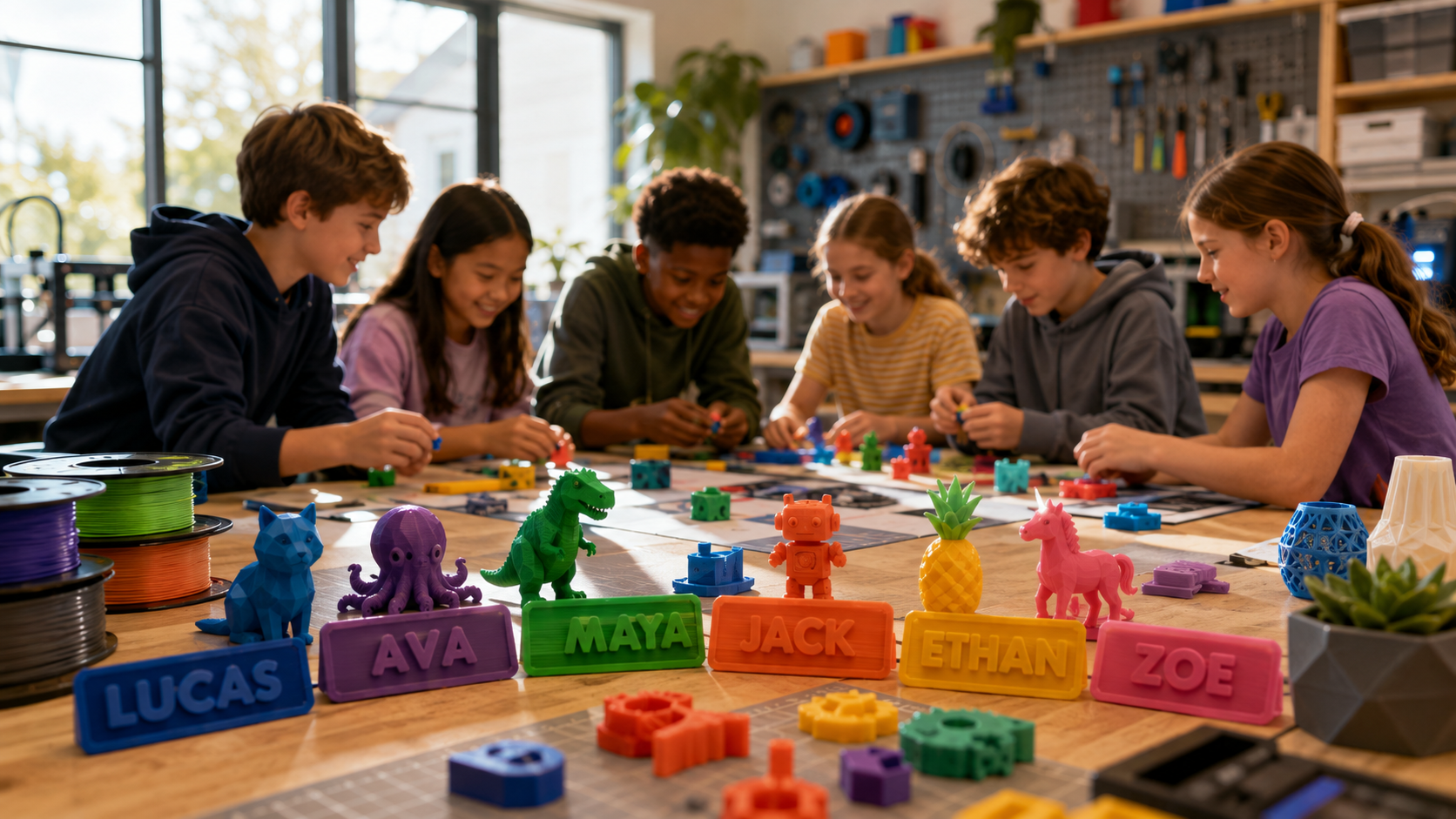
When a child selects a model from a library, chooses the filament color, and types in a name or number to add to the surface, the object that comes out of the printer already has a character. It is not just 'a car.' It is the blue car with the number seven on the hood that they designed on Tuesday afternoon.
That emotional investment changes how children play. They are more careful with objects they made themselves. They are more likely to incorporate them into ongoing imaginative play rather than setting them on a shelf. And they are more likely to come back to the printer asking what else they can make.
The Educational Value of 3D Printing

|
Spatial Reasoning |
Engineering Thinking |
Creative Ownership |
|
Choosing a model size and seeing it appear in physical space builds the same mental skills assessed in STEM aptitude tests. Children who print regularly develop a stronger intuition for three-dimensional space. |
When a snap-fit puzzle piece doesn't click together, children ask why. The process of printing, testing, and understanding why something did or didn't work is design thinking in practice. |
Selecting, modifying, and personalizing a digital model develops creative confidence. A child who has printed thirty objects starts approaching other creative challenges with the same 'I can make this' mindset. |
Why 3D Printing Fosters Interactive Play

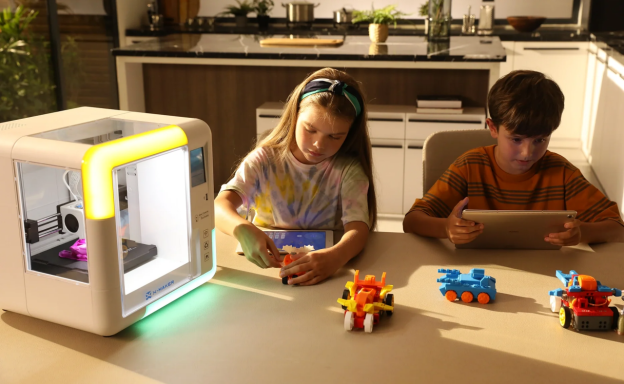
A 3D printed toy is not a static object. The AOSEED X-MAKER JOY's app turns the printing process itself into the first play session — the child browses, selects, and watches the printer build their toy layer by layer through the observation window. By the time the print finishes, the child already has plans for how to use it.
That first interaction — designing, printing, playing — becomes a habit. Each toy leads to another. The printer becomes a tool the child returns to independently, not something that requires adult involvement every session.
Best Easy 3D Printed Toys for Kids to Build and Play With
These five categories produce the highest play value and the most consistent requests for repeat sessions. Each uses a different play style to suit different children and ages.
Mini Race Cars and Push-Along Vehicles

|
|
Mini Race Cars — Built for Immediate Play |
|
⏱ 60–120 min |
Pull-back race cars and push-along vehicles are among the most reliably satisfying first toy prints. They print in one to two hours, need no assembly if designed well, and are ready to race the moment the build plate cools. Children naturally organize competitions, want to print a second car to race against the first, and start asking about printing a ramp to launch from. Model ideas: Pull-Back Race Cars (Printables), simple rolling car designs, push-along truck models |
The Pull-Back Race Cars on Printables are a specific model set designed for this kind of immediate floor-play. Kids wind the mechanism and release — the physics element makes it more satisfying than a simple push toy.
Building Blocks and Puzzles

|
|
Building Blocks and Puzzles — Open-Ended Play |
|
⏱ 30–90 min per set |
Snap-together building sets and 3D puzzles have high replay value because the toy resets. Every time the child disassembles the puzzle, it is ready to be solved again. Interlocking puzzle blocks let children build structures, knock them down, and build something different next session. Compatible-brick designs can expand an existing building collection with custom pieces. Model ideas: Interlocking Puzzle Blocks (Printables), dinosaur stacking toys, tangram sets |
The Interlocking Puzzle Blocks on Printables are specifically designed for open-ended building — pieces snap together reliably, and the set is large enough to keep a 7-year-old occupied. The Dinosaur Stackable Toys add a themed stacking game to the same play category.
Action Figures and Animal Figurines

|
|
Action Figures and Animal Figurines — Character Play |
|
⏱ 30–75 min per figure |
Customizable figures are the foundation of imaginative play for children aged 5 to 10. Blank figurines printed in PLA invite the child to decorate with markers or acrylic paint — turning the printer session into two activities rather than one. Articulated animal models that move add the same immediate tactile satisfaction as the best-loved toys in any store. Model ideas: Action Figures 4 Toy Characters (Printables), articulated fox models, animal figurine sets |
The Action Figures 4 Toy Characters set is specifically designed for part-swapping — children mix and match components between characters. This interchangeability adds a creative dimension that extends well beyond a single print session.
Dollhouses and Miniature Furniture

|
|
Dollhouses and Miniature Furniture — World Building |
|
⏱ 15–35 min per piece |
For children who love narrative play, the best 3D printing projects are ones that expand the world they already inhabit. Miniature furniture, small household items, and accessory sets turn a cardboard box into a furnished home. Each print adds a room, a garden, a garage, or a kitchen — the project never runs out of next steps. Model ideas: Tiny chairs and tables, dollhouse windows, miniature kitchen accessories, garden fence sections |
The AOSEED Toy Library includes an updated collection of home, garden, and character accessory models — printable in matched color sets so a child's miniature world looks cohesive rather than random. Weekly updates mean there is always a new room's worth of furniture to add to the collection.
Educational Models and STEM Toys

|
|
Educational Models and STEM Toys — Learning Through Making |
|
⏱ 25–60 min per model |
Solar system models, gear systems, bridge-load demonstrators, and anatomy models turn 3D printing into a classroom tool. These projects are particularly effective because the child builds the model and therefore understands it in a way that looking at a diagram never produces. Model ideas: Solar system scale models, simple gear fidgets, spinning tops, linkable train cars |
The AOSEED X-MAKER creation kits extend this category into working mechanical builds — printed chassis with motors, gears, and electronics that produce functional objects rather than display models. A gear mechanism the child printed and assembled is a gear mechanism they genuinely understand. The Linkable Train Cars on MakerWorld are a simpler example of the same principle — modular cars that connect and expand over multiple sessions.
How to Choose the Right 3D Printed Toy Projects for Kids

Matching the project complexity to the child's age and attention span is the difference between a successful first session and one that ends in frustration. Use this table as a starting filter.
|
Age Group |
Best Toy Types |
What They Develop |
|
Ages 3–6 |
Single-piece chunky toys, large building blocks, simple figurines, large animal prints |
Fine motor development, color recognition, imaginative play, cause and effect |
|
Ages 7–9 |
Snap-fit puzzles, pull-back vehicles, articulated animals, fidget toys, train sets |
Spatial reasoning, problem-solving, mechanical curiosity, perseverance |
|
Ages 10–12 |
Multi-part builds, STEM mechanism toys, creation kit components, custom designs |
Design thinking, engineering principles, iterative improvement, digital literacy |
|
Ages 13+ |
Full creation kits, custom CAD-designed objects, complex STEM builds, modular systems |
Advanced engineering, material science, independent project management |
Ages 4 to 6: Simple, Chunky Toys with Large Parts
The goal for this age group is a successful print in under 45 minutes that produces an object the child can immediately hold and play with. One-piece figurines, chunky vehicles, and stackable animals all work well. Let the child choose the filament color before the session starts — that single decision creates ownership before the printer even begins.
Ages 7 to 9: More Complex Models Like Puzzles and Interactive Vehicles
Children in this range have developed patience for multi-step projects and the fine motor skills to snap axles or connect puzzle pieces. Pull-back car mechanisms, interlocking block sets, and articulated animals are natural choices. This age group also responds particularly well to sets — print all four animal figurines, all the train car types, or the complete puzzle series across multiple sessions.
Ages 10 and Above: Customizable and STEM-Oriented Projects
Older children are ready to move from choosing from a library to modifying what they choose. Guided design apps that let them add their name, adjust a size, or change a feature take them into genuine creative work. STEM builds — gear systems, creation kit RC cars, bridge-load models for school projects — give these children the depth that keeps them engaged beyond the first month.
Picking by Interest: Racing Cars, Animals, Building Sets, or Educational Models
|
Child's Current Interest |
First Project to Print |
What It Leads to Next |
|
Cars and speed |
Pull-back race car in their favorite color |
Ramp, second car for racing, custom track sections |
|
Animals and nature |
Articulated fox or flexi dragon |
Animal bookmark, skeleton model, habitat diorama |
|
Building and designing |
Interlocking puzzle block set |
Custom compatible bricks, architectural models |
|
Science and STEM |
Spinning top set for speed comparisons |
Gear mechanism, simple machine model, creation kit build |
|
Pretend play and stories |
Simple figurine in their story's main character |
Miniature furniture, props, character accessories |
Safety Considerations for 3D Printed Toys for Kids

Three things determine whether a 3D printed toy is safe for a child: the material it is printed in, the design choices made before printing, and the printer design used to make it. Get these three right and the rest of the experience is straightforward.
What Materials Are Best for Kids' 3D Printed Toys?
|
|
PLA |
PETG |
ABS |
Resin (SLA) |
|
Safe for kids under 8 |
Yes — first choice |
Yes — good step up |
Needs ventilation |
Not for home use |
|
Toxic fumes |
Minimal at normal temps |
Low — well-ventilated space |
Requires ventilation |
Toxic before curing |
|
Durability |
Good for normal play |
Strong, impact-resistant |
Tough, heat-resistant |
High detail, fragile |
|
Ease of printing |
Easiest — best for beginners |
Moderate — needs heated bed |
Difficult — warps easily |
Requires wash and cure station |
|
Recommended for |
All ages, all project types |
Ages 8+ durable toys |
Ages 14+ with ventilation |
Adults only |
The CPSC's toy safety standards specify that toys for children under 8 must not have hazardous edges or detachable small parts. These requirements apply directly to 3D printed toys: design choices matter as much as material choice. Always inspect finished prints for sharp support-removal points and sand any rough edges before handing a toy to a young child.
Ensuring Toys Are Free from Sharp Edges or Small Parts
A safety check takes about two minutes and should happen after every print intended for children under 8. Run a finger along every surface. Check where support material was removed. Use fine-grit sandpaper on any rough spots. For children under 3, verify that every part of the finished print is larger than 25mm in diameter — this is the CPSC's small-parts guidance threshold for choking hazard assessment.
|
✓ Quick Post-Print Safety Check 1. Run finger along all surfaces — check for sharp layer edges or support removal points. 2. Check any snap-fit or moving joint areas for thin plastic that could break. 3. For children under 3 — verify no part is smaller than 25mm in any dimension. 4. For paint or decoration — use non-toxic acrylic or poster paint only. 5. For mechanical toys — verify no part can detach with normal play force. |
Why an Enclosed 3D Printer Is Safer for Kids
The Washington State Department of Health's guidance on safe 3D printing in schools specifically recommends enclosed printers for any environment where children are present — citing protection from heat hazards, particulate matter, and chemical emissions. The same logic applies at home: an enclosed printer keeps the nozzle, heated bed, and moving belts inside a sealed chamber. The child watches through a window. Their hands stay outside. The printer can live in a shared family space rather than a locked room.
Enclosed printers also produce better toy prints. The stable internal temperature prevents the warping that causes puzzle pieces to not fit, wheels to print slightly oval, or figurine bases to curl. The physical safety benefit and the print quality benefit work in the same direction.
How to Make 3D Printing Fun and Easy for Kids

The habits established in the first three sessions determine whether 3D printing becomes a regular part of family life or an occasional novelty. These three approaches make the difference.
|
Start with Easy Wins |
Encourage Customization |
Set Up a Creation Station |
|
Choose models under 60 minutes, no supports, flat bottom for the first session. The child's confidence on day one determines whether they come back on day two. A complex failed print on session one is the most common reason a printer moves to the garage. |
Let children decorate their prints with non-toxic acrylic paint or markers after printing. This extends the creative session beyond the print time and makes every toy uniquely theirs. A white or light-colored print in PLA is the ideal canvas. |
Give the printer a permanent place at a height where the child can see through the observation window. Keep a small box of filament spools nearby. Label it. Make 3D printing feel like a legitimate part of the household rather than an adult's machine the child is allowed to use occasionally. |
Real Starter Ideas Families Can Print First
Here are specific models organized by what the family is looking for that afternoon. Each row links directly to the verified model file.
Best First Prints for Imaginative Play
|
Project |
Age |
Time |
Why It Works |
|
5+ |
90 min |
Wind mechanism creates immediate racing competition — no track required |
|
|
6+ |
30 min each |
Part-swap feature means one print session produces infinite character combinations |
|
|
4+ |
20 min each |
Multiple textures and shapes — different fidgets for different sensory preferences |
|
|
5+ |
15–20 min |
Print two tops and race them — who spins longest is a reliable sibling contest |
Best First Prints for Sibling or Family Play
|
Project |
Age |
Time |
Why It Works |
|
5+ |
45 min set |
Print two sets in different colors — each child has their own color to build with |
|
|
4+ |
30–45 min each |
Each child prints a car type — connect all together for a collaborative train |
|
|
4+ |
45–60 min |
Who can stack the highest? Balance competition works for all ages at once |
|
|
Custom game tokens (print and paint) |
6+ |
20 min each |
Print a personalized character token for every family member before game night |
Best First Prints for Rainy Afternoons and Indoor Activities
|
Project |
Age |
Time |
Why It Works |
|
6+ |
Session of 2–3 hours |
Print multiple pieces throughout the afternoon — collection grows while they play |
|
|
4+ |
30–45 min per car |
Each print adds a car to the fleet — a full afternoon produces 3–4 cars |
|
|
5+ |
90 min for pair |
Two cars in different colors — race them while the third prints |
|
|
Miniature furniture pieces |
5+ |
15–30 min each |
Print tables, chairs, and beds throughout the afternoon — build a whole room |
Best First Prints for Gifts or Rewards
|
Project |
Age |
Time |
Why It Works |
|
Personalized name tag — child's name printed |
4+ |
15–20 min |
Fastest personal gift — name spelled out in their chosen color |
|
5+ |
15–20 min |
Quick, satisfying, immediately playable — perfect classroom or party favor |
|
|
6+ |
30 min |
Printed and painted for a specific friend — genuinely personal gift |
|
|
Trophy top — recipient's name on base |
5+ |
20–25 min |
Award for a real achievement — printed the day it happens, given that night |
Conclusion
The best 3D printed toys for kids are the ones that create the expression — the quiet, careful, proud one — that comes when a child holds something they made themselves. Not unboxed. Made.
Start with one project that matches what the child cares about most. A car for the car-obsessed. An animal for the nature-lover. A puzzle for the puzzle-solver. Print it together. Have the second project chosen before the first one finishes.
The printer stays active when there is always a next project waiting. A Toy Library that updates weekly, a design app a child can use independently, and a content ecosystem that grows with their curiosity — these are the things that turn a single print into a lifelong creative habit.
For families just getting started, AOSEED 3D printers for kids shows both current models with age guidance and pricing — useful when deciding between a first printer for a younger child and a more capable model for a growing maker.
FAQs
Can kids play with 3D printed toys?
Yes. 3D printed toys made with PLA filament and designed with appropriate part sizes are safe to play with. Inspect every finished print for sharp edges before handing it to a child, and verify that no part is small enough to present a choking hazard for the child's age. PLA is non-toxic, biodegradable, and the standard material for all family-oriented 3D printing.
Is it legal to sell 3D printed toys?
Yes, you can sell 3D printed toys. Two requirements apply. First, ensure you have the right to use the digital design file commercially — some licenses are restricted to personal use. Second, ensure the finished product meets local toy safety regulations, which in most jurisdictions include requirements around small parts, hazardous edges, and material safety for children's products.
Is a 3D printer suitable for a 7-year-old?
Seven is an excellent age for independent 3D printing with a well-designed family printer. Children at this age can navigate an app-based model library, choose designs, select filament colors, and start print jobs without adult technical help. Adult supervision is most useful for loading filament and removing finished prints from the build plate. Most 7-year-olds can manage the full workflow independently after two or three guided sessions.
What are 3D printed toys?
3D printed toys are physical objects created layer by layer by a desktop 3D printer from a digital design file. The printer reads the file and deposits material in thin horizontal layers until the finished object appears. For children's toys, FDM printing — which melts and deposits plastic filament — is the standard method because it is safe, affordable, and produces durable results with non-toxic PLA material.
What is the best material for 3D printed toys?
PLA is the best starting material for children's toys at any age. It is derived from renewable plant materials like corn starch, non-toxic, biodegradable, easy to print, and available in a wide range of bright colors. For toys that need to be more durable — outdoor toys, active-play items, objects that need to survive drops repeatedly — PETG is the natural step up. Avoid ABS for young children without dedicated ventilation, and avoid resin for any child use.
How long do 3D printed toys last?
PLA toys used for normal indoor play last for years with typical child handling. They can become brittle if stored in direct sunlight for extended periods, which is why storing toys indoors is the standard recommendation. PLA's main limitation is heat — it begins to soften above around 60°C, which means it should not be left in a hot car or near a heat source. For outdoor or especially rough-use toys, PETG holds up better to environmental stress.
Is 3D printing safe for a 3-year-old?
With strict adult supervision and age-appropriate models, a 3-year-old can participate in 3D printing as a watching and choosing experience. Print only single-piece models with no detachable parts and no geometry smaller than 25mm in any dimension. The child chooses the color, presses the final button with help, and watches through the enclosed printer's window. Keep them away from the printer during operation and during cool-down after printing.
What is the 20 toy rule for kids?
The 20 toy rule is a parenting philosophy that suggests limiting a child's accessible toys to around 20 items at any one time to encourage deeper focus and more creative play with fewer things. 3D printing fits this philosophy well — a child can 'retire' a print they have finished with and replace it with a new one, keeping the collection intentional rather than accumulated. The printer makes each addition deliberate and meaningful rather than passive.
What are easy 3D printing ideas for kids just getting started?
The best first ideas are single-piece models that print in under an hour and require no assembly. A simple figurine in the child's favorite color. A spinning top. An animal bookmark. A push-along car. These print reliably, produce an immediately usable object, and demonstrate the full cycle from tapping a button to holding something real. From there, the second project is the child's choice — which is where the habit begins.
Sources
- Printables — Dinosaur Stackable Toys (PLA, multicolor, great for balance play), Dinosaur Stackable Toys, 2021.
- Printables — Action Figures 4 Toy Characters (customizable, part-swap), Action Figures 4 Toy Characters, 2023.
- Printables — Interlocking Puzzle Blocks (snap-together, open-ended), Interlocking Puzzle Blocks, 2022.
- Printables — Pull-Back Race Cars (wind and race, immediate play), Pull-Back Race Cars, 2022.
- Thingiverse — Simple Fidget Toy Set (tactile play items for kids), Simple Fidget Toy Set, 2019.
- MakerWorld — Linkable Train Cars (modular, connect-and-rearrange), Linkable Train Cars, 2022.
- Reddit r/3Dprinting — What Toys Have You Printed for Your Kids?, What Toys Have You Printed for Your Kids, 2023.
- CDC / NIOSH — Approaches to Safe 3D Printing (ventilation, emissions guidance), Approaches to Safe 3D Printing, 2023.



Further reading

Thanksgiving STEM Activities for Kids: Table Projects and Simple Engineering Challenges

Halloween STEM Activities for Kids: Spooky Builds That Teach Real Science

STEM Crafts for Kids: Build, Decorate and Test