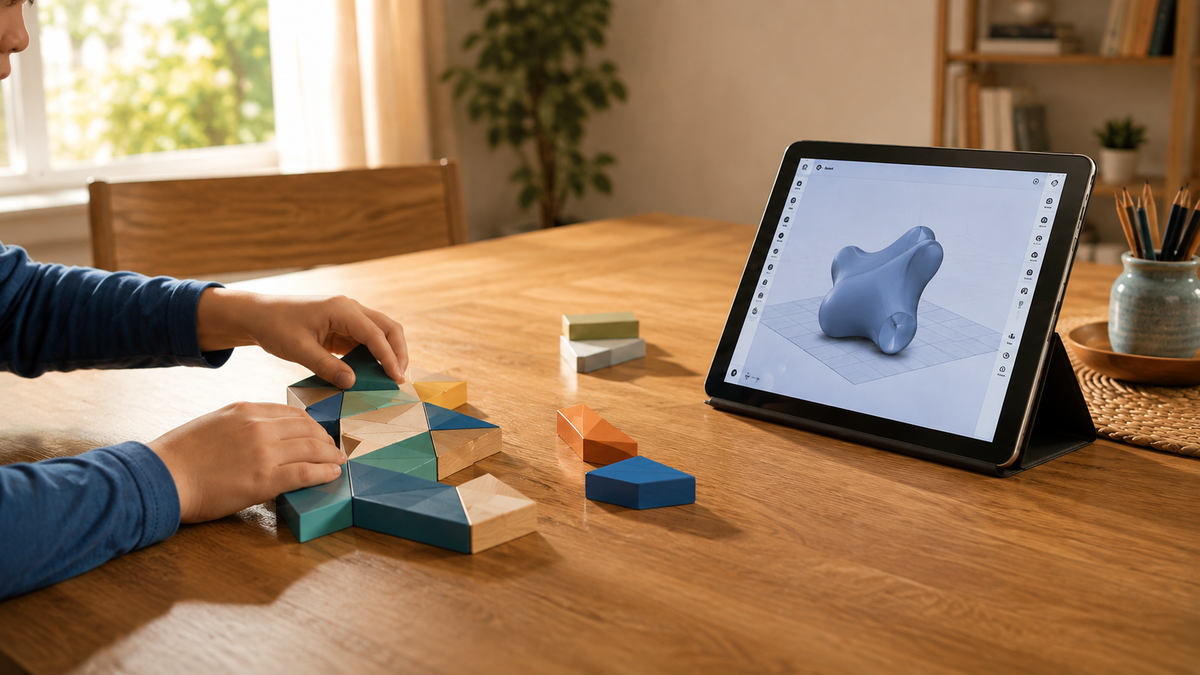
AI vs CAD for Kids: Which Design Path Fits Each Age?
For most children, AI and CAD are not competing destinations. They are different starting tools. CAD is better when the learning goal is measurement, fit, constraints, and deliberate control. AI is better for rapid concept generation, visual variation, and turning a story idea into a first draft. The strongest workflow often uses AI to explore and CAD to correct, dimension, assemble, and prepare the model for printing.
A practical age sequence is: ages 5 to 7 build with simple shapes and use AI mainly for ideas; ages 8 to 10 add dimensions and predictable edits; ages 11 to 13 define constraints before asking AI for alternatives; ages 14 to 17 combine both paths and defend the choices. These are entry points, not developmental limits. Experience, patience, and the project goal matter more than birthday.
Use the quick-pick table below to choose the first tool, then judge the result by what the child can explain and revise. This guide compares the skills each path builds, age-based workflows, AI inside kids' design apps, printability checks, and the situations where CAD-first or AI-first saves the most time.
Quick Pick by Age
|
Age |
Start With |
AI’s Job at This Stage |
First Project That Works |
|
5–7 |
Shape building only |
Suggest a theme, nothing more |
Block animal or name tag |
|
8–10 |
Shapes plus real numbers |
Hand them the challenge, not the model |
Pencil holder or game token |
|
11–13 |
Constraints and parts that fit |
Offer two or three rival concepts |
Phone stand with a set angle |
|
14–17 |
Dimensioned models and tolerance |
Explore options, then get edited |
Fitted enclosure or robot mount |
One rule holds across all four rows. The child decides. That stays true whatever produced the file.
AI vs CAD for Kids: What Actually Differs

Speed is not it. The real difference sits in where the thinking happens, and that turns out to matter far more than how quickly a file shows up.
What CAD Asks a Child to Do
CAD starts with geometry. A child places a cylinder, sets its height, cuts a hole through a block, then lines two parts up so they actually meet. Every one of those moves carries a number.
Failure shows up locally. If the hole sits three millimetres off centre, the child can see it, find it, and move it. Cause and effect stay in the open. That is the whole educational value.
What AI-Assisted Design Asks a Child to Do
AI starts with language. The child says what they want, then judges what comes back. Some tools reach further and assist inside the modeling work itself, filling in sketches, flagging conflicting geometry, or generating several options from a set of stated goals.
The output arrives fast. Fast is not correct. A model can look convincing on screen and still be the wrong size, hollow where it should be solid, or impossible to print without collapsing halfway up.
|
What You Are Comparing |
CAD Path |
AI-Assisted Path |
|
Control |
Every millimetre and angle is set by the child |
Limited. The child steers with words and picks from what returns |
|
Speed to first result |
Slow. The object gets built step by step |
Near instant from a short description |
|
What gets practised |
Measurement, geometry, constraints, revision |
Describing intent, comparing options, judging output |
|
Where mistakes show up |
During building, and they are traceable |
After generation, and they are easy to miss |
|
Best use |
Parts that must fit something real |
Getting unstuck and exploring shape ideas |
|
Main risk |
Frustration if the project is too ambitious |
The child selects instead of designing |
What Each Path Teaches, and What It Skips
Skills CAD Builds
Rotating a model is the first real gain. A shape that reads correctly from the front can be far too thin from the side, and only turning it exposes that. Children start connecting a flat screen to a solid object.
This is trainable. A meta-analysis of spatial-skills training in children aged nought to eight found that hands-on exploration, visual prompts, and gestural training all produced measurable gains, sitting on top of an earlier review of 217 studies where training beat the control condition with an effect size near 0.47. The same reviews tie spatial ability to later achievement in science, maths, and engineering. Worth knowing before you skip the slow route. See the meta-analysis on early spatial-skills training
Measurement stops being abstract. Widen a base from 20 mm to 30 mm and the printed object comes out visibly wider. The number did something. Constraints arrive later and teach a harder idea, which is that a design carries rules and not just an appearance.
Skills AI Prompting Builds
A vague instruction returns a vague object. Children work that out fast, and they start noticing that shape, size, use, and style each change what comes back, so prompting turns into an exercise in saying exactly what you mean.
Judging beats prompting. UNESCO’s framework for students sets out twelve competencies across four dimensions, one of which is a human-centred mindset, and it stages learning as understand, then apply, then create. Critical judgement of AI output sits right at the centre of it. The aim is not fluent users. It is people who can tell when the machine is wrong. Read the UNESCO AI competency framework for students
What AI skips is the part where a child works out why a wall snapped. Building teaches that.
|
PRACTICAL TIP Give the same brief to both tools in one sitting. Ask for a phone stand at a set angle with a fixed base width. Let the child build one version by hand and generate the other. Then measure both against the brief. The comparison teaches more than either tool does alone. |
Ages 5 to 7: Shapes First, AI as Idea Source

The goal is small. Digital objects are made of shapes, and shapes can be moved, resized, joined, and deleted. That is the lesson.
Skip numbers for now. Taller, wider, centred, and beside will carry a child a long way before millimetres need to appear at all. Keep sessions to fifteen or twenty minutes with one clear goal each.
Schools already expect roughly this. The K-2 engineering-design standards ask students to define a simple problem that could be solved by a new or improved object, then build a prototype showing how something works. No dimensions required at that stage either. See the K-2 engineering design standards
Let AI supply the prompt, never the object. A robot badge works. Build a castle from five shapes works better, because the constraint is baked into the brief. The child still does every bit of the building.
Good projects here use few parts and read clearly when finished. Block animals, towers, name tags, simple vehicles. Avoid tight fits.
Ages 8 to 10: Add Real Measurements

Now the numbers matter. Give the project a stated requirement. The box must be 50 mm wide. The tag has to fit inside a marked rectangle. Suddenly the measurement has a job to do.
Three features are worth introducing together, and between them they cover most of what this age needs. Cutting a hole through a block. Aligning text against a base. Grouping several shapes into one object. Each of the three solves a problem the child can actually see on screen.
AI works well here as a challenge generator. Ask it for a desk organiser brief that has to hold three specific objects, then step back and let the child model it. The brief comes from the machine. The solution does not.
Keep prints small. A revision that costs twenty minutes gets attempted, and one that costs four hours quietly does not.
Ages 11 to 13: Constraints First, Then AI Alternatives
Middle school is where constraints start doing real teaching work. A phone stand needs a target angle and a fixed base width. A part has to clear something else. Trade-offs appear.
The middle-school standards put it plainly. Students are expected to define the criteria and constraints of a design problem precisely enough that the solution can succeed, then evaluate competing solutions through a systematic process, then analyse test data and combine the best characteristics of several designs into a better one. Read that again. It describes what to do with AI output. See the middle school engineering design standards
That is the turn. AI stops being an idea machine and becomes a source of rival candidates. Ask for three approaches to the same problem, then have the child say which constraints each one satisfies and which it quietly ignores.
Parametric thinking belongs here. Once a dimension controls several connected features, changing one value updates the rest, and revision stops being a rebuild. Editing is the skill. Not generating.
Strong projects at this stage include small enclosures, phone stands, game accessories, organisers, and robot mounts. Each should carry at least one measurable requirement.
Ages 14 to 17: One Combined Workflow

Older students can run something close to a real design process. CAD holds the geometry. AI handles exploration, repetitive work, and comparison.
Tolerance separates this band from the last one. A 10 mm peg does not drop cleanly into a 10 mm printed hole, because the process and the material both add variation. Learning that changes how a student dimensions everything afterwards.
High-school standards ask for exactly this reasoning. Students analyse complex real-world problems by specifying criteria and constraints, then evaluate a solution using prioritised criteria and explicit trade-off considerations. Generative design fits under that heading cleanly enough, as long as the student can explain why the options differ rather than just picking the strangest shape on offer. See the high school engineering design standards
Optimisation needs a definition of better before it means anything. Lighter is not automatically better if the part snaps or cannot be manufactured. Make the student state the target first.
Then ask for one written justification per accepted AI suggestion. It takes two minutes. It also keeps authorship where it belongs.
|
Age Band |
Add This |
Hold This Back |
AI Round Limit |
|
5–7 |
Move, resize, combine, delete |
Numeric dimensions |
One theme prompt per session |
|
8–10 |
Holes, alignment, grouping, set sizes |
Constraints and assemblies |
One challenge prompt, then hands off |
|
11–13 |
Constraints, trade-offs, parametric edits |
Generative design and simulation |
Three concepts, then edit in CAD |
|
14–17 |
Tolerance, optimisation, generative options |
Nothing, but require written reasons |
Unlimited with a justification each |
What AI and CAD Look Like Inside One Kids’ Design App

Most families will not install professional CAD software for a seven-year-old. They also will not want a toy that only does prompts. The practical answer is one app carrying both paths, with room for the child to move between them as they grow.
A combined kids' design app may place block building, shape assembly, sculpting, drawing conversion, and AI-assisted generation in one workflow. Before describing a specific app, verify which tools are included in the current version and which printer or subscription each feature requires.
Hardware and software set practical limits. Match the printer's build volume, supported materials, interface, and supervision needs to the projects the child will actually complete, and verify current specifications before making age-based recommendations.
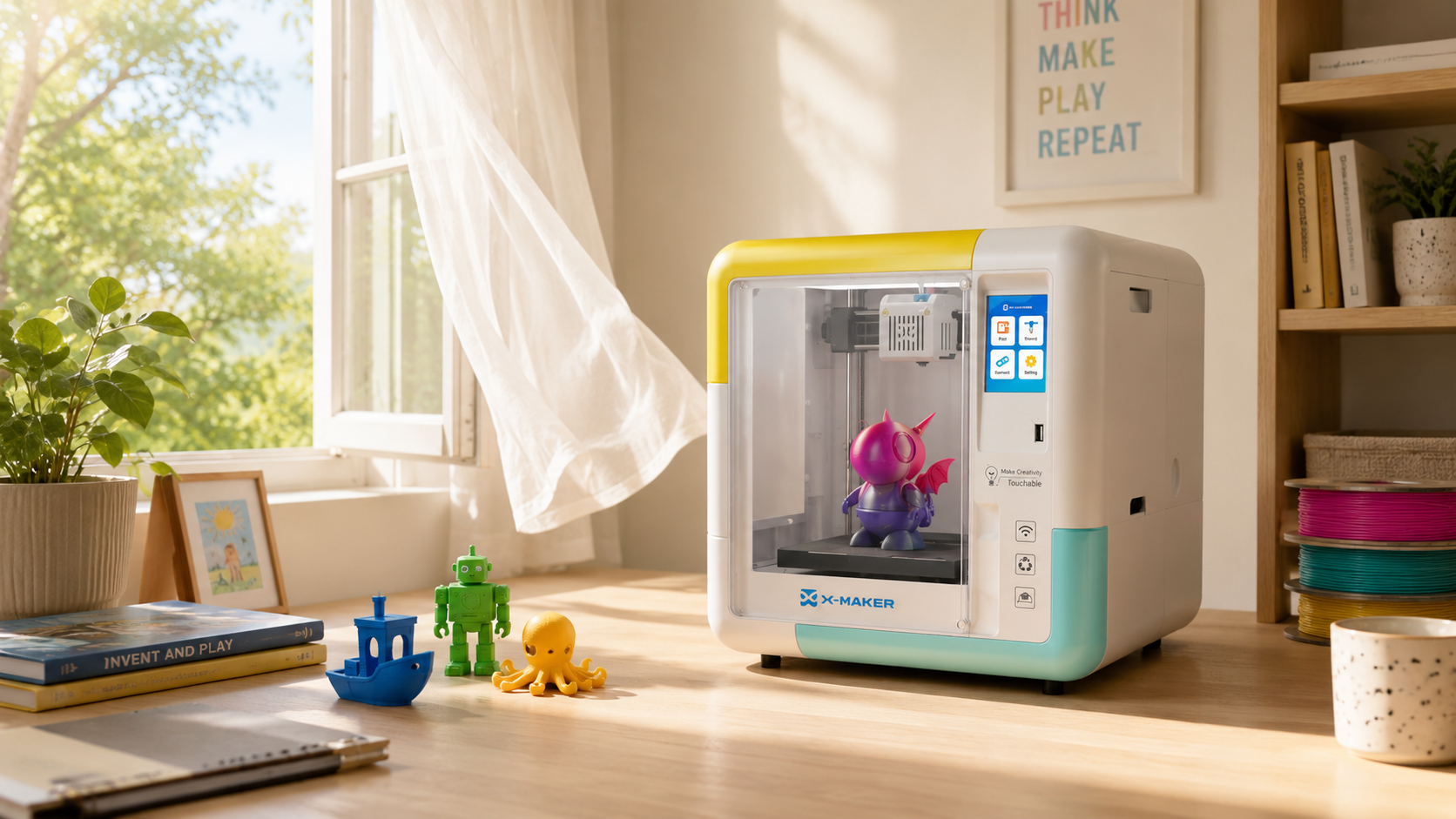
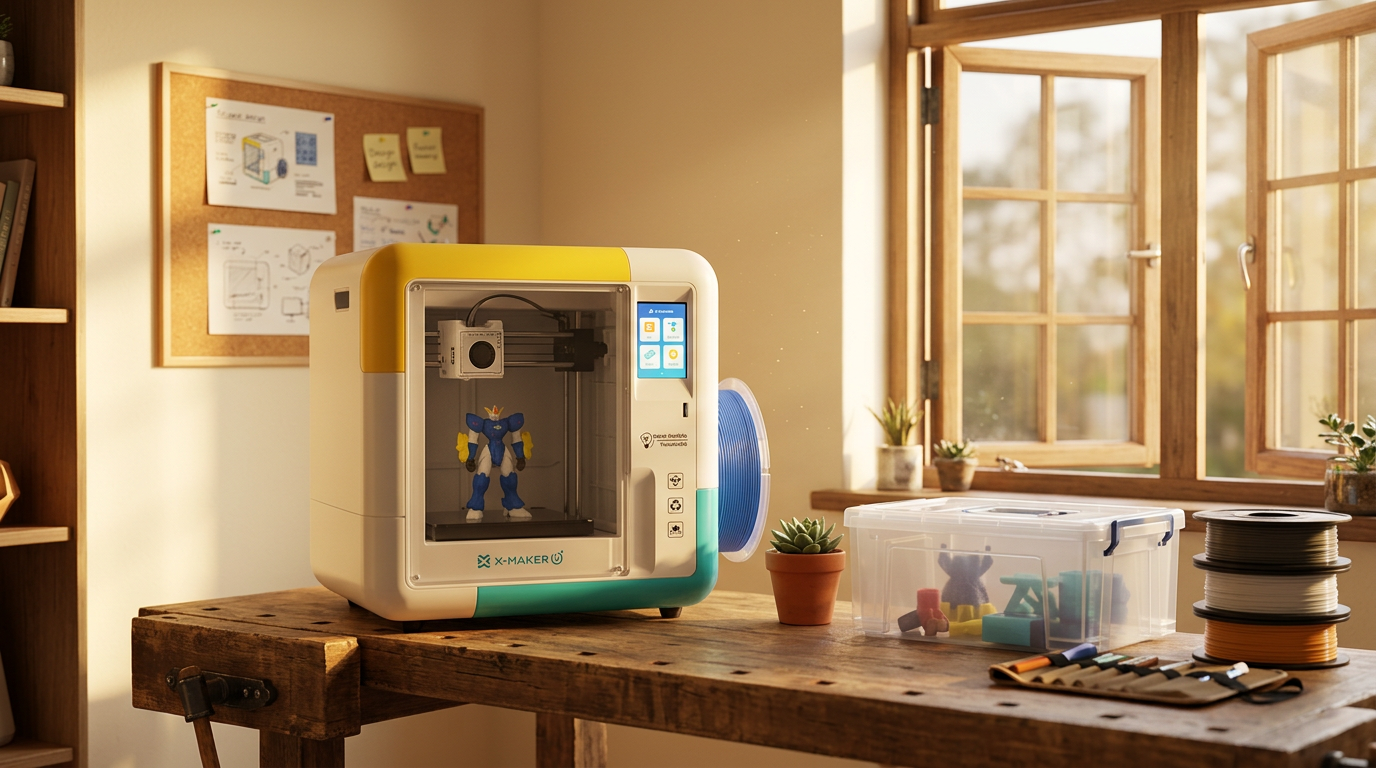
Both printers are fully enclosed and run under 50 dB, and both use PLA tested to EN 71-3, ISO 10993, and ISO 16000. The model library runs to thousands of ready-made designs with weekly updates. That matters most for the youngest band. A child who is not modeling yet still needs something to print.
|
App Path |
What the Child Does |
Which Skill It Trains |
Best Age Fit |
|
CubeX |
Builds objects from virtual blocks |
Spatial construction, part relationships |
5–10 |
|
Magic 3D |
Snaps predefined shapes together |
Composition and alignment |
5–10 |
|
Art 3D |
Sculpts virtual clay by touch |
Form and proportion |
8–13 |
|
DrawX |
Turns a drawing into a 3D shape |
Translating 2D intent into 3D |
6–12 |
|
AI Word / AI Image |
Describes or photographs an idea |
Prompting, then judging the result |
8–17 |
|
Kids’ modeling tools |
Sets dimensions and edits geometry |
Measurement, constraints, revision |
11–17 |
How to Check an AI-Generated Model Before Printing
Generated files skip the reasoning a child would normally do while building. This check restores it. Six questions. In order, every time.
- Does it match the request? List what is missing, what got added, and where the tool read the instruction differently.
- Are the dimensions right? Measure the parts that have to be a certain size. Screen appearance proves nothing about scale.
- Does it make physical sense? Check that parts connect, the base is stable, and thin features will not snap on first handling.
- Can it be edited? A model that resists precise change is a dead end once testing reveals a problem.
- Will it print? Look for a usable solid, a flat contact face, unsupported overhangs, and whether it fits the build volume.
- What would you change? Require one human-directed improvement even when the output looks fine.
That last question does most of the work. It keeps the child an author rather than a picker.
|
BEFORE YOU HAND OVER AN AI DESIGN TOOL Prompt-based tools collect what a child types, says, or photographs. In the US, apps directed at children under 13 fall under COPPA, which means the operator has to notify a parent and get consent before collecting personal information, and has to honour the parent’s choices about how it gets used. Read the account name, the microphone permission, and the photo permission before the first session. See the FTC guidance on protecting your child’s privacy online One more, said once. The nozzle and bed get hot, so first sessions need an adult nearby whatever the enclosure does. |
|
NOT SURE WHICH DESIGN PATH YOUR CHILD IS READY FOR? COMPARE KID-FRIENDLY 3D PRINTERS BY AGE AND DESIGN TOOLS AND MATCH THE HARDWARE TO THE BAND THEY ARE IN TODAY, NOT THE ONE THEY WILL REACH IN THREE YEARS. |
When to Lead With CAD, and When to Lead With AI
Two lists. Read whichever one describes your week.
Lead with CAD when:
- The part has to fit something that already exists, like a shelf, a bracket, or a broken clip.
- The learning goal is measurement, geometry, or working out why a design failed.
- The child is under eight and still learning that shapes combine into objects.
- A school or homeschool task asks for stated criteria and constraints.
- The project will get revised several times after test prints.
Lead with AI when:
- The child knows what they want but cannot picture a starting shape.
- The session is about style, character, or decoration rather than fit.
- You need several rival concepts quickly so the child can compare and choose.
- A blank screen has already stalled two sessions in a row.
- The child is old enough to check the output and then edit it.
When both lists apply, run AI first and CAD second. Explore, then build.
Conclusion
AI and CAD teach different parts of design.
Use AI to explore options and CAD to control dimensions and constraints, then keep measurement, printability checks, testing, and revision in the child's workflow.
FAQs
Will AI Replace CAD Design?
Not for every task. AI can accelerate concepts, variations, and some repair work, while CAD remains important when dimensions, constraints, tolerances, assemblies, and later edits must be controlled. The practical workflow is often AI for options and CAD for decisions.
Can AI Make a CAD Model?
Sometimes. The important question is what kind of file and editability the tool provides.
- If the output is an editable parametric or solid model, it may support a CAD workflow.
- If the output is only a triangle mesh, it may be useful as a reference or starting shape but harder to dimension precisely.
- If the part must fit another object, verify measurements and rebuild critical features with constraints.
Is CAD the Same as AI?
No. They are different tools that can be used in the same design process.
- CAD records geometry, dimensions, constraints, and design intent through explicit modelling operations.
- AI generates or suggests output from prompts, examples, or learned patterns.
- A product can combine both, but the generated result still needs CAD-style checking when accuracy matters.
Is AI a Threat to 3D Artists?
It changes some tasks and expectations, but the impact depends on the role. Concept variations may become faster, while art direction, topology, rigging, material decisions, client communication, originality, and production constraints still require judgement. Children should learn both how to use generated ideas and how to edit, credit, and evaluate them responsibly.
Can ChatGPT Do CAD?
It can explain modelling steps, help write scripts for compatible CAD tools, and troubleshoot parameters, but it does not replace visual inspection or dimensional verification. If it generates code or a file workflow, run it in the intended CAD environment, inspect the model, and test critical dimensions before printing.
What Is the Best AI for CAD?
There is no single best tool; the right choice depends on the required output and the learner.
- For precise parts, prefer tools that keep dimensions, constraints, and editable history.
- For concept exploration, mesh or image-to-3D tools may be sufficient if the result will be rebuilt or repaired.
- For children, choose an age-appropriate interface, transparent privacy terms, and an easy route from generation to editing and print checking.
- For school use, confirm licensing, account control, data handling, and export formats before adoption.
Sources
- National Library of Medicine (PMC), “Is Early Spatial Skills Training Effective? A Meta-Analysis”
- Next Generation Science Standards, “K-2.Engineering Design”
- Next Generation Science Standards, “MS.Engineering Design”
- Next Generation Science Standards, “HS.Engineering Design”
- UNESCO, “AI competency framework for students”
- U.S. Federal Trade Commission, “Protecting Your Child’s Privacy Online”



Further reading
AI vs CAD for Kids: Which Design Path Fits Each Age?

AI-Generated 3D Models for Kids: 9 Printability Checks Before You Print

How to Fund a Classroom 3D Printer: Grant Budget and Proposal Checklist