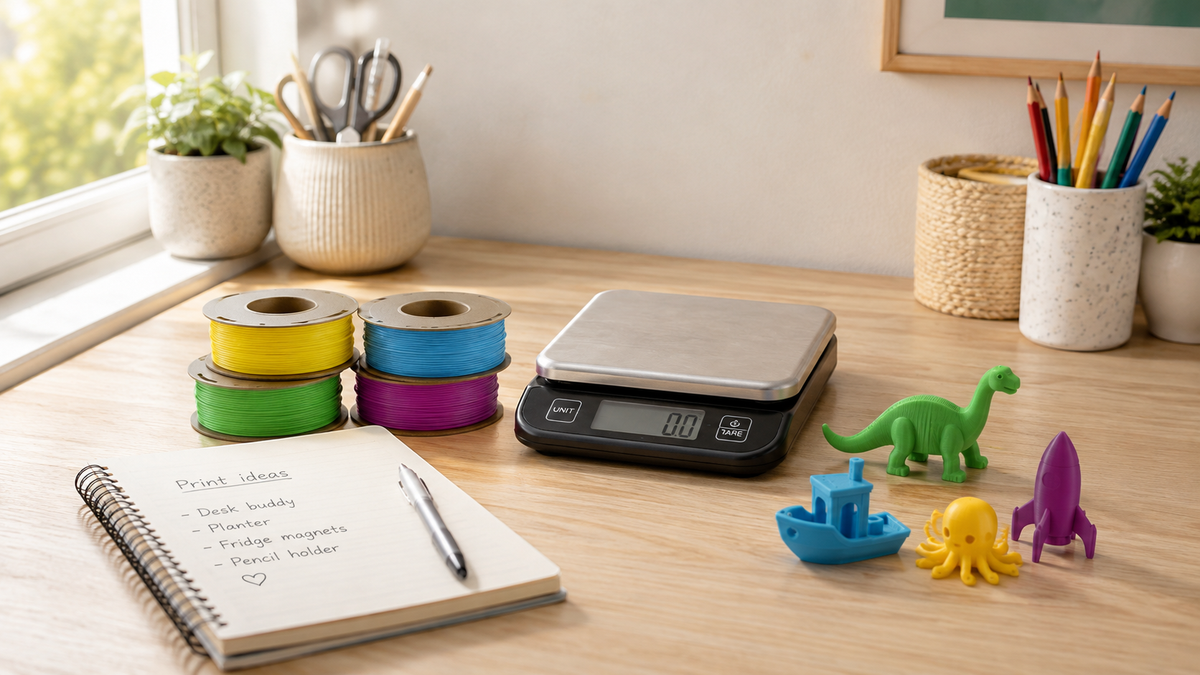
How Much 3D Printing Filament Do I Need?
A spool of filament looks like plenty of plastic right up until one large print swallows a third of it. Most people ask this question in spools. Grams answer it better. A household printing a few small toys on Saturday mornings might stretch one 1 kg spool across four months, while two siblings sharing a printer after school can finish the same spool in three weeks. Same machine. Different output. The gap is not printing hours. It is what they print, at what infill, and how often a job collapses at hour nine.
Use the slicer’s gram estimate for each planned model, add the estimates for the month, and include a waste margin based on your own failure and support history. If you do not have that history yet, treat the household ranges below as examples—not forecasts—and recalculate after your first four weeks.
Quick pick: monthly filament by household pattern
|
How the printer gets used |
Typical monthly use |
In 200 g rolls |
What to keep on the shelf |
|
Weekend only, small toys and keyrings |
60–150 g |
Under 1 roll |
One roll, plus a spare colour |
|
A few prints most weeks |
200–400 g |
1–2 rolls |
Two rolls open, one ssunopened |
|
Something on the plate most days |
400–800 g |
2–4 rolls |
A four-colour pack, restocked monthly |
|
Two kids sharing, or a homeschool group |
1–2 kg |
5–10 rolls |
One 1 kg spool plus colour rolls |
|
Classroom set or small-batch selling |
2–4 kg and up |
10+ rolls |
Buy by the kilogram, track per project |
The Short Answer: Plan in Grams, Not Spools

Most mainstream slicers estimate filament length and, when material density is configured, estimated grams. Treat that number as a planning estimate: confirm the filament profile, include supports and purge structures, and leave additional material for priming and failed starts.
Size misleads people constantly. A tall hollow vase with two walls and no infill can run for eleven hours and use 90 g. A palm-sized bracket at 60% infill can eat 140 g in under three. Volume on screen tells you almost nothing. Mass tells you everything.
Once you know your average per print, monthly planning becomes multiplication. The maths is simple. Twelve prints averaging 55 g is 660 g. That is one 1 kg spool with room to spare, or four 200 g rolls with a little borrowed from a fifth.
|
Start here Slice your three most typical models with the settings you actually use. Note the grams. Average them. That single number will predict your monthly consumption more accurately than any published table, including this one. |
How Much Filament Do You Need Per Month?

Four patterns cover almost every household. Find yours. Then adjust after a month of real data.
Weekend Printing: Under 200 g a Month
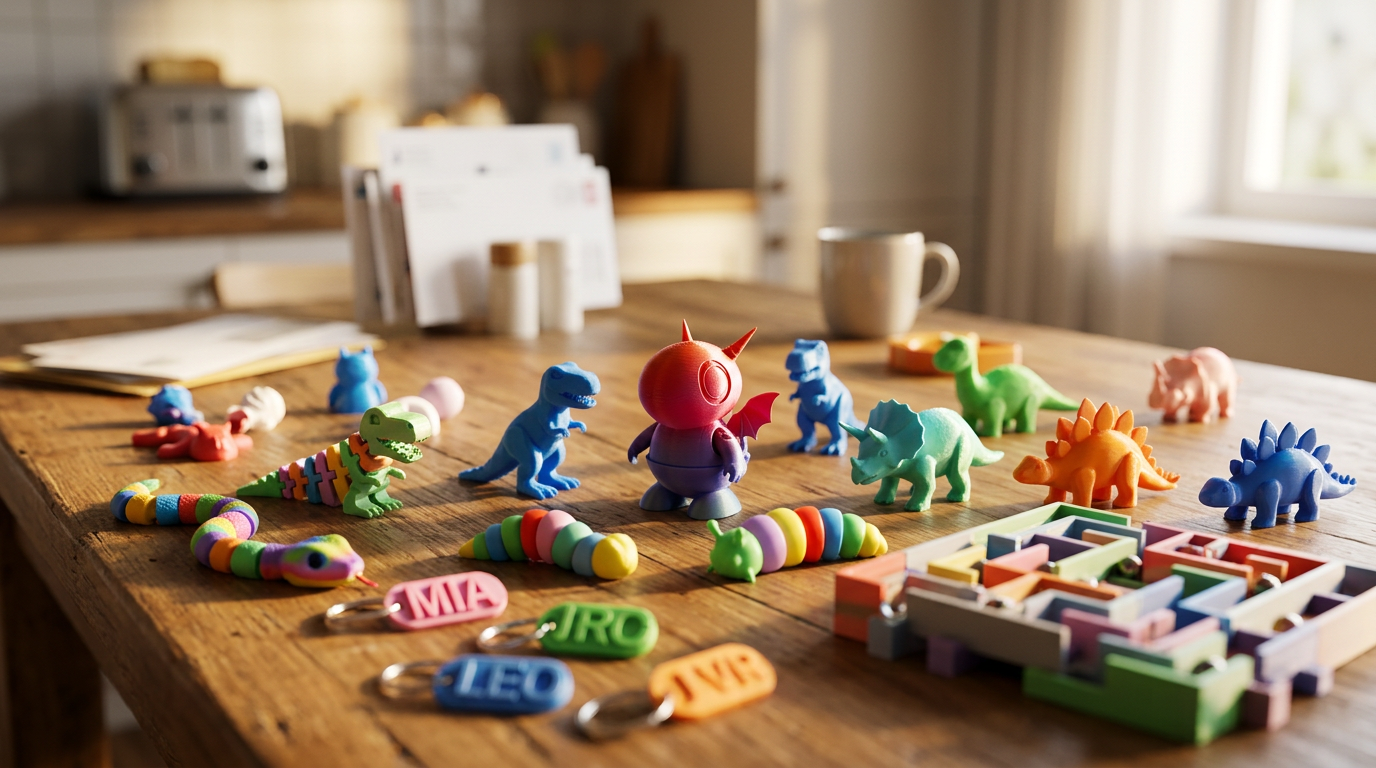
This is the most common pattern in homes with a kids’ printer, and it is nothing to apologise for. A few models on Saturday, a birthday gift in a good week, the occasional replacement part for something that broke. Small toys land between 10 g and 25 g each. Print six of them and you have used 90 g. Not much, really.
At this rate one 200 g roll covers a month with margin. A 1 kg spool lasts five months or longer, which raises a different problem. Open PLA absorbs moisture over time, so a spool sitting half-used since spring may print worse in autumn. Small appetite, small roll.
Regular Family Printing: 200 to 400 g a Month
Prints happen a few times a week. Someone has a project. Someone else wants a matching one in a different colour. Model sizes creep upward as confidence grows, and the first 100 g print usually arrives in month two.
Two 200 g rolls will normally cover it. Keep one unopened. Nothing kills momentum faster than running dry on a Sunday afternoon with the model already sliced.
Most Days: 400 to 800 g a Month
The printer has become part of the routine rather than an event. Multi-part builds appear, along with functional pieces that need real wall counts. Overnight jobs start happening.
Plan on four 200 g rolls, or roughly three quarters of a kilogram. Colour changes matter at this level too. Colour matters here. If a project needs three colours, you cannot substitute grams from the wrong roll, so total stock has to exceed total consumption.
Shared, Classroom, or Selling: 1 kg and Up
Two children on one machine roughly doubles output. Not because each child prints more. The queue never empties. A homeschool group or a classroom set moves faster still. Small-batch selling turns filament into inventory, and inventory needs records.
Buy by the kilogram. Log grams per product, include failures in the figure, and reorder before stock drops below the amount your scheduled jobs require.
|
Usage level |
Print hours per week |
Grams per week |
How long 1 kg lasts |
|
Casual |
5–9 hours |
40–70 g |
14–25 weeks |
|
Frequent |
17–25 hours |
135–200 g |
5–7 weeks |
|
Heavy |
40–168 hours |
320–1,345 g |
5–22 days |
The bands below are planning scenarios, not measured household averages. Each scenario should be based on clear assumptions—for example, 8 prints × 20 g plus a 15% contingency—and you should replace those inputs with your own slicer estimates and actual usage after the first month.
How to Calculate Your Own Filament Needs

Four steps. None of them require maths beyond a calculator app.
1. Read the Slicer Estimate
Slice the model with the settings you intend to print, then look for the filament figure. Most slicers report grams, meters, or both. Grams are the one to note, because spools are sold by weight and your kitchen scale reads in the same unit.
Reslice after any change. Always. Scaling a model to 120% does not add 20% of material, it adds closer to 70%, because width and depth grow alongside height. People get caught by this constantly.
2. Find Your Average Grams Per Print
Take your last five finished prints and add the estimates. Say they were 35 g, 55 g, 80 g, 40 g, and 90 g. That is 300 g across five jobs, so 60 g per print.
The average is more honest than any single job. Five beats two. One large piece always distorts a small sample.
3. Multiply by Monthly Volume
Count the jobs first. Then multiply. Fifteen prints at 60 g comes to 900 g, so one 1 kg spool covers the month with 100 g of headroom. That headroom is thinner than it sounds.
Batch work uses the same arithmetic. A 120 g item printed twenty times needs 2.4 kg before a single gram of waste is counted.
4. Add a Margin for Waste
The slicer estimates the planned toolpath. It does not know about the first layer that peeled, the test cube, the purge before a colour change, or the calibration tower. Real consumption sits above the estimate. Every time.
First use the slicer’s total estimate, including supports, adhesion structures, and purge where reported. Then add a contingency based on your records. For an untested long print, keep enough extra filament to restart the job rather than relying on a fixed 5–10% rule.
How Much Filament Does a Printer Use Per Hour?
No single number exists. Anyone quoting one precisely is guessing. Material flow depends on geometry, extrusion width, wall count, infill, and nozzle size.
Do not plan filament purchases from a universal grams-per-hour number. For your own records, divide the slicer-estimated grams by the estimated print time for several representative models; use that rate only for similar models and settings.
Print speed is a separate matter. A faster machine deposits the same plastic in less time, so a 300 mm/s printer and a 120 mm/s printer will use nearly identical material on the same model. Speed changes your evening. It does not change the mass.
Why 200 g Rolls Change the Math for Family Printers
Almost every filament guide online is written around the 1 kg spool, because almost every guide is written for adult hobbyists. That unit is wrong for most family printing. It skews the plan in both directions.
A 200 g roll is 20% of a kilogram. In PLA at 1.75 mm that is roughly 67 meters, or somewhere between eight and twenty small toys depending on size. For a child printing on weekends, one roll is a month. For a household running most days, four rolls is a month. Those are numbers a parent can actually shop against.
Smaller rolls can offer two practical advantages: lower upfront cost and less material sitting open before it is used. They also make it easier to keep more colors on hand without buying a full kilogram of each. However, a smaller roll still needs sealed, dry storage because moisture exposure depends on the material and your room’s humidity, not roll size alone.
If you are comparing AOSEED filament bundles, check the current official product page for the exact filament SKU, bundle contents, and any material test documentation. A material test applies only to the specimen and conditions stated in its report and does not certify every finished print, design, or child-use scenario.
|
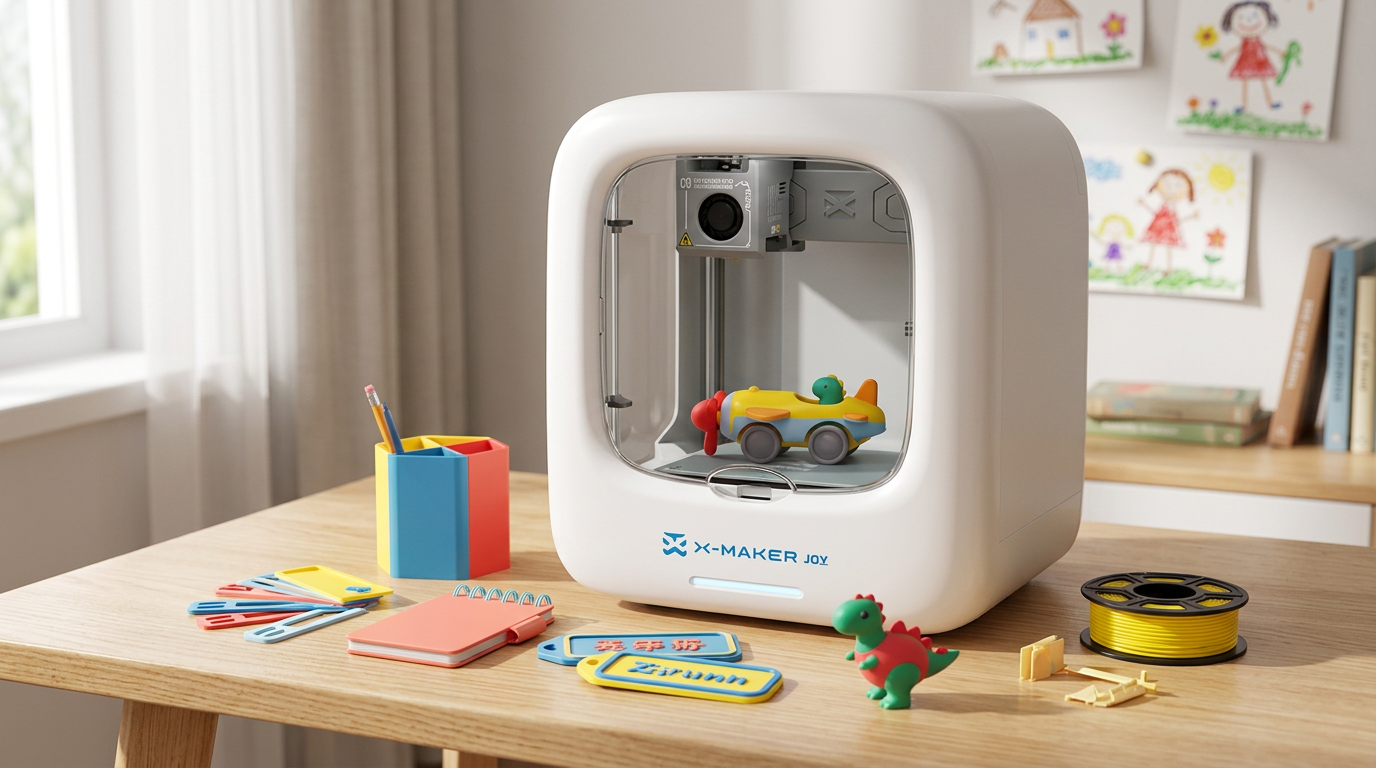
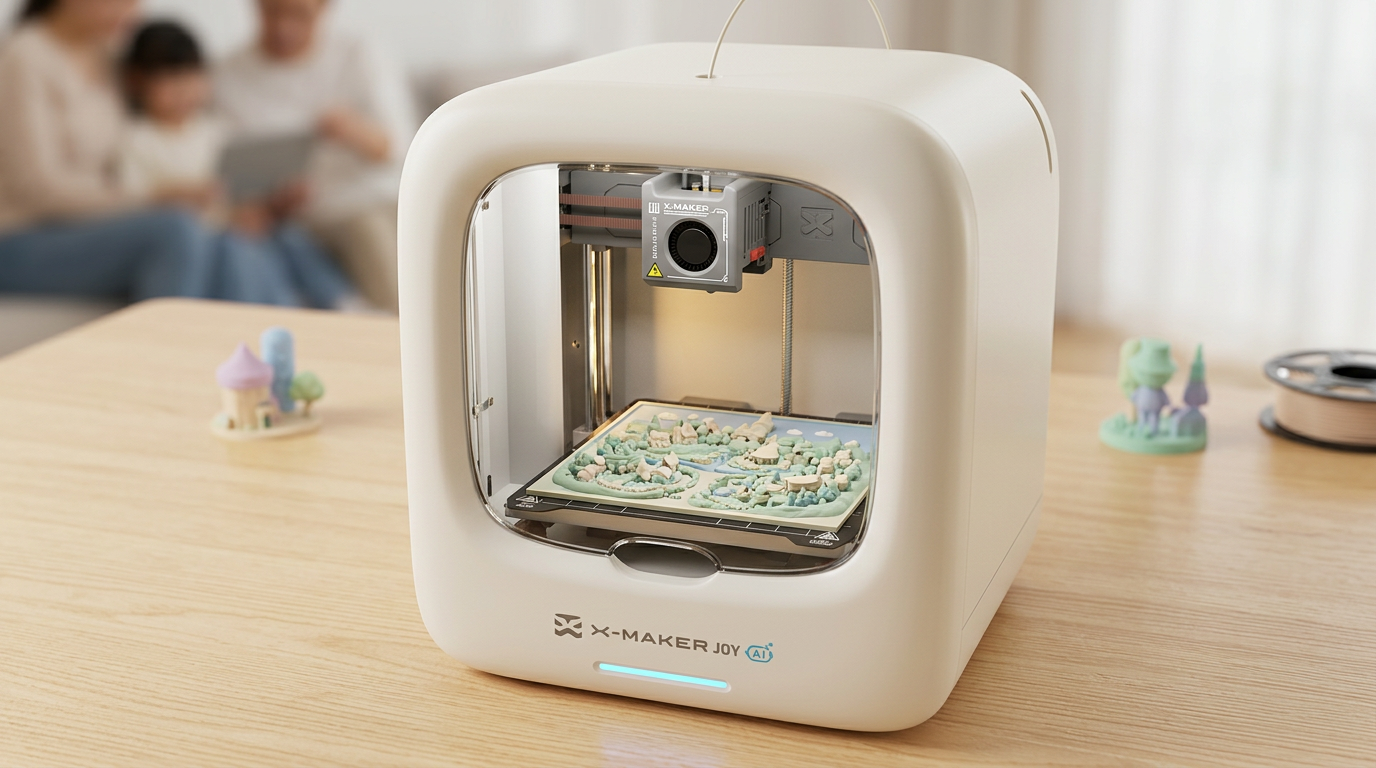
BUILD VOLUME DECIDES MONTHLY APPETITE. THE X-MAKER JOY PRINTS INSIDE A 120 MM CUBE AND RUNS PLA ONLY, WHICH SUITS AGES 4 TO 12 AND KEEPS MONTHLY USE LOW. THE X-MAKER OPENS UP TO A 150 MM CUBE AND HANDLES PLA AND ABS FOR AGES 9 TO 16, SO PROJECTS GET BIGGER AND SO DOES THE FILAMENT BILL. BEFORE YOU BUDGET FOR PLASTIC, COMPARE KIDS’ 3D PRINTERS BY AGE AND BUILD SIZE AND WORK OUT WHICH CUBE YOUR CHILD WILL FILL. |
What Actually Drives Filament Use

Five levers. They account for most of the variation between two prints of identical outside dimensions.
Model Size and Volume
Bigger usually means more, but hollow beats solid every time. A large decorative shell can use less plastic than a small dense component. Reslice after scaling. Never estimate.
Infill Density
Infill is the internal lattice. At 10% a model is light and airy, at 20% it is sturdy for most purposes, and at 50% it is close to a brick. Fifteen percent is plenty for decorative pieces. Load-bearing parts are a different conversation, and the honest answer there is usually more walls rather than more infill.
Wall and Perimeter Count
Walls form the shell. Each additional perimeter line adds plastic on every single layer, so a change that looks minor multiplies across two hundred layers. Walls buy strength more efficiently than infill, gram for gram. Walls win. That makes them the better lever when a part has to survive being dropped.
Supports, Rafts, and Brims
Support material holds up overhangs and then goes in the bin. On a complex model it can account for a meaningful share of total mass, all of it discarded. Rotating a model 30 degrees sometimes cuts supports in half. Try three orientations in the slicer before committing to a long job.
Failed Prints and Purge Waste
Nobody budgets for this. Everybody pays it. A first layer that lifts at minute four costs three grams. A spaghetti failure at hour nine on a 300 g print costs most of the 300 g. Multi-colour prints add purge waste that never becomes part of the object at all.
|
Cutting waste is also a safety habit Failures often trace back to temperature and enclosure discipline, and the same discipline lowers emissions. NIOSH advises printing at the lowest recommended temperature and waiting before opening a closed printer. Its research also notes that filament material and colour significantly affect volatile organic compound emission rates. An enclosed build area helps on both counts, which is one reason school guidance keeps recommending them. |
How Long Does One Spool or Roll Last?
Divide 1,000 g by your weekly consumption and you have your answer in weeks. Simple division. Use 250 g a week and a kilogram lasts a month. Use 60 g a week and it lasts four.
The number of finished objects works the same way. A 1 kg spool holds fifty 20 g toys in theory, ten 100 g parts, or two large 400 g pieces with 200 g left over. Reality lands lower, because supports and failures take their cut.
|
Print size |
Grams each |
Copies from 200 g |
Copies from 1 kg |
|
Small toy or keyring |
10–25 g |
8–20 |
40–100 |
|
Medium model or part |
50–200 g |
1–4 |
5–20 |
|
Large prop section |
300–700 g |
Not enough |
1–3 |
|
Multi-part project |
900 g total |
Not enough |
One project, 100 g spare |
Multi-part builds deserve a warning of their own. Six sections at 120 g, 160 g, 180 g, 90 g, 210 g, and 140 g total 900 g. A fresh kilogram covers it on paper, with 100 g of margin for supports, purge, and one small failure. That is a tight window for a project spanning several days.
Does Filament Type Change How Much You Need?
Weight is weight. A kilogram is a kilogram whichever polymer you buy. What changes is length, because densities differ. It matters when you plan in meters and stops mattering the moment you plan in grams.
|
Material |
Meters per kg at 1.75 mm |
Meters per kg at 2.85 mm |
Notes for family use |
|
PLA |
334 m |
115 m |
Cool-running, lowest particle emissions, the default for kids’ printers |
|
PETG |
329 m |
112 m |
Tougher and more moisture-resistant, needs tuning for stringing |
|
ABS |
400 m |
135 m |
Needs a heated bed and an enclosure, better ventilation required |
|
TPU |
340 m |
116 m |
Flexible, slower to print, different profile entirely |
Some guidance reports lower particle emissions for PLA than for several other common filaments under the tested conditions, but emissions and formulations vary. Follow the printer and filament instructions, use effective exposure controls and ventilation, and keep children away from the hot end, heated surfaces, and moving parts.
What Should You Budget Each Month?
Take the price you actually pay per roll or spool and multiply by the quantity you actually use. Use your own price. Shipping, colour choice, and specialty materials swing the figure more than the base price does.
The proportional method is simplest. If a roll costs you X, then using half of it costs half of X. A month at 400 g is two 200 g rolls. A month at 900 g is close to one kilogram.
Electricity barely registers by comparison. A printer drawing about 100 W for two hours uses 0.2 kWh. At the U.S. residential average of 16.5 cents per kilowatt-hour reported for 2024, that is roughly three cents. Rates have climbed since, and yours may differ considerably by state, so check your own bill if the number matters to you. It usually will not. Filament and failed prints dominate the running cost.
How to Cut Monthly Filament Use Without Weakening Parts

The aim is removing plastic that does no work. Not hollowing everything out.
- Match infill to the job. A display figure at 15% is fine. Reslice at three densities and read the gram difference before you commit.
- Reorient before adding support. A rotated model often needs half as much scaffolding, and every gram of support is a gram thrown away.
- Use walls, not infill, for strength. Two extra perimeters usually beat jumping from 20% to 40% infill, and cost less material.
- Prototype small. Test one feature at 40 g rather than discovering at 300 g that a hole is undersized.
- Prevent failures rather than absorb them. Check the first layer before walking away. Dry storage, a clean nozzle, and a settled profile save more filament over a year than any slicer setting.
- Spend the spool ends. A roll with 40 g left still prints clips, calibration cubes, and small toys. Weigh it, match it to an estimate, print something useful.
|
Where guided libraries help Curated model libraries reduce a cost most people never attribute correctly. A model that has been checked and profiled prints first time far more often than a random download, and every avoided failure is filament you keep. AOSEED’s library runs to more than 8,000 reviewed models with weekly additions, alongside guided design apps that keep children editing known-good geometry rather than building unprintable overhangs from scratch. |
When to Buy More Filament, and When to Wait
Buy more now if:
- Your next planned print needs more grams than the spool has left, plus a margin.
- A multi-part project is queued and the total exceeds what is on the shelf.
- A colour is required and no roll of that colour is open.
- You are printing for a deadline, a birthday, or a school submission.
- Two people share the machine and the queue has not emptied in a fortnight.
Wait if:
- You have not yet finished one roll and cannot state your monthly average.
- Half-used spools are already sitting on the shelf in colours nobody has asked for.
- The only reason to buy is a lower price per kilogram on a material you rarely reach for.
- Storage is limited and open PLA would sit for months absorbing moisture.
Conclusion
Filament planning stops being guesswork the moment you switch units. Slice the model, read the grams, average five prints, multiply by your monthly count, then add a margin for the failures and purge that every real month contains. Then track it. After four weeks of notes your own history beats every published range, including the ones above.
For most families the honest figure is smaller than expected. Usually much smaller. One to four 200 g rolls a month covers weekend printing through to daily use, and thinking in rolls rather than kilograms keeps colour variety affordable while the plastic stays fresh.
If you are still choosing hardware, monthly filament needs will depend partly on build volume, the kinds of models you plan to print, and who will use the machine. Check the manufacturer’s current product page and manual for the exact model’s build volume, supported materials, bundle contents, region-specific price and warranty, material settings, ventilation requirements, and adult-supervision guidance before buying.
FAQs
How do I calculate how much filament I need?
Slice the model using the exact settings you plan to print, then read the filament figure your slicer reports. Grams are the number to use, because spools and rolls are sold by weight and a kitchen scale measures the same way. If one model needs 80 g and you want ten copies, the base requirement is 800 g. Then add for the things the estimate ignores: supports, purge lines, calibration, prototypes, and the print that fails at hour six. For a whole month, add the estimates for every project you expect and compare the total against 1,000 g per kilogram spool or 200 g per roll. Keep a short record of estimates against finished results and your future orders will stop being guesses.
How much filament does a 3D printer use per hour?
There is no single rate, because flow changes with geometry and settings. As a planning figure, around 8 g per hour holds up for PLA on default profiles, averaged across three common benchmark models. At that rate fifty printing hours is roughly 400 g, and a 200 g roll covers about 25 hours of machine time. Real prints scatter widely around that. A thin decorative piece can run all evening on very little plastic, while a thick functional part with four perimeters burns through material fast. Infill, wall count, nozzle diameter, extrusion width, supports, and scale all shift the hourly figure. Divide the grams used across several finished prints by their total hours and you will have a rate that fits your own machine far better than any published average.
How long will 1 kg of filament last?
Anywhere from five days to six months. Published estimates put casual printing at four to six months per kilogram, frequent printing at five to seven weeks, and heavy printing at five to twenty-two days. Those ranges rest on assumptions about weekly hours and grams per hour, so treat them as frames rather than promises. The arithmetic is more reliable than the labels: someone using 250 g a month gets about four months from a kilogram, and someone using a full kilogram monthly finishes it in one. Large props, dense functional parts, heavy support structures, and failed prints all shorten spool life quickly. Printing in several colours can make each individual spool appear to last longer while your total monthly consumption stays high, so track total weight rather than how often you swap one colour.
How much does 200 g of filament cost?
It costs 20% of whatever you paid for a 1 kg spool, or the full price of a 200 g roll if that is how you buy it. Multiply your spool price by 0.20 and you have the material cost. If you bought a spool for $20, then 200 g of plastic represents about $4 of it. That figure covers the filament inside the finished object only. It excludes shipping, electricity, support material, purge waste, failed attempts, and the nozzle you will eventually replace. For anything you sell, calculating from the finished object weight alone understates the real cost, sometimes badly, because a support-heavy design can waste a third of the material it consumes. Use your slicer’s total material figure, including support and purge where it reports them separately, before you price anything.
How long is 2.2 lbs of filament?
About 2.2 lbs equals 1 kg, but the length depends on both material and diameter, so weight alone cannot be converted. At 1.75 mm, a kilogram of PLA runs roughly 334 meters and PETG about 329 meters. ABS reaches around 400 meters and TPU around 340 meters for the same weight, because those plastics are less dense. Move to 2.85 mm filament and the same kilogram gives far fewer meters, roughly 115 for PLA, since each meter is much thicker. Brand formulations and real filament tolerances shift these numbers slightly too. Check the diameter and material printed on the spool label before converting anything, and remember that grams are the easier unit for planning because that is how both spools and slicer estimates are expressed.
How much does it cost to run a 3D printer for 2 hours?
Usually a few cents. Convert the printer’s average power draw to kilowatts, multiply by two hours, then multiply by your electricity rate. A printer averaging 100 W is 0.1 kW, so two hours uses 0.2 kWh. At the U.S. residential average of 16.5 cents per kilowatt-hour reported for 2024, that comes to roughly three cents, though rates have risen since and vary widely by state. Nameplate wattage overstates real use, because heaters and motors cycle rather than running flat out, so a plug-in energy meter gives a truer reading. Electricity is rarely the number worth optimising. Filament, wasted material from failures, replacement nozzles, and build surfaces all cost more over a year than the power bill does.
Is a 3D printer an expensive hobby?
Recurring costs are modest for occasional printing and climb steadily with volume. Filament is the easiest expense to measure, because every completed and every failed print consumes it. A casual maker may take months to finish one kilogram, while someone printing daily can clear a roll in a fortnight. Beyond plastic there are nozzles, build surfaces, tools, storage, and electricity, none individually large. What actually drives cost is scale and ambition: large cosplay pieces, repeated prototypes, and anything printed for sale need a real material budget, while keyrings and household fixes do not. The purchase price is only the entry fee. Track your monthly grams for three months and you will know your true running cost better than any online estimate.
Which filament is better for beginners, PLA or PETG?
PLA, without much argument. It prints at lower temperatures, sticks reliably, needs no heated bed on most machines, and forgives a badly tuned profile. It also carries the lowest particle emission rate among common filaments, which matters in a home with children. PETG earns its place later. It is tougher, handles moisture better, and holds up in functional parts that PLA would deform, but it demands more tuning to control stringing and surface marks and behaves differently around the nozzle and bed. Neither wins outright, because the right choice depends on whether ease, strength, heat resistance, or appearance matters most for the object in hand. Learn your printer on PLA first, then test PETG on something small before trusting it with a long job.
Sources
- All3DP, “1 kg of PLA Filament: How Long Does It Last?”
- CDC / NIOSH, “3D Printing (Additive Manufacturing)”
- CDC / NIOSH, “How to Reduce Exposures When 3D Printing with Plastic Filament”
- Washington State Department of Health, “3D Printers”
- U.S. Energy Information Administration, “Residential electric bills in Hawaii and Connecticut are twice those in New Mexico, Utah”


Further reading

STEM Building Toys for Kids: Blocks, Kits and Printers Compared

Toy 3D Printer: What to Look for in a Printer That Makes Toys at Home

Personalized Gifts for Kids: Name Tags, Keepsakes and Custom Toys You Can Design