3D Printer Filament Storage: Keep Spools Dry and Dust-Free
Good 3D printer filament storage keeps moisture and dust from ruining your prints. Seal each spool with silica gel, check the humidity with a hygrometer, and dry any filament that starts popping before running another print. Most materials store best at about 10% to 30% relative humidity.
This guide explains how moisture and dust affect filament and how to tell whether a spool needs drying or better storage. It also compares storage containers and lists safe drying temperatures that will not warp the filament or spool.
|
If you... |
Buy this |
Rough cost |
|
Print PLA now and then |
Heavy-duty zipper bag plus reusable silica gel |
$ |
|
Keep spare colors for months |
Reusable vacuum bag plus desiccant |
$ |
|
Print several times a week |
Gasket bin, hygrometer, rechargeable desiccant |
$$ |
|
Run nylon, TPU, or PVA |
Powered dry box that feeds the printer |
$$$ |
|
Own more than ten spools |
Electronic dry cabinet |
$$$$ |
Why wet or dusty filament ruins prints

What moisture does inside the hotend
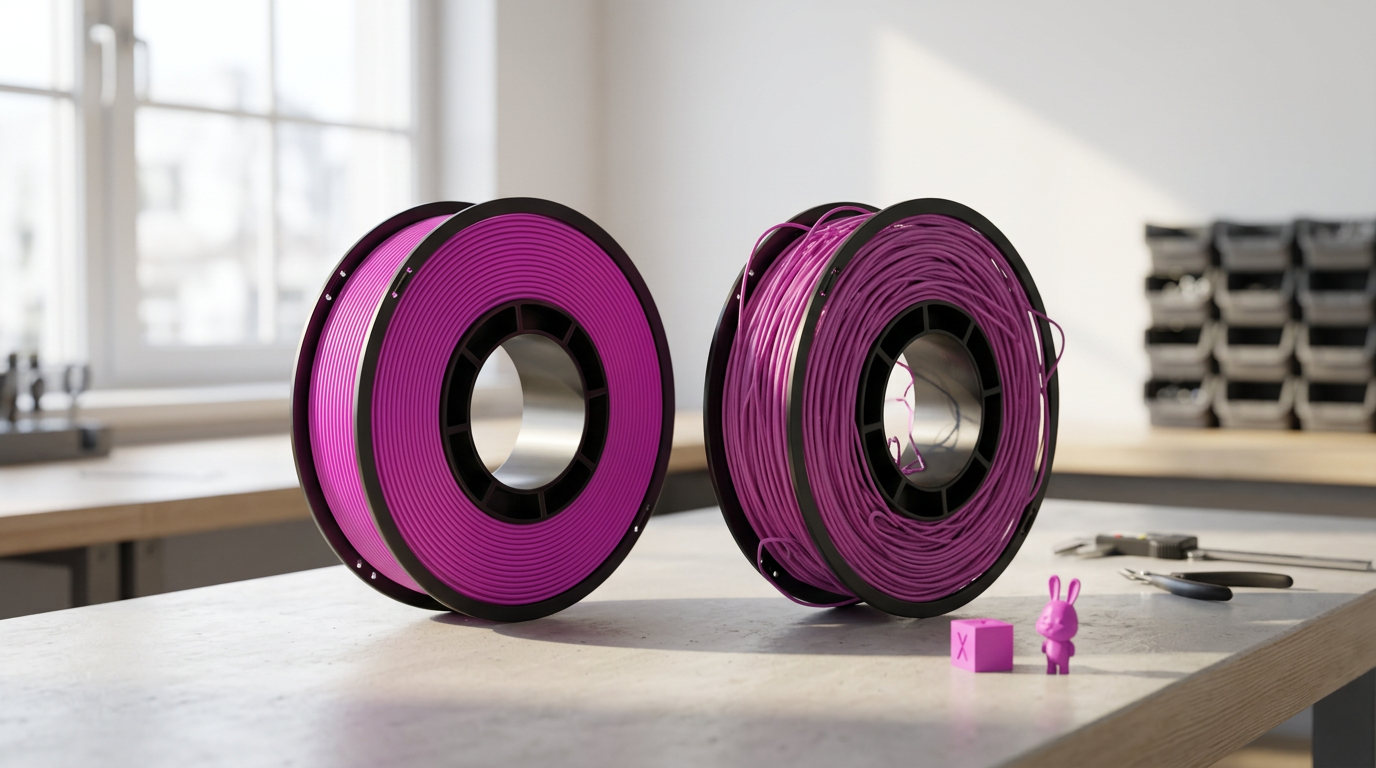
Most 3D printing plastics are hygroscopic. They pull water out of the air. Nothing looks different from outside. Then the filament hits the hotend. Trapped water turns to steam. The steam blows small bubbles into the extrusion, and you get popping, stringing, rough walls, and layers that peel apart under light load.
None of this is folklore. Peer-reviewed testing across common FFF filaments has recorded real losses in stiffness and strength after ordinary exposure to humid air.
What dust does to the feed path
Dust, pet hair, and workshop grit settle on an open spool. The printer drags all of it into the feeder, the PTFE tube, and the nozzle. Buildup on the drive gears cuts grip. Debris at the tip adds partial clogs. Flow goes uneven.
The early symptoms look like moisture. Thin lines. Gaps. An irregular flow rate. Sealed storage prevents most of it.
|
What you see or hear |
Usually means |
|
Popping or hissing at the nozzle |
Moisture flashing to steam in the hotend |
|
Stringing and fine wisps |
Wet filament, sometimes plus retraction settings |
|
Rough, bumpy surface |
Moisture or dust riding on the strand |
|
Weak layers, parts snap easily |
Water absorbed deep into the filament |
|
Random gaps or under-extrusion |
Dust or debris partly clogging the path |
Wet, or just needs storing?
Run a test extrusion first

Dry by symptoms, not on a schedule. Push out a short length before a big print. Watch. Listen. That one test beats changing five slicer settings.
|
Signs it is still dry |
Signs it soaked up moisture |
|
Feeds as a smooth, steady strand |
Popping, sizzling, or hissing |
|
Quiet at the nozzle |
Bubbles or cloudy patches in the line |
|
Consistent wall texture |
Rough surface and extra stringing |
|
Bends normally for the material |
Brittle snap, or soft and sticky (PVA) |
When to dry it and when to bin it
A spool that has only taken in water from the air usually comes back after a proper dry cycle. Replace it when it stays brittle, sticky, or inconsistent afterward. Replace it too if the spool itself cracked or deformed. Heat cannot undo that.
Age is not the deciding factor. Storage is. A sealed two-year-old roll beats a month-old one left open in a humid room.
The best ways to keep filament dry
Bags, bins, and boxes compared

|
Method |
Blocks dust |
Blocks moisture |
Best for |
|
Original factory bag, resealed |
Yes |
OK |
Unopened spools, short term |
|
Heavy-duty zipper bag plus desiccant |
Yes |
OK |
PLA and PETG in regular use |
|
Reusable vacuum bag plus desiccant |
Yes |
Good |
Spares stored for months |
|
Gasket-sealed bin plus hygrometer |
Yes |
Good |
Daily drivers, several spools |
|
Powered dry box |
Yes |
Very good |
Nylon, TPU, PVA, long prints |
|
Electronic dry cabinet |
Yes |
Very good |
Large collections |
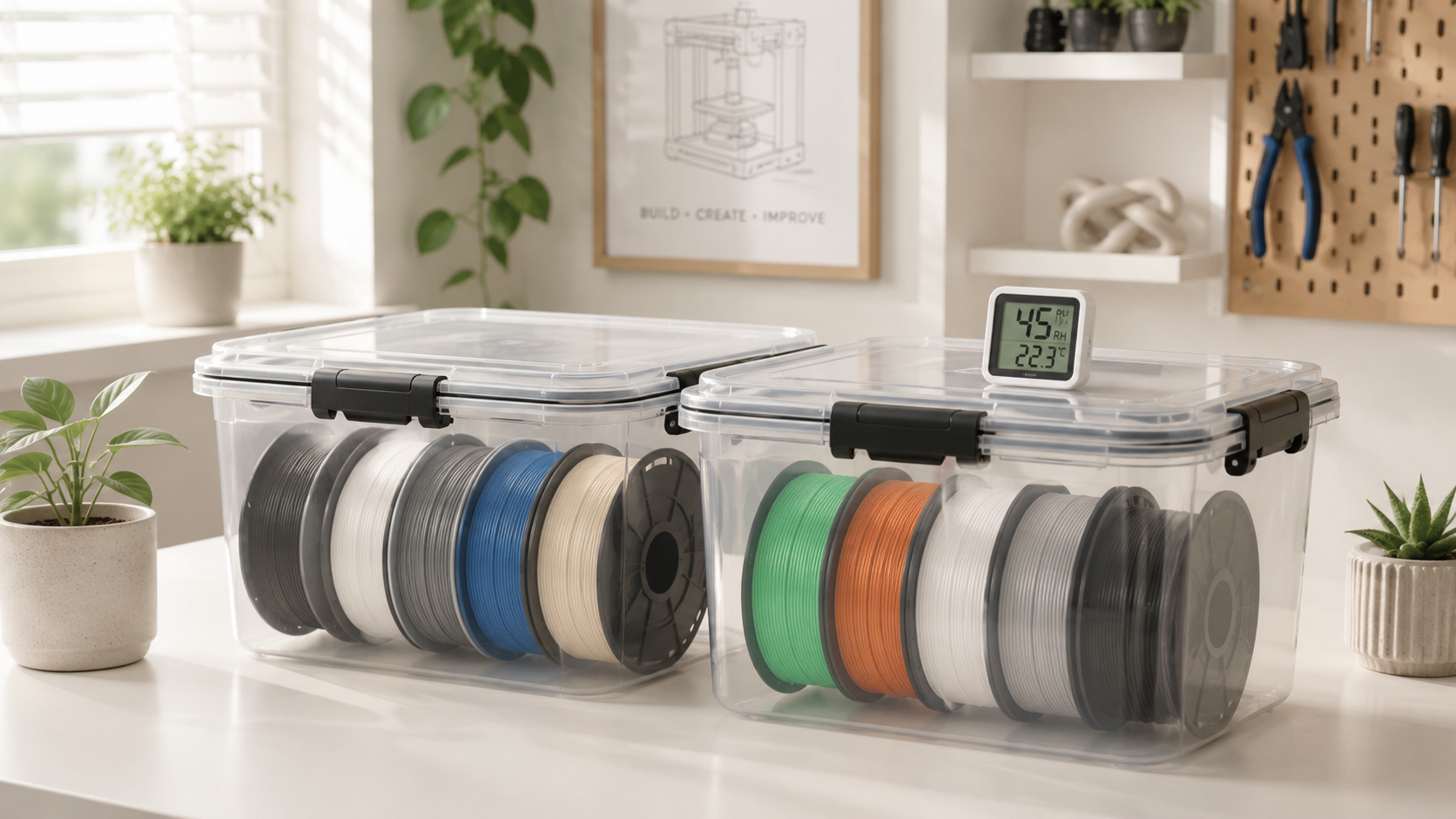
A sealed food container with $15 of desiccant can control humidity about as well as a $50 commercial box. The seal and desiccant matter more than the container’s price. Choose a clear container or add an external hygrometer so you can check humidity without opening the lid. The seal and the desiccant matter more than the price. One condition. You have to read the number inside without opening the lid.
Getting the seal right
|
Size the container so the spool turns freely and air reaches the desiccant. A flexing lid leaks even with a gasket fitted. Press around the edges and check the seal makes contact all the way round. |
Watch a vacuum bag for the first day. If it puffs back up, the valve or a seam leaks. Cardboard spool edges cut thin bags. Do not pull the plastic tight over them.
Desiccants that actually pull water

Which type to buy
|
Desiccant |
Absorbs |
Reusable |
Watch out for |
|
Silica gel packets |
Moderate |
Yes, bake dry |
One packet cannot dry a whole tote |
|
Indicating silica beads |
Moderate |
Yes |
Recharge when the color flips |
|
Molecular sieve |
Aggressive |
Yes |
Costs more, needs more heat |
|
Calcium chloride / DampRid |
High |
No |
Turns to brine, real spill risk |
Rechargeable indicating silica is the usual pick. Cheap. Reusable. It flips from orange to green as it saturates. Keep calcium chloride for a big upright container, where a leak cannot reach a spool.
Where to put it in the box
Air has to move around the desiccant. Use a shallow vented tray. Not a packet buried under three spools. In a tall cabinet, split it across shelves.
|
Put loose beads in a vented holder, never straight into the bottom of the box, or they roll into bearings and the filament outlet. Keep the hygrometer away from the tray too. Sitting next to it, the sensor reads lower than the rest of the box. |
Monitor humidity and hit these targets
Reading the number properly
A cheap digital hygrometer turns guessing into a number. One per bin. Two cheap sensors side by side can read three or four points apart, so follow the trend rather than chasing a perfect figure. A spike when you open the lid is normal. What matters is how fast it settles.
Lab testing ranks moisture uptake from high to low as roughly nylon, then PETG, then PLA and ABS, with TPU lowest. Match your effort to the material.
Target humidity by material

|
Material |
Target humidity |
Notes |
|
PLA |
Below ~30% RH |
Forgiving; a sealed bin with silica gel is enough |
|
PETG |
Below ~20% RH |
Shows symptoms sooner in humid rooms |
|
ABS / ASA |
Below ~20% RH |
Sealed storage protects surface and extrusion |
|
TPU |
Below ~20% RH |
Aim closer to 15%; keep the feed path short |
|
Nylon |
As low as you can |
Very thirsty; molecular sieve or plenty of silica |
|
PVA / PC |
Below ~20% RH |
Reseal fast; lower is better on long prints |
Target ranges only. Always follow the number printed on the spool you are using.
Box still high hours after closing? The desiccant is saturated, or the gasket has failed. Fix the leak before adding more packets.
How to dry filament that is already wet
Dryers, dehydrators, and ovens
Storage and drying solve two different problems. Desiccant keeps a dry spool dry. It cannot pull water from the middle of a soaked one. That takes heat and time. Use a dedicated dryer, a food dehydrator, or an oven you have checked with a separate thermometer.
|
Skip the air fryer. Its concentrated heat can spike high enough to warp the spool or fuse the filament loops together. Do not use an appliance for food again after it has been used to dry filament. An oven is only suitable if you have verified that it holds a low, steady temperature. Ovens only work if they hold a low, steady temperature you have verified yourself. |
Temperatures and times by material
|
Material |
Typical dryer temp |
Rough time |
|
PLA |
40-45 C |
4-6 hours |
|
PETG |
55-65 C |
4-6 hours |
|
ABS / ASA |
60-70 C |
4-6 hours |
|
TPU |
45-50 C |
4-6 hours |
|
Nylon |
70-80 C |
6-12 hours |
|
PVA |
~45 C |
4-6 hours |
Starting points only. Use the setting printed on your spool, and never guess a drying temperature from the nozzle temperature.
Move the spool into sealed storage while it is still warm. Then run a test extrusion. No popping, no stringing, clean test print, done. If problems remain, repeat at the same temperature. Do not raise the heat. Check the nozzle and slicer too.
Keep dust out of the feed path
Five habits that do the work
- Reseal spools the moment a print ends. One left mounted overnight collects dust, especially in a garage or near pets.
- A small foam filter, clipped around the strand, wipes it clean before the extruder. Keep it light so it does not add drag.
- PTFE tubing gives a covered path from a dry box to the printer on long feeds.
- On multi-hour prints, cover the spool, and add desiccant under the cover for sensitive material.
- Brush or vacuum the feeder area, spool holder, and nearby shelves on a schedule.
Enclosed printers help, storage still matters

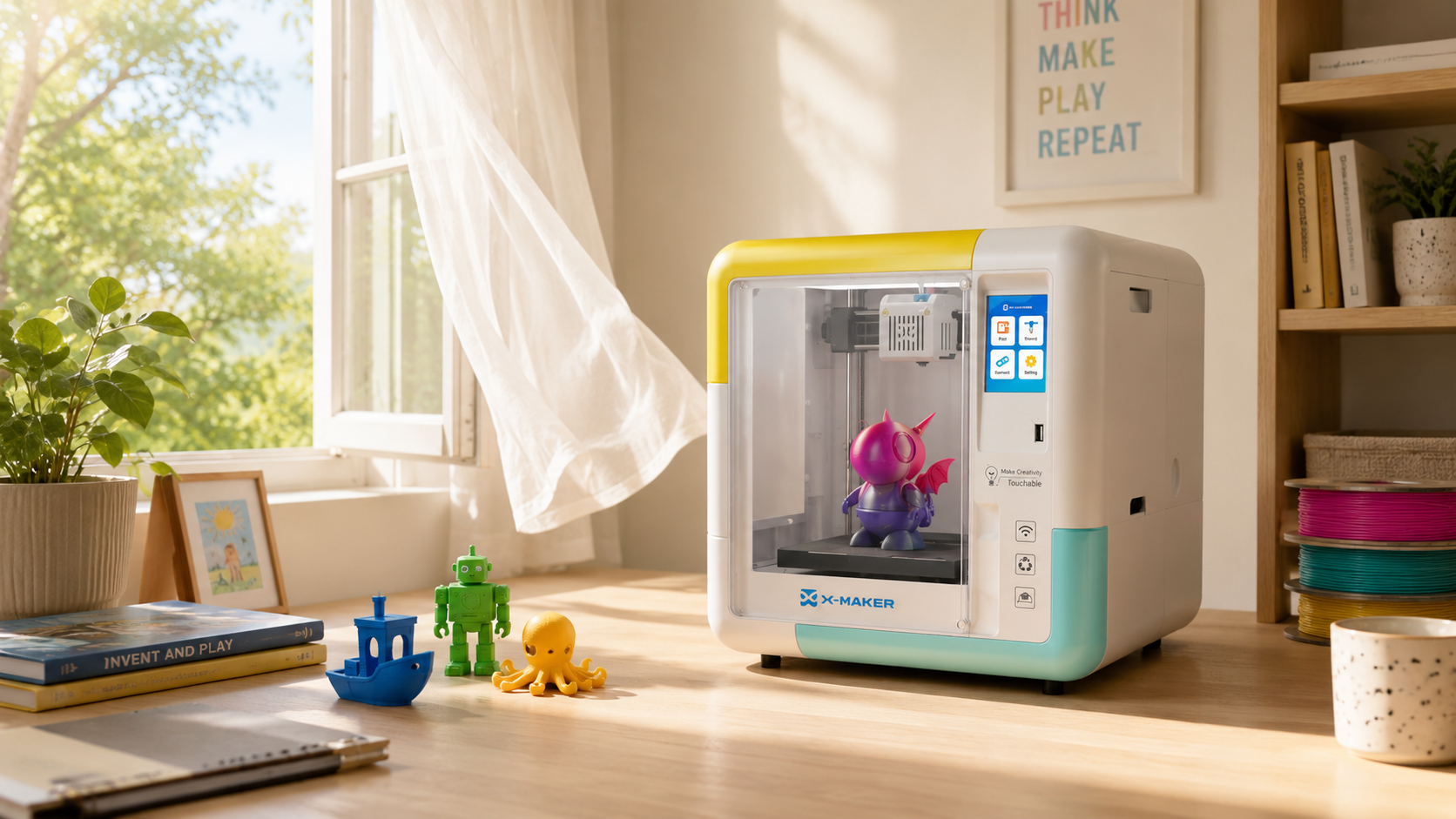
A fully enclosed machine keeps drafts and airborne dust off the print while it runs. Handy in a busy family room. The mounted spool still needs its own sealed home between jobs. An enclosure does not control humidity.
Build a cheap DIY dry box

Six steps, one afternoon
- Start with a rigid, gasket-sealed container wide enough for the spool to spin without touching the walls.
- Add bearing rollers or a center rod so the spool turns under light pressure and will not tip.
- Drop in a vented desiccant tray with indicating beads and a humidity card.
- Mount a small hygrometer where you can read it through the lid.
- Drill a clean hole for a PTFE push-fit near the spool tangent so the filament leaves straight.
- Seal it, close the latches, and leave it. Falling, stable humidity means the box is tight.
Test it with the heaviest spool you own. Reading climbs fast? Press around the lid, and check for cracks near the drilled holes.
Mistakes that keep filament wet
The seven common ones
- Leaving spools mounted between prints. Moisture and dust build up even with the printer off.
- Thin bags with no desiccant. They stop some dust but let humid air through.
- Trusting desiccant to dry a soaked spool. It maintains dryness; it does not rescue a wet roll.
- Rice as a moisture absorber. Not made for low humidity, and it sheds starchy dust.
- Storage near a window, radiator, or hot enclosure. Heat and sun warp spools and fade filament.
- Too much heat when drying. Guessing from the nozzle temperature warps the spool and fuses loops.
- Ignoring saturated desiccant. Once it is full, humidity climbs again inside a closed box.
|
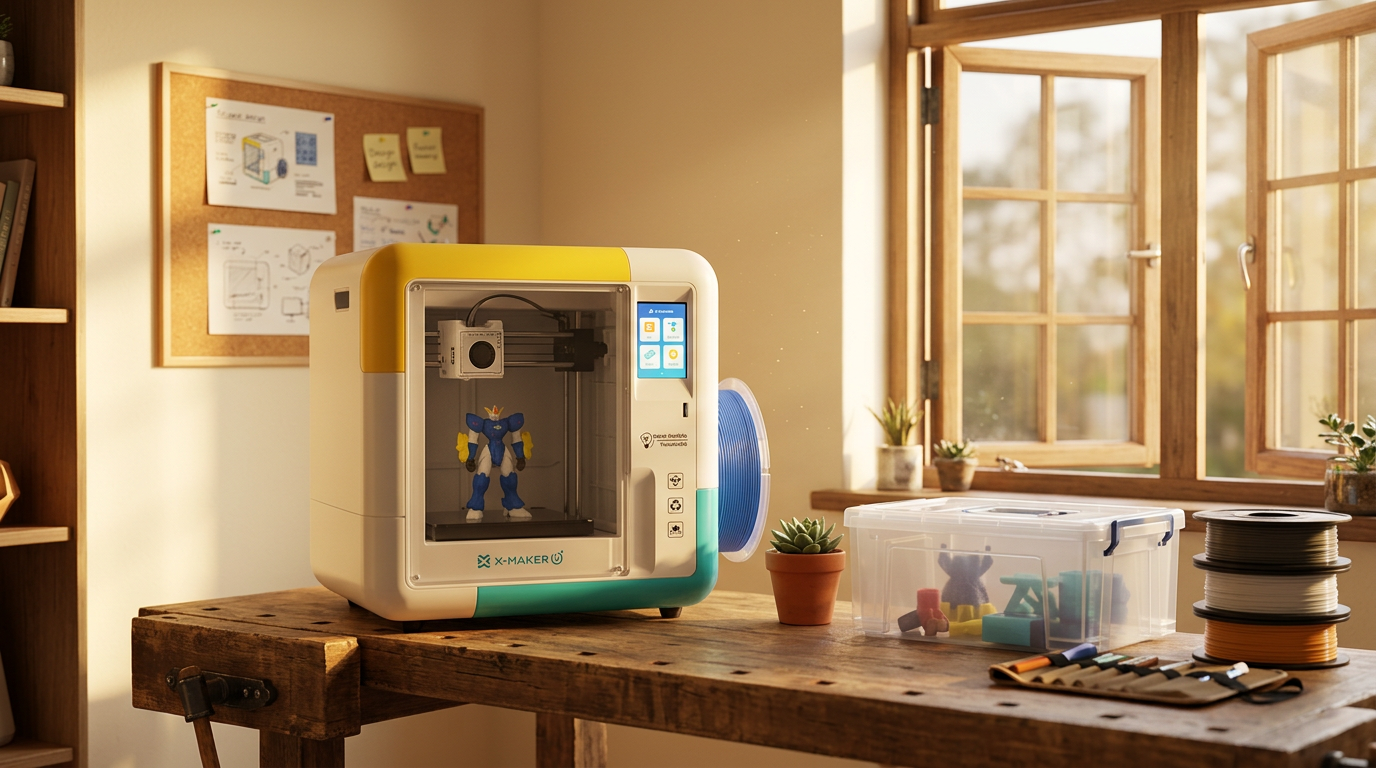
BUILDING A FIRST SETUP FOR A YOUNG MAKER? kid-friendly 3D printers built for beginners SHIP FULLY ENCLOSED AND PLA-ONLY, SO GOOD FILAMENT HABITS ARE EASY TO KEEP FROM DAY ONE. |
When to store, when to dry
Store it when
- The test extrusion is smooth and quiet
- The spool is new or was sealed after its last print
- The hygrometer in its box still reads low
- You are pausing between prints, not troubleshooting
- The material is PLA or ABS in a dry room
Dry it when
- You hear popping, sizzling, or hissing at the nozzle
- Walls come out rough, stringy, or full of tiny holes
- Layers separate under light hand pressure
- The spool sat open for days, or a bag seal failed
- You are about to run nylon, TPU, or PVA on a long print
Conclusion
The short version
Dry, clean filament is the cheapest upgrade any printer gets. A sealed bin. Fresh silica gel. A hygrometer. Then the habit of resealing spools after each print. Storage keeps a dry spool dry. Drying fixes a wet one. A short test extrusion tells you which you have.
For families setting up their first machine, an enclosed printer sized for a first-time family runs PLA only and arrives fully assembled. The X-MAKER JOY is $259, down from $339, and the enclosure keeps dust off the print while your storage routine handles the spool. More on the ecosystem atAOSEED's family-friendly 3D printing platform.
FAQs
How do I keep my 3D printer filament dry?
Sealed, with desiccant. Any airtight bag, gasket bin, or dry box works, as long as there is fresh silica gel inside and a hygrometer in the bigger containers so you can check humidity without lifting the lid. Storage only protects filament that is already dry. A soaked spool needs heat first. Label each one with the material and the date you opened it.
What is the best moisture absorber for filament?
Rechargeable silica gel, for most people. It is cheap and reusable, and indicating beads change color when full. Molecular sieves pull harder for nylon and engineering filament. Calcium chloride and DampRid absorb more water, but they turn to a liquid that can spill onto spools, so keep them out of small boxes. Loose beads go in a vented holder, never the bottom of the box.
How do I keep dust away from a 3D printer?
Keep idle spools sealed. Dust, pet hair, and debris get pulled into the feeder and pack around the extruder gears. A small foam filter, clipped on the strand, wipes it clean before the extruder, and PTFE tubing gives a covered path from a dry box to the printer. Keep the foam dry and light so it does not add drag.
Are Ziploc bags good for storing filament?
Yes, the heavy-duty ones. A thick zipper bag with fresh desiccant is fine for PLA, PETG, and other everyday filament. Thin household bags are the weak point, tearing on cardboard spool edges and trapping more air than a vacuum bag, which makes them poor for long storage or sensitive material. Drop the bagged spool in a rigid tote, safe from punctures and sunlight.
What is the cheapest way to keep filament dry?
A zipper bag, a reusable silica gel pack, and careful sealing after each print. For a small PLA or PETG collection that is about as cheap as it gets. Once you own several spools a gasket bin works out cheaper, since one bin holds several rolls and a shared desiccant tray. Neither dries wet filament, though. And opening the bag often lets humid air back in.
Does PLA really need to be dried?
Not always. A well-stored PLA spool extrudes smoothly, with no popping and no rough surface. Drying earns its place only after those symptoms show up and you have ruled out temperature and retraction. Baking every roll on a schedule just adds heat it did not need, and that can soften the filament or warp the spool. Test extrude a little. Listen for popping first.
How often should you dry PLA filament?
By condition, not by calendar. A spool in a sealed bin with dry desiccant can print for months. Leave one open in a humid room and it may need drying far sooner, the moment you hear popping or see weak layers and stringing. Room humidity, the container, how often you open it, all of it shifts the timing. Write the last drying date on the spool. Then let the prints decide.
What is the best container for storing filament?
For most people, a gasket-sealed plastic bin. One bin holds several spools plus rechargeable desiccant and a hygrometer, and it shuts out dust and humidity at the same time. Vacuum bags save space. Big collections do better in an electronic dry cabinet. What fits depends on how many spools you have, what they are made of, and how long they sit.
Sources
- Polymers (MDPI), “Effect of Moisture on the Mechanical Properties of Twelve Common FFF Filaments”
- National Library of Medicine, “Humidity Effects on the Mechanical Properties of Six FFF Polymers”
- Elsevier (ScienceDirect), “Moisture-Induced Changes in the Behaviour of 3D-Printed Polymers”
- Technologies (MDPI), “Filament Moisture and the Surface Finish and Strength of Printed Nylon”


Further reading
AI vs CAD for Kids: Which Design Path Fits Each Age?

AI-Generated 3D Models for Kids: 9 Printability Checks Before You Print

How to Fund a Classroom 3D Printer: Grant Budget and Proposal Checklist