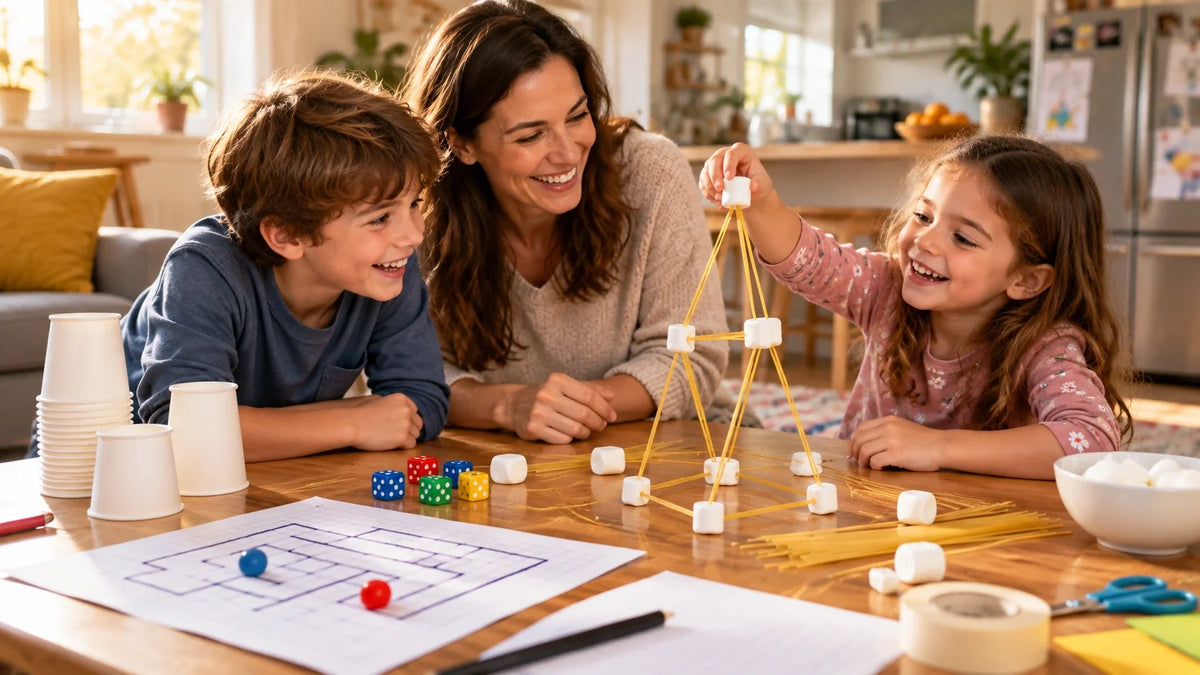
STEM Crafts for Kids: Build, Decorate and Test
Pick crafts kids can test, not just finish. Build it, make it theirs, measure what it does, then change one thing and try again.
A paper helicopter takes five minutes to fold. Timing ten drops, trimming the blades and doing it again takes longer. That second part is where a craft turns into STEM.
Every project below runs on one loop: build, decorate, test, adjust. Most use paper, cardboard, straws and tape from the drawer. Each comes with a simple test, so kids always have a number to beat.
QUICK PICK: 10 STEM CRAFTS BY TIME AND AGE
|
Craft |
Ages |
Time |
What Kids Test |
Mess |
|
Paper Helicopter |
5+ |
15 min |
Fall time from a fixed height |
Low |
|
Straw Rocket |
5+ |
20 min |
Launch distance by fin design |
Low |
|
Index Card Tower |
6+ |
25 min |
Height, then load before collapse |
Low |
|
Straw Geometry Sculpture |
6+ |
30 min |
Which shapes stay rigid when pressed |
Low |
|
Cardboard Marble Maze |
6+ |
45 min |
Run time from start to finish |
Medium |
|
Egg Drop Contraption |
8+ |
45 min |
Survival at rising drop heights |
High |
|
Craft Stick Bridge |
8+ |
60 min |
Weight held at the center |
Medium |
|
Rubber Band Car |
8+ |
60 min |
Distance rolled per wind |
Medium |
|
Paper Circuit Card |
9+ with an adult |
30 min |
Whether the LED lights, and why not |
Low |
|
Pizza Box Solar Oven |
9+ with an adult |
60 min plus sun |
Temperature rise every 10 minutes |
Medium |
What Makes a Craft a STEM Craft?
The Difference Is the Question
A regular craft is done when the glue dries. A STEM craft starts asking questions right then. Does it fly farther? Hold more? Spin faster?
One bridge project covers three STEM subjects. The structure is engineering, the measuring is math, and the push of coins on the deck is science.
|
Type |
Main Goal |
Example |
What Gets Measured |
|
Regular craft |
Looks good, practices a technique |
Painted cardboard house |
Nothing in particular |
|
STEM activity |
Answers a science or math question |
Timing how fast ice melts |
Time, temperature |
|
STEM craft |
Builds an object that has to do a job |
A decorated box that keeps ice frozen |
Minutes until the ice melts |
|
STEAM craft |
Adds art or design as a learning goal |
A string art star |
Spacing, angles, pattern |
Skills Kids Pick Up Along the Way
Most of the learning comes from comparing versions. Kids practice:
• Measuring distance, time, height, weight and angles
• Sketching a plan before cutting
• Choosing materials for a reason, like tape that bends versus glue that holds
• Making a prediction and checking it
• Recording results to compare two designs
• Finding the weak point and fixing only that part
These habits match what schools already teach. The Next Generation Science Standards for grades 3 to 5 ask students to define a design problem with success criteria and limits on materials, time or cost. The LEGO Foundation's review of the research on learning through play found play teaches best when it is joyful, meaningful, engaging, iterative and social. Testing and rebuilding covers the iterative part.
The Build, Decorate, Test Loop

1. Set a Challenge You Can Measure
"Make a paper bridge" is vague. "Make one sheet hold 20 coins across a six inch gap" is a finish line. Add a limit too: ten index cards, one strip of tape, 20 minutes. Limits force choices, and choices are where the thinking happens.
2. Sketch It, Then Build Cheap
A quick labeled drawing takes two minutes and saves ten. Neatness doesn't matter. Build version one from the cheapest material on the table.
3. Decorate With a Purpose
Let kids turn the rubber band car into a fire truck or a shark. Then ask what changed. Extra paper adds weight. A tall fin catches air. Now the paint job is an experiment too.
4. Predict, Test, Write It Down
Before each test, ask for a specific guess, like "the long blades will fall slower." Check it afterward. Wrong guesses are fine. The written guess is what makes the result worth discussing.
5. Change One Thing and Test Again
Change the wheels, axle and body at once and nobody knows which one helped. Change one thing. Hold the rest steady. The standards call this a fair test that controls variables and looks for failure points.
SAMPLE TEST LOG: RUBBER BAND CAR (EXAMPLE FIGURES)
|
Trial |
What Changed |
Prediction |
Distance |
Keep or Drop |
|
1 |
Nothing, first build |
About 3 ft |
2.6 ft |
Baseline |
|
2 |
Wider wheelbase |
Straighter and farther |
4.3 ft |
Keep |
|
3 |
Cardboard spoiler added |
No change |
3.6 ft |
Drop, too heavy |
|
4 |
Second rubber band |
Much farther |
6.2 ft |
Keep |
|
TIP · KEEP A ONE PAGE PROJECT LOG Fold a sheet into four columns: trial, change, guess, result. Tape it to the fridge. Kids who see last week's number want to beat it. |
Paper and Cardboard STEM Crafts

Paper Helicopter
Split the top of a paper strip into two blades and fold them opposite ways. Add a paperclip at the bottom and drop it from the same spot each time.
Test it: time five drops, then try longer blades, heavier paper or a second clip.
Straw Rocket
Roll paper into a tube slightly wider than a straw. Tape the nose shut, add fins and slide it on. One hard breath sends it across the room.
Test it: measure distance, then change one thing: fin size, tube length or launch angle.
Index Card Tower
Hand over ten index cards and 12 inches of tape. Cards can be folded, rolled or stacked. Tallest freestanding tower wins.
Test it: measure height, then set a paperback on top. The strongest tower is often not the tallest.
Paper Bridge
Lay a flat sheet across two books six inches apart. It sags under one coin. Folded into pleats, a tube or a U channel, the same sheet can carry dozens.
Test it: add coins one at a time at the center. Keep the span, paper and coins the same each round.
Cardboard Marble Maze
Glue cardboard strips into walls, ramps and dead ends inside a box lid, then tilt it to steer a marble through. An adult runs the glue gun.
Test it: time a run. Find where the marble sticks or jumps out, move that wall and time it again.
Engineering STEM Crafts With a Clear Goal

Craft Stick Bridge
Glue craft sticks into triangles, join them into two side trusses and connect them with a deck. Press a stick square and a stick triangle first. The square folds. The triangle holds.
Test it: rest the bridge between two chairs, hang a bag from the center and add weight in small steps. Note where it bends or cracks first.
Craft Stick Catapult
Band six stacked sticks together. Band two more at one end, slide the stack between them as a pivot and tape a plastic spoon to the top stick.
Test it: launch a pom pom and measure the distance. Move the pivot closer to the spoon, then farther away, and compare.
Rubber Band Car
Build a light cardboard body, push skewer axles through straw pieces and add bottle cap wheels. Hook a rubber band to the rear axle, wind it back and let go.
Test it: measure distance per wind. If it curves, check wheel alignment. If it stalls early, look for axle friction.
Straw Roller Coaster
Tape straws into a track that starts high on a cardboard wall and drops toward a cup. Every hill and curve raises the difficulty.
Test it: roll ten marbles and count how many land in the cup. Fix the spot where most fly off.
Egg Drop Contraption
Give every builder the same kit: one sheet of cardboard, five straws, three feet of tape and a plastic bag. The goal is a package that keeps a raw egg whole.
Test it: start at waist height, then a chair, then a stair landing. An adult manages the drop spot. A baking tray underneath saves the floor.
Mini Wind Turbine
Cut blades from a paper cup, pin them to a cork hub and mount it on a straw so it spins freely. Older kids can add a hobby motor and LED with an adult nearby.
Test it: set a fan to one speed and count spins in 30 seconds. Try three blade angles. Keep the winner.
ENGINEERING CHALLENGE CARDS
|
Craft |
Challenge |
Constraint |
Measure |
|
Craft stick bridge |
Span 12 inches |
30 sticks and glue |
Weight at first crack |
|
Catapult |
Land in a cup 6 feet away |
10 sticks, 4 rubber bands |
Hits out of 10 |
|
Rubber band car |
Roll 6 feet in a straight line |
One rubber band |
Distance and drift |
|
Egg drop |
Survive a 6 foot drop |
The five item kit above |
Pass or fail per height |
|
Wind turbine |
Spin at the lowest fan speed |
Paper and one cork |
Spins per 30 seconds |
Science and Nature STEM Crafts

DIY Barometer
Stretch a cut balloon tightly over a jar and tape it down. Glue a straw on top as a pointer and stand a card behind it for marks.
Test it: mark the pointer at the same hour each day for a week and compare with the weather. It won't match a real barometer, and that gap is worth discussing.
Homemade Anemometer
Staple four paper cups to two crossed card strips. Pin the center to a pencil eraser and color one cup for counting.
Test it: count turns in 30 seconds in the yard, on the porch and by an open door.
Pizza Box Solar Oven
Line a pizza box flap with foil, seal the opening with plastic wrap and lay black paper inside. Prop the flap to bounce sunlight in. NASA's solar oven design challenge uses nearly the same materials plus thermometers. An adult handles the cutting.
Test it: record the temperature every 10 minutes, change the flap angle and compare.
Seed Paper
Soak torn scrap paper, blend it into pulp and stir in wildflower seeds. Press it into cookie cutter shapes on a towel and let it dry for a day or two.
Test it: plant pieces in two pots with different light and count the days to sprouting.
Mason Jar Terrarium
Layer small stones, soil and two small plants in a clear jar. Decorate the lid. Leave the glass clear.
Test it: check the glass each morning for condensation. A closed jar recycles its own water, and kids can watch that cycle for weeks.
Circuit and Technology STEM Crafts
Light Up Paper Circuit Card

Run two copper tape lines inside a folded card, set an LED across the gap and fold a corner over a 3 volt coin cell. Draw a candle flame, robot eye or star around the light.
Test it: if it stays dark, flip the LED so the long leg meets the positive side. Then check the tape for tears.
Circuit Flower
Cut paper petals and route copper tape to an LED at the center. Sketch the path in pencil first so kids see where the current travels.
Test it: bend the stem gently. If the light cuts out, that joint needs reinforcing.
Electric Playdough Creature
Salt dough conducts electricity. Sugar dough doesn't. Shape a creature from both, push LED legs into two conductive parts and connect a battery pack.
Test it: if the eyes won't light, look for spots where the conductive halves touch. A strip of insulating dough fixes the short.
PAPER CIRCUIT TROUBLESHOOTING
|
Symptom |
Likely Cause |
Fix |
|
LED stays dark |
LED is backward |
Turn it so the long leg meets the positive side |
|
Light flickers |
Loose battery contact |
Hold the fold shut with a binder clip |
|
Dark after bending the card |
Torn copper tape |
Patch the tear with a short piece of tape |
|
Battery feels warm |
Short circuit |
Separate the two tape lines right away |
|
SAFETY · COIN CELLS AND SMALL PARTS Coin batteries are dangerous if swallowed. The U.S. Consumer Product Safety Commission warns they can burn through a child's throat in as little as two hours. Hand out one at a time, collect them after, and keep them away from children six and under. LEDs and beads are choking hazards for toddlers too. |
Math and Geometry STEM Crafts
Straw Geometry Sculpture
Join equal straw pieces with short lengths of pipe cleaner. Start with a triangle and a square, then build a pyramid and a cube.
Test it: press each shape. Triangles hold, squares fold flat. Then count faces, edges and corners.
String Art Geometry
Punch evenly spaced holes around a paper plate. Thread string from hole to hole with a fixed rule, such as "skip three."
Test it: switch to skip five or skip seven and compare the stars that appear.
Symmetry Fold Art
Fold paper in half, paint one side and press the halves together. The fold is the line of symmetry.
Test it: fold a fresh sheet twice and aim for four matching quarters.
Geometric Paper Quilt
Arrange paper squares and triangles into a repeating quilt block. Rotate and flip pieces to watch the pattern shift.
Test it: measure each piece before gluing. An eighth of an inch off looks obvious after ten repeats.
Take STEM Crafts Further With a Kids' 3D Printer
Design, Print, Then Test It Like Any Other Craft
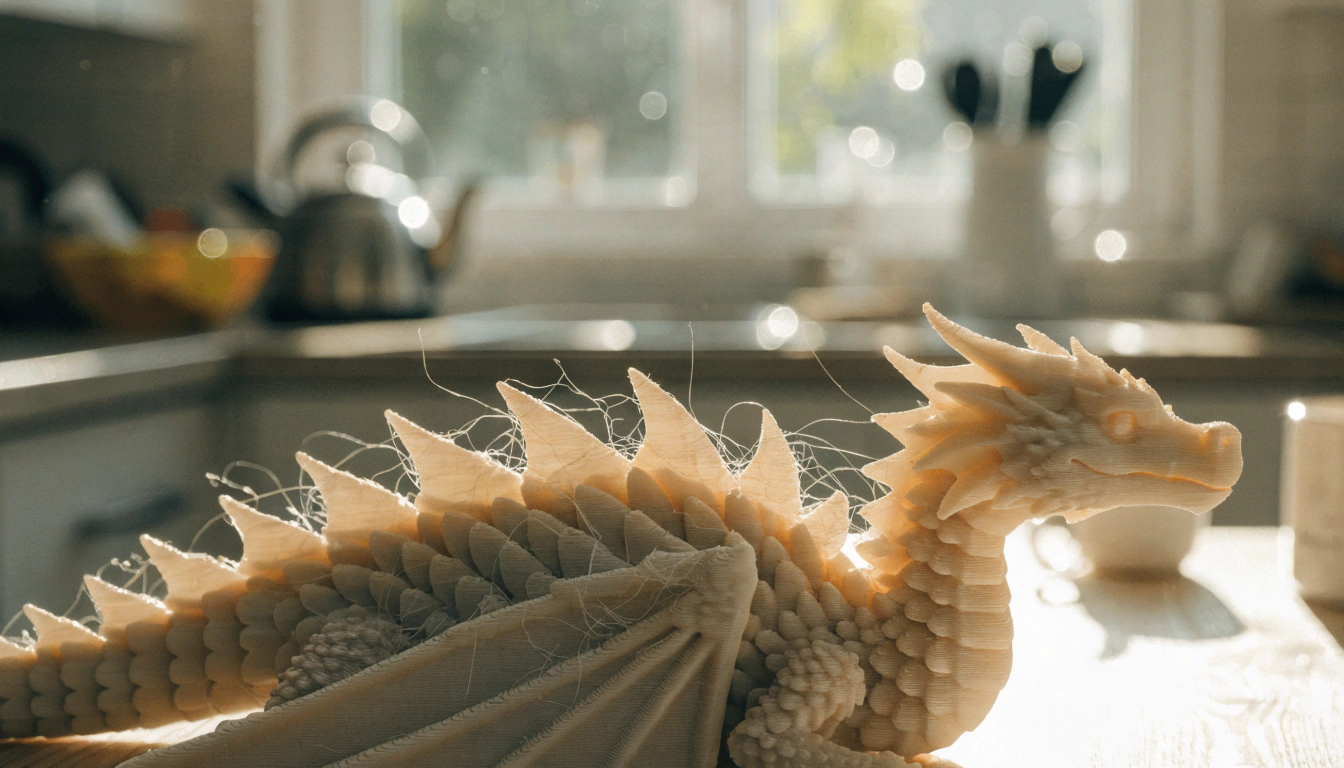
Cardboard has limits. Axles wobble, blades tear, and a good maze falls apart within a week. Printing only the part that keeps failing lets kids keep the craft and upgrade one piece.
The loop stays the same. Kids design a wheel or hub in an app, print it, paint it and run the same test. Version three comes out exactly as drawn, and version four is one edit away.
What Kids Can Print for Their Crafts
|
Craft |
Printed Part |
What It Fixes |
|
Rubber band car |
Matched wheels and axle clips |
Drift from uneven bottle caps |
|
Paper helicopter |
Weighted hubs in three sizes |
Guesswork with paperclips |
|
Marble maze |
Snap in walls and ramps |
Walls peeling off the cardboard |
|
Catapult |
Arm with a fixed pivot |
Pivot slipping between launches |
|
Wind turbine |
Blade sets at set angles |
Blades that are hard to cut identically |
A Good First Printer for Younger Makers
Families starting out usually want the parent's job to stay small. A guided toy-making printer for younger kids like the X-MAKER JOY fits that brief. It is fully enclosed, prints PLA only, and has one tap printing, auto leveling and a built in camera. The AOSEED app adds thousands of ready to print models and mini design apps for kids with no design background. AOSEED recommends it for ages 4 to 12.
|
WHICH AOSEED PRINTER FITS YOUR CHILD? • X-MAKER JOY: ages 4 to 12, 120 x 120 x 120 mm build area, PLA only, $239. • X-MAKER: ages 9 to 16, 150 x 150 x 150 mm build area, touchscreen, quiet motors under 50 dB, $359. Age fit, build size and project style are laid out side by side when you compare kids' 3D printers. |
STEM Crafts for Different Ages
Age Guide at a Glance
|
Age |
Try These |
Adult Role |
What to Measure |
|
3 to 5 |
Cup towers, cardboard ramps, sink or float boats, eggshell planters |
Building partner. Cuts every piece ahead of time |
Taller or shorter, faster or slower |
|
6 to 8 |
Paper helicopters, straw rockets, marble mazes, paper bridges |
Sets up, cuts thick card |
Counts, seconds, coins held |
|
9 to 12 |
Craft stick bridges, solar ovens, rubber band cars, paper circuits |
Safety check. Owns hot glue, blades and batteries |
Averages across trials, temperature, distance |
Preschoolers, Ages 3 to 5
Keep builds big and short. Ask small questions: which one is taller, and what happens if we tip the ramp? Talking matters more than writing it down. Skip coin cells, beads and small magnets.
Ages 6 to 8
Kids this age can follow three or four steps and keep a tally. Have them build two versions and say which worked better. The early grades engineering standard asks for that same comparison.
Ages 9 to 12
Older kids can handle more variables and real targets. Ask why they changed a design, not just which won. Three trials per design and an average make the comparison fairer.
When to Keep It Simple and When to Step Up
Keep It Simple When
• The child is under six or new to building
• You have 30 minutes or less
• The last attempt ended in tears
• The craft needs a blade, hot glue or a battery and no adult is free
Easier means parts cut ahead of time, two designs to choose from and a shorter goal. Keep the thinking with the child. Instead of fixing a wobbly tower, ask which part looks unstable.
Step Up the Challenge When
• The first design works on the first try
• Kids start asking "what if" without being prompted
• They compare numbers across trials on their own
• A cardboard part keeps failing and a printed part would let them test the real idea
Harder means a tighter limit, not longer instructions. Fewer sticks for the same load. One rubber band, a longer run.
Conclusion
The craft is the easy part. The learning shows up in versions two and three, when a child looks at a sagging bridge and picks which joint to fix. Paper, tape and craft sticks cover that ground for years.
When kids run out of cardboard ideas and start asking for parts they can design, AOSEED's family-friendly 3D printing platform carries the same build, decorate, test loop into printed toys and tools. The X-MAKER JOY is the simplest place to start at $239, with guided design apps and a fully enclosed build area.
FAQs
What Are Some Fun STEM Projects for Kids?
Paper helicopters, straw rockets, marble mazes, craft stick bridges, rubber band cars, egg drops, solar ovens and paper circuits are reliable picks. The fun comes from a result kids can measure and beat. A paper bridge holding six coins is mildly interesting. A tube bridge holding 40 gets kids hooked. Start with one material you have and give it a goal with a number in it.
What Are Some STEM Activities for Elementary Students That Take 30 Minutes?
Paper helicopters, index card towers, straw rockets, paper bridges and straw geometry shapes all fit in half an hour. Spend ten minutes building, ten testing and ten changing one thing and testing again. Save longer builds like marble mazes for two sessions. Lay out materials first and give one clear challenge, such as the tallest tower from ten index cards.
What Makes a Good STEM Project?
A clear problem, room for the child to make choices and a result you can measure. It should need real thinking without being so hard that an adult takes over. Limits matter: a fixed number of craft sticks and a target load make a bridge challenge work. Before starting, agree on what has to work, which materials are allowed and how you will test it.
What Are Some Fun and Easy STEM Activities for 5th Grade Students?
Bridge challenges, rubber band cars, egg drops, solar ovens, wind turbines, paper circuits and weather tools suit fifth graders. Give a fixed span, a set number of sticks and a target load. Students can sketch options, build prototypes and average several trials, which matches the grades 3 to 5 engineering standards. Require a second version with evidence for each change.
What Are Some Fun and Engaging STEM Projects for 4th Grade Students?
Straw roller coasters, paper bridges, catapults, rubber band cars, solar ovens and paper circuits all work. Fourth grade is the point to move from "does it work?" to "how well does it work?" A rubber band car or solar oven also fits the fourth grade standard on refining a device that converts energy. Give students a one row per trial table to compare numbers, not impressions.
What Are Some Fun and Engaging STEM Activities for Three Year Olds?
Cup and block towers, cardboard ramps for toy cars, sink or float tests, sorting by shape and planting beans work well. Keep materials large and sessions short. "Which ramp makes the car go faster?" is a full science lesson at this age. Avoid anything small enough to swallow, and keep batteries out of reach. Ask one short question and let the child show you the answer.
What Are Some Fun Activities for STEM Clubs?
Team challenges work best: bridge building, egg drops, marble mazes, tower races, rubber band cars and catapult target games. Give every team identical materials and one goal, such as 20 craft sticks to span a gap and hold the most weight. Teams see that one problem has several working answers. Keep a weekly build, test, record, redesign format and swap the challenge each time.
What Are Some STEM Hobbies?
Robotics, coding, electronics, model building, 3D design and printing, astronomy, gardening and math puzzles all grow from crafts. A child who loves paper circuits may like electronics. One who keeps redesigning bridges may enjoy engineering kits or designing parts to print. Watch which project your child returns to without being asked. That is the best clue for the next kit, club or hobby.





Further reading

Thanksgiving STEM Activities for Kids: Table Projects and Simple Engineering Challenges

Halloween STEM Activities for Kids: Spooky Builds That Teach Real Science
STEM Crafts for Kids: Build, Decorate and Test