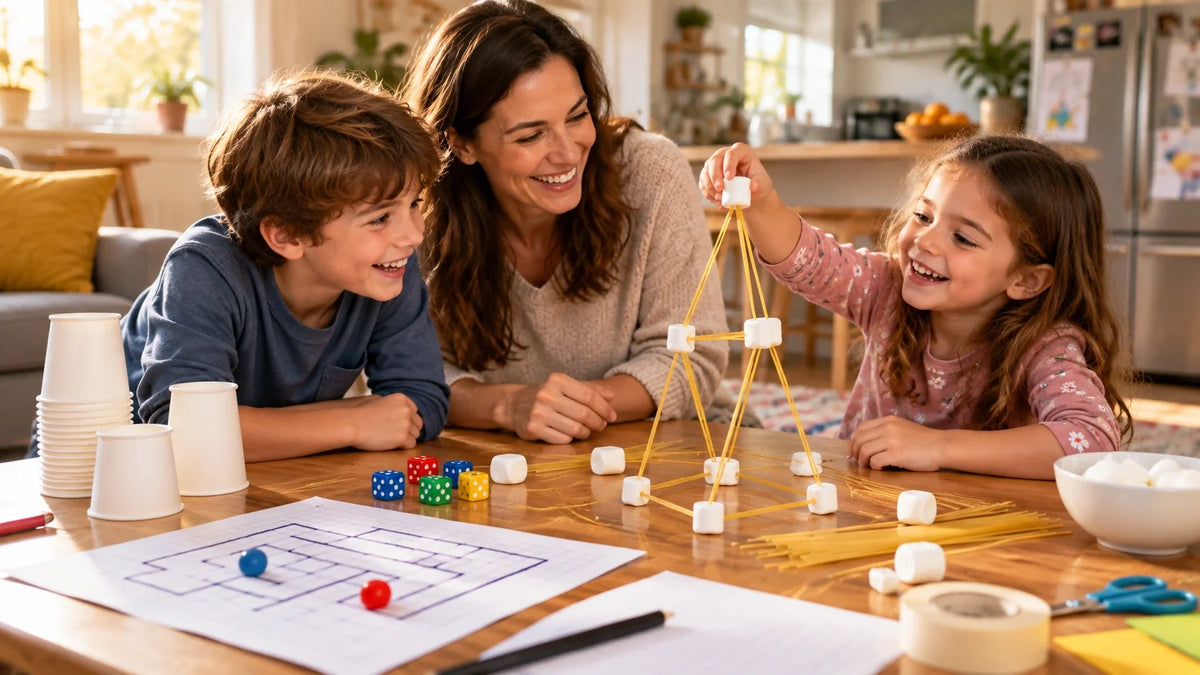
Thanksgiving STEM Activities for Kids: Table Projects and Simple Engineering Challenges
Thanksgiving dinner takes hours to cook. Most kids are bored within the first one.
A bag of cranberries, a box of toothpicks, a roll of foil and a few balloons can change that. Give those supplies one clear goal and they become bridges, boats and small science tests that fit on a kitchen or classroom table.
The projects below cover quiet table builds, engineering challenges, science experiments, and math or coding games. Each has a test built in, so a collapsed tower is information for the next try.
Quick Picks: Match the Activity to Your Day
|
Activity |
Ages |
Time |
Mess |
Main Skill |
|
Cranberry and toothpick structures |
5 to 11 |
15 to 20 min |
Low |
Geometry, stability |
|
Paper turkey balance |
5 to 9 |
10 to 15 min |
Low |
Center of mass |
|
Cranberry bridge |
8 to 14 |
20 to 30 min |
Low |
Load testing |
|
Foil Mayflower boat |
6 to 12 |
20 min |
Medium (water) |
Buoyancy |
|
Pumpkin volcano |
5 to 10 |
15 min |
High (foam) |
Chemical reactions |
|
Turkey balloon rocket |
7 to 14 |
20 min |
Low |
Force and motion |
|
Dinner budget challenge |
9 to 14 |
20 min |
None |
Money math |
|
Turkey coding game |
5 to 14 |
30 min or more |
None |
Sequencing, debugging |
What Makes a Thanksgiving Activity a STEM Activity?
A turkey theme alone is not enough. The activity needs a question to answer or a problem to solve.
"Build with cranberries" is free play. "Build a cranberry tower that stands for 30 seconds" is engineering, because kids now have something to measure and a reason to try again.
STEM Challenge vs. Craft vs. STEAM Project
|
Format |
What Kids Make |
How Success Is Judged |
Thanksgiving Example |
|
Craft |
A finished object |
It looks the way they planned |
Decorated paper turkey |
|
STEM challenge |
A design that has to work |
A measurable test |
Paper turkey that balances on a pencil tip |
|
STEAM project |
A working design with an art layer |
Test result plus design choices |
Balloon parade float that rolls 2 meters and is decorated like a float |
|
TIP Add one testable rule to any craft. Stand without support. Hold 10 pennies. Roll past a tape line. That single rule turns decoration into design. |
Thanksgiving STEM Table Projects for Kids
These six fit on one table and clean up in minutes. Put out only the materials for the current challenge.
1. Cranberry and Toothpick Structures

Kids push toothpicks into fresh cranberries to form triangles, squares, cubes and pyramids.
Then they press gently on each shape. Squares fold over. Triangles hold. That is why real bridges are full of triangles.
Level up: build a tower from exactly 20 toothpicks and see who gets the most height.
2. Candy Pumpkin Tower Challenge
Give every builder 25 candy pumpkins and one rule: the tower must stand alone for 10 seconds. Measure from the table to the top piece.
When a tower falls, ask where it failed first. Usually the base was too narrow.
Level up: limit the base to four pieces.
3. Paper Turkey Balance Challenge
Cut a cardstock turkey and try to balance it on a pencil eraser. It tips. Kids tape paper clips to the tail and slide them until it sits level.
That is center of mass, found by feel.
Level up: make the turkey balance on its beak.
4. Standing Place Card Challenge
Hand out index cards, tape and five craft sticks per person. Each place card must stand by itself and show a guest’s name clearly from across the table.
Level up: the card has to survive a gentle breeze from a paper fan.
5. Pie Fraction Challenge
Cut paper circles into halves, thirds, fourths and eighths. Call out orders such as "serve three fourths of a pie."
Kids combine pieces to check. The pieces either fill the circle or leave a gap.
Level up: fill one order using pieces from pies cut two different ways.
6. Gratitude Coding Cards
Write commands on index cards: step forward, turn left, name something you are thankful for.
One child lines the cards up as a program. Another follows it exactly. If it misses the target, the programmer swaps the wrong card.
That swap is debugging.
Simple Thanksgiving Engineering Challenges
Good engineering challenges have a goal, a limit and a test, but no single right answer.
TeachEngineering’s overview of the engineering design process lays out the ask, plan, build, test and improve loop for K to 12 classrooms. It fits a kitchen table just as well.
Build a Turkey Cage
Put a toy or paper turkey on the table. Kids build a cage around it from toothpicks, craft sticks, straws or modeling dough.
Set the rules first: the turkey fits inside, the cage has a roof, and each builder gets 20 pieces. Test by tilting the table or trying to lift the turkey out.
Cranberry Bridge Challenge

Place two books 15 cm apart. Kids bridge the gap with cranberries and toothpicks, then add pennies to the center one at a time.
Record the count when it sags. Reinforce only the spot that failed, and log each trial.
Sample Record Sheet (example entries)
|
Trial |
Change Made |
Pennies Held |
Where It Failed |
|
1 |
Flat span, no triangles |
6 |
Middle sagged |
|
2 |
Added triangles along both sides |
14 |
Left end joint pulled out |
|
3 |
Doubled toothpicks at both end joints |
22 |
Still standing at 22 |
Pumpkin Catapult Challenge
Bind stacked craft sticks with rubber bands and add a plastic spoon. Kids launch pom poms or candy pumpkins at a bowl.
Change one thing per round, such as the fulcrum position, and compare distance.
|
SAFETY Aim at an empty wall or a target on the floor, never at faces or the dinner table. Soft, light projectiles only. |
Floating Mayflower Boat Challenge

Each builder shapes a boat from a 30 cm square of foil, floats it in a tub, and adds pennies until water spills in.
Wide, flat hulls usually carry more. Kids tend to find that out on boat two.
Turkey Balloon Rocket and Parade Float
Thread string through a straw and tie it tight between two chairs. Tape an inflated balloon to the straw, add a paper turkey, and let go. Measure the distance.
For the parade version, mount the balloon on a small cardboard car with bottle cap wheels. Straight wheels matter more than big balloons. Average three runs, since one can be a fluke.
Thanksgiving Science Experiments for Kids
Ask for a prediction before every test and write it down. Compare it with the result afterward.
Pumpkin Volcano

Put two tablespoons of baking soda in a small hollow pumpkin on a tray and pour in half a cup of vinegar. The bubbling is carbon dioxide.
To make it an experiment, change only the baking soda between rounds. The American Chemical Society lesson on reaction amounts shows why the foam stops growing once one ingredient runs out.
Dish soap makes taller foam, but it adds a second variable. Leave it out while comparing amounts.
Cranberry Float Test
Drop fresh cranberries into a clear bowl of water. Most float because of small air pockets inside, which is also why growers flood the bogs at harvest, as The Conversation’s piece on cranberry science explains.
Add a grape and a raisin. Kids predict each one, then fill in a float or sink column.
Butter in a Jar
Fill a jar one third full with heavy cream, seal it and shake. It turns whipped, then solid, leaving butter in thin buttermilk.
Time each stage. Two jars shaken two different ways make a fair comparison.
Leaf Chromatography
Tear colorful leaves into small pieces, cover them with a little rubbing alcohol in a jar, and stand a coffee filter strip in the liquid. Within an hour, bands of pigment creep up the paper.
Red and yellow leaves often show different bands than green ones.
|
SAFETY Rubbing alcohol is flammable. An adult handles it, the jar stays away from stoves and candles, and this experiment belongs on a planned science day rather than the busy holiday table. |
Thanksgiving Math and Coding Activities
No water, no foam. Math and coding games run quietly and scale well across ages.
Thanksgiving Dinner Budget Challenge
Hand kids a menu with prices and a spending limit. They plan one main dish, three sides and one dessert without going over.
Sample Menu (practice prices)
|
Item |
Price |
Item |
Price |
|
Turkey (12 lb) |
$24.00 |
Stuffing |
$5.75 |
|
Mashed potatoes |
$6.50 |
Cranberry sauce |
$3.50 |
|
Green bean casserole |
$7.25 |
Dinner rolls |
$4.25 |
|
Pumpkin pie |
$9.00 |
Apple pie |
$11.00 |
Use a $50 limit for younger kids. Older kids can add 8% sales tax or work out the cost per guest for a table of eight.
Turkey Feather Patterns
Arrange colored paper feathers around a turkey body in a repeating pattern, such as red, red, yellow, blue. Kids name the next feather.
Older kids write numbers on the feathers (3, 6, 12, 24), find the rule, then build a pattern for someone else.
Code a Turkey Game

ScratchJr, a free coding app built for ages 5 to 7, is a gentle start, and older kids can move up to Scratch. A turkey that dodges a farmer makes a good first game.
Get one action working before adding the next. When something breaks, the bug sits in one block. Finding it is the lesson.
Thanksgiving STEM Scavenger Hunt
Each clue needs a small task first: find something longer than 30 cm, finish a number pattern, decode a simple cipher. In groups, rotate who solves each clue.
Thanksgiving STEM Activities by Age
Age is only a starting point. Reading level, patience and hand control matter too.
|
Ages |
Start With |
Adult Role |
Make It Harder |
|
5 to 7 |
Cranberry shapes, paper turkey balance, sink or float, feather patterns |
Cutting, water, small pieces |
Add one rule, such as a height target |
|
8 to 11 |
Cranberry bridge, foil boats, balloon rockets, budget challenge |
Setup and safety checks |
Limit materials, record three trials |
|
12 to 14 |
Controlled experiments, coding games, parade float tuning |
Chemicals and heat only |
Graph results, average repeated trials |
Mixed ages? Same project, different rules. The six year old builds any bridge; the eleven year old builds one that holds 20 pennies.
How to Turn Any Thanksgiving Activity Into a STEM Challenge
The same five steps work for every project here. Science Buddies breaks the design process into more detailed steps; this is the kitchen table version.
1. Set the goal. Write it down: "Bridge spans 15 cm and holds 10 pennies."
2. Predict. Ask what will happen and why. Wrong guesses are fine.
3. Build a rough first version. It only has to be testable.
4. Measure and record. Height, distance, pennies, seconds. One line per trial.
5. Change one thing and test again. Compare the new result against the first.
|
TIP Resist fixing a wobbly tower for them. Ask "Which part moved first?" and let them choose the next change. |
Take the Challenge Further With a 3D Printed Thanksgiving Project
Paper and cranberries get kids to a first design. A 3D printer lets them make it exact, test it and print version two.
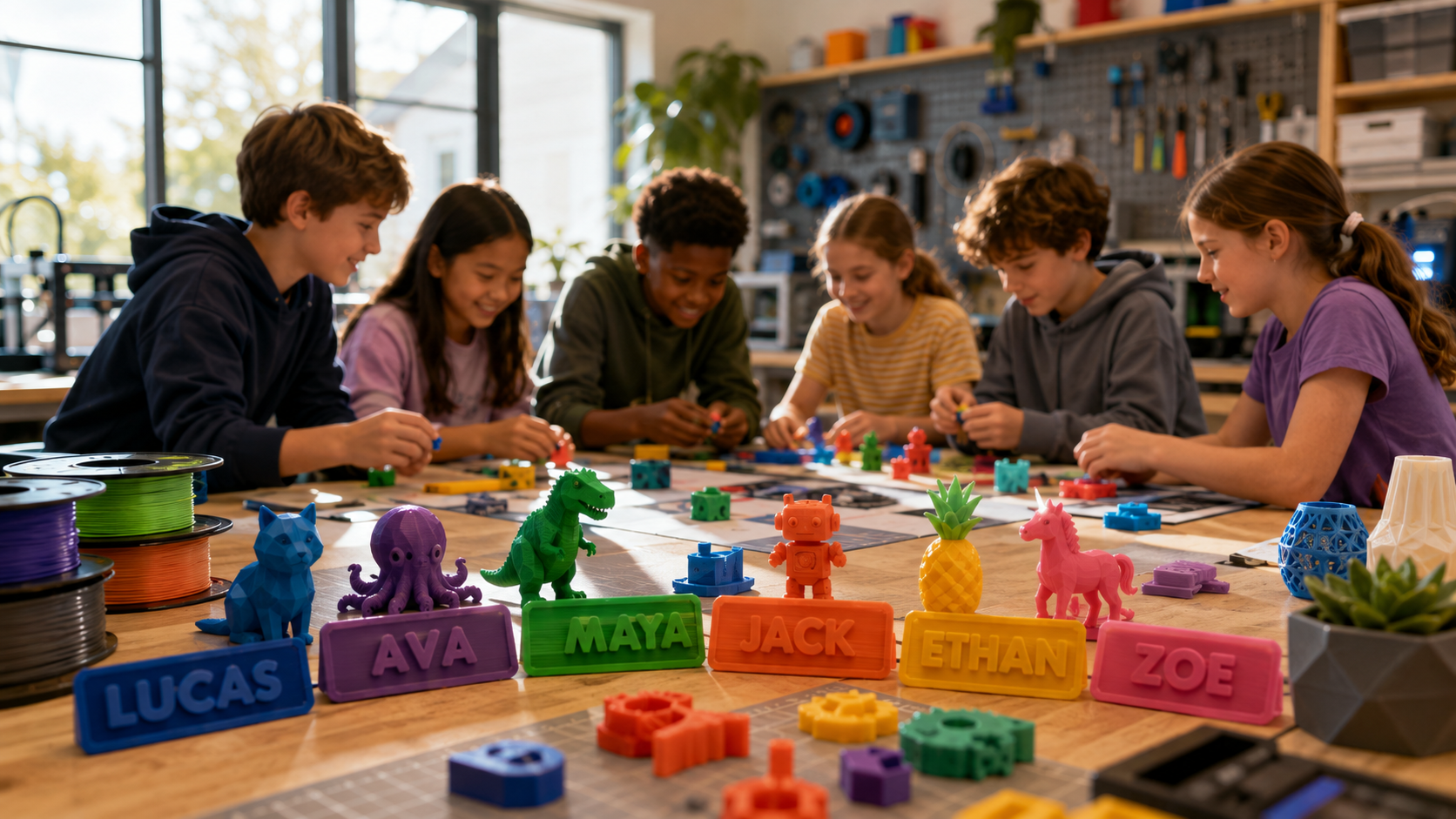
Take a turkey place card holder. The child designs it in an app, prints it, and checks that a card stands in the slot. Too loose? Edit and print again. The finished piece stays on the table for dinner.
For families just starting, a guided toy making printer for younger kids such as the AOSEED X-MAKER JOY keeps the parent’s job small. The build area is fully enclosed, kids print from a tablet app, and the model library holds thousands of ready designs with weekly updates. The product page lists a recommended age of 4 to 12.
Printed projects that match this guide:
• Place card holders with each guest’s name raised on the front
• Pie fraction pieces that fit together into one full circle
• Two boat hulls in different shapes for the float test
• Turkey game pieces for a gratitude board game
X-MAKER JOY vs. X-MAKER at a Glance (checked on the live product pages, September 28, 2026)
|
Feature |
X-MAKER JOY |
X-MAKER |
|
Recommended age |
4 to 12 |
9 to 16 |
|
Build volume |
120 x 120 x 120 mm |
150 x 150 x 150 mm |
|
Design tools |
16 mini design modules plus 2 premium design modules |
15+ in app design games plus advanced design tools |
|
How kids print |
One tap from the AOSEED app |
App, touchscreen, or SD/USB |
|
Monitoring |
Built in camera |
Built in camera |
|
Price |
$239 (listed at $339) |
$359 (listed at $509) |
|
Best fit |
First projects, younger kids |
Bigger builds, older kids, STEM classes |
|
NOT SURE WHICH MODEL FITS YOUR CHILD? SEE AOSEED’S 3D PRINTERS FOR KIDS SIDE BY SIDE, WITH AGE FIT, BUILD SIZE AND PROJECT STYLE FOR HOME OR SCHOOL. |
How to Set Up Thanksgiving STEM at Home or School
Ten minutes of prep before guests arrive saves an hour of cleanup.
|
Setup Step |
Why It Helps |
|
Sort supplies into small bowls |
Kids see their options without spreading materials across the room |
|
Cover the table for water or foam |
Cleanup takes minutes instead of an hour |
|
Post one challenge on a card |
"Tower 30 cm tall, 20 pieces or fewer" keeps the group focused |
|
Keep test food apart from serving food |
Nobody eats a cranberry from the float test |
|
Leave a clear testing zone |
Towers and boats get measured without being bumped |
|
Rotate roles in groups |
Builder, measurer, recorder and materials manager all get a turn |
|
SMALL PARTS Cranberries, candy pumpkins, pennies and uninflated balloons are choking hazards for children under 3. If toddlers are around, keep supplies off low surfaces. The U.S. Consumer Product Safety Commission’s small parts guidance explains why that age group is treated separately. |
On the day itself, pick dry builds. Save water and foam for the weekend after.
When to Choose a Table Project and When to Add 3D Printing
Choose a table project when:
• The kitchen is busy and you need something quiet for 15 to 20 minutes
• Kids of mixed ages are sharing one set of materials
• Grandparents and cousins want to build at the same time
• You want a quick test, not an object to keep
Add a 3D printed project when:
• Your child keeps redesigning the same idea and wants it exact
• You want a keepsake from the day, like named place card holders
• The paper version breaks before it can be tested properly
• The holiday break is long enough to design one day and print the next
Conclusion
Thanksgiving STEM does not need a kit. Cranberries, foil, toothpicks and a clear goal get kids predicting, measuring and rebuilding.
Pick one project that fits your child’s age, then run it twice. The second attempt is where most of the learning happens.
When a paper design is ready to become something a child can hold, AOSEED’s toy creation platform for families adds a printed round to the same challenge. The X-MAKER JOY is currently $239, with the guided app and model library included.
FAQs
What Are Some STEM Activities for Thanksgiving?
Cranberry and toothpick structures, pumpkin volcanoes, foil boat tests, turkey balloon rockets and paper turkey balancing. Each pairs a holiday theme with something kids can measure.
The test is what makes it STEM. A cranberry bridge becomes engineering once kids count the pennies it holds. A pumpkin volcano becomes chemistry once they change the baking soda and compare the foam.
Start with one activity that uses supplies you already have, and give it a single number to beat.
What Are Some Fun Thanksgiving Activities for Kids?
Turkey cages, balloon races, standing place cards, scavenger hunts and boat challenges. Kids like a clear goal and a quick result.
Younger children do best with short, visual challenges, like balancing a paper turkey on a pencil. Older kids enjoy limits: 20 toothpicks only, a $50 dinner budget, or a race judged on three runs.
Set up an activity corner before cooking starts so kids have somewhere to go.
What Are Some STEM Activities for November?
Leaf chromatography, cranberry float tests, pumpkin catapults, butter in a jar and parade float builds. The season supplies most of the materials.
Fall leaves introduce pigments. Cranberries work as building connectors one day and float test objects the next. The parade theme leads into wheels, balloons and friction.
For a month of activities, rotate weekly between a science experiment, an engineering build, a math game and a coding project.
What’s a Fun Thanksgiving Game?
A STEM scavenger hunt. It works for families, cousins and whole classrooms.
Each clue asks for a small task before it reveals the next spot, such as finding something longer than 30 cm or finishing a number pattern. Teams solve together, so kids with different skill levels all contribute. The prize can be first pick of dessert.
Walk the route yourself first. Five or six clues is plenty.
What Are Some Easy Thanksgiving Crafts for Kids?
Paper turkeys, gratitude cards, place cards, paper pies and leaf decorations. All take basic supplies and under 30 minutes.
Any of these becomes STEM with one working rule. The place card must stand without support. The turkey must balance on one foot. The pie must split into equal eighths that fit back together.
Add one testable requirement instead of handing out steps to copy.
What Are Some Fun Gratitude Games to Play on Thanksgiving?
Thankful charades, a gratitude guessing game, a thankful scavenger hunt and gratitude coding cards.
Coding cards add a STEM twist. Kids arrange command cards into a path, and one card says "name something you are thankful for." A second child follows the program. If it goes off course, the group fixes the faulty card and runs it again.
Keep each round under five minutes so everyone gets a turn before dinner.
What Are Some Fun Activities for Thanksgiving Day at School?
Cranberry engineering, turkey tower challenges, pie fractions, balloon vehicles, budget problems and coding projects. Each fits one class period.
Small teams work best. Give every team the same materials and goal, then ask for a written prediction, three recorded trials and a short note on what changed between versions. Rotate builder, measurer and recorder roles.
Choose low mess projects so setup and cleanup take under ten minutes.
What Kinds of Activities Are Commonly Seen on Thanksgiving?
Cooking together, the parade, football, crafts, gratitude circles and games. STEM projects slot in between them.
Many traditions already hold STEM ideas. Baking is measuring and chemistry. Parade balloons are an engineering problem. A butter jar or cranberry float test takes ten minutes and uses kitchen supplies.
Pick one tradition your family enjoys and add a single question kids can test.



Further reading
Thanksgiving STEM Activities for Kids: Table Projects and Simple Engineering Challenges

Halloween STEM Activities for Kids: Spooky Builds That Teach Real Science

STEM Crafts for Kids: Build, Decorate and Test