7 Best Spool Holders for Multiple Filament Rolls That Stay Put
A spool holder looks like the least interesting part of a 3D printing setup. It is also the part that decides whether a long print finishes. The extruder pulls filament in small tugs, thousands of times an hour, and every one of those tugs tries to drag the holder across the desk. One roll can get away with a cheap stand. Four rolls cannot.
Once several spools share a bench, three problems show up together. Holders creep. Rolls rub. Loose filament drops over the edge of a flange and knots. None of that is exotic. It is what happens when a light plastic frame is asked to hold two kilograms of plastic still.
Below are seven holder styles that hold their position, what each one is actually good at, and how to tell which one fits the printers you already own.
|
If your main problem is… |
Pick this holder style |
Why it works |
|
One or two rolls feeding at once |
Independent roller stands |
Cheap, easy to reposition, and each spool turns on its own bearings. |
|
Rolls from four different brands |
Universal adjustable holder |
Arms and rollers move to match odd widths and diameters. |
|
Twenty rolls and no floor space |
Multi-tier storage rack |
Vertical frame, gravity-anchored, but treat it as storage and not as a feed station. |
|
A collection that keeps growing |
Modular interlocking holder |
Add one unit at a time. Linked bases behave like one heavier block. |
|
A humid room or a roll that stays loaded for weeks |
Dry-box holder |
Sealed enclosure with desiccant, and the spool still turns inside it. |
|
A desk with nothing left on it |
Wall or hanging mount |
Moves the weight off the work surface. Needs real wall hardware. |
|
Constant filament swaps and slack |
Auto-rewind holder |
Takes up loose filament when tension drops, at the cost of more moving parts. |
Review Method and Fast Verdicts
This review compares holder architectures rather than temporary marketplace rankings. Each type is judged on loaded stability, startup resistance, controlled coast, spool-size range, feed-path alignment, desk or wall space, moisture protection, and what happens when several rolls are installed at once.
Independent roller stand: best for mixed hub sizes and easy expansion; weakest when lightweight stands sit loose on a smooth desk.
Universal adjustable holder: best for households that buy several spool formats; verify both adjustment range and loaded weight rating.
Multi-tier rack: best for compact storage; use a separate feed position unless each active spool has independent clearance and a clean filament path.
Modular interlocking holder: best for a growing two- or three-printer bench; linked bases improve stability, but connection strength and roll spacing still need testing.
Dry-box holder: best for moisture-sensitive or rarely used materials; only earns the name when the enclosure seals, the spool turns freely inside it, and humidity control can be maintained.
Wall-mounted holder: best when desk space is the limiting factor and the structure can carry the full loaded weight; weakest for renters, changing layouts, or long angled feed paths.
Auto-rewind holder: best for workflows with repeated unloading or multi-material retraction; adds the most setup and can create feed resistance if the clutch or spring is poorly tuned.
Overall verdict: for most family desks, a low independent roller or a linked modular stand is the easiest design to understand and test. Choose a dry-box holder when storage humidity is the real problem, and a rewind mechanism only when slack is a repeated, observed failure.
What Makes a Spool Holder Stay Put

Three things keep a holder in place. Grip. Mass. A feed path that does not pull sideways. Get those right and the holder style matters far less than the marketing suggests.
A base that resists the pull
A full one-kilogram roll on a smooth desk is a sled waiting for a reason to move. The reason arrives every time the extruder retracts. Silicone pads and rubber feet raise friction cheaply, and they cost nothing in shelf space. Extra base weight does the same job by a different route, which helps when the holder has to be narrow but still carry a wide spool. Keep the centre of gravity low. A tall narrow stand under a heavy roll tips before it slides. Low and wide wins.
Placement is the other half. If the spool sits far to one side of the printer, the filament leaves the roll at an angle and pulls the holder in that direction all day. Move the holder. Not the printer.
Bearings that turn without fighting back
Bearings and rollers exist to lower the force needed to start a spool turning. That matters more than it sounds. A stiff bearing makes the roll rotate in small jerks instead of moving steadily. The extruder feels every jerk as a change in resistance. You can often hear it.
New bearings often feel tight. A drop of light lubricant usually fixes it. Covered bearings stay smoother for longer because the covers keep dust and oxidation off the rolling surfaces. Frictionless is not the goal. Some drag helps. A very smooth heavy spool will keep turning after the printer stops pulling, and that is how loops end up on the floor.
Room for the widest roll you own
Spools are not standard. Outer diameter, width and centre-hole size all vary between brands, and a holder sized around one 1 kg roll may not close around another. Roller designs are more forgiving here because the spool rests on its outer rim rather than on a fixed shaft. Width still matters. The rollers need to sit far enough apart to carry the spool without touching its sides.
Measure before you buy. Widest roll, largest diameter, heaviest loaded weight. Three numbers, two minutes.
|
THE ONE MEASUREMENT PEOPLE SKIP Weigh the roll, do not guess it. Ten full 1 kg spools on one shelf is about 10 kg of plastic before the spools themselves are counted, and shelf ratings are quoted per shelf rather than per rack. |
On an enclosed printer the calculation changes again, because the spool sits in a compartment that was designed around it. For families printing with a machine that already has a filament bay, a holder built to match the printer it feeds removes the guesswork about diameter, width and feed angle in one step. There is nothing to align and nothing to weigh down.
The 7 Best Spool Holder Types for Multiple Rolls

These are styles. Not products. Styles outlast SKUs, and the reason a holder works is the same whether it cost eight dollars or eighty.
1. Independent roller stands
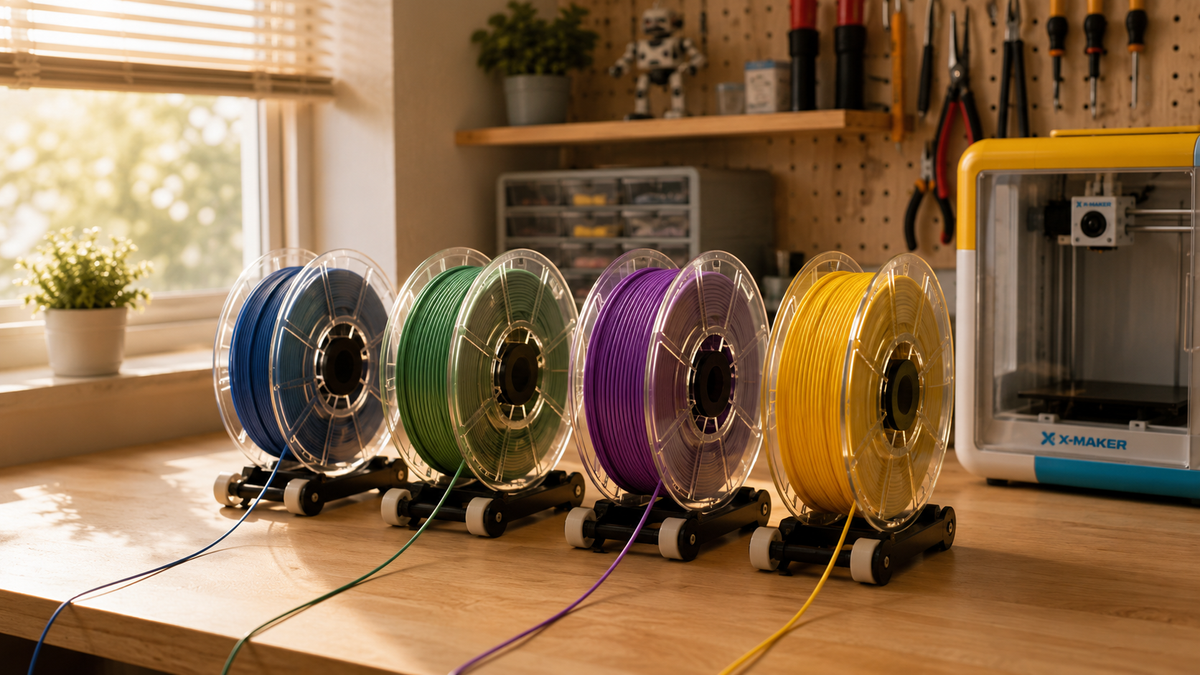
Each spool sits on a pair of low supports and turns on rollers under its outer rim. Nothing threads through the centre hole. Hub size stops mattering. Two supports can slide closer together or further apart to match the roll.
They are the easiest style to expand and the easiest to move. That is also the weakness. Space is the cost. Separate stands eat desk space as the count climbs, and a light pair will walk across a smooth table unless the pads grip properly. Align neighbouring stands so the rolls cannot bump.
2. Universal adjustable holders
Built around the idea that your spools will not match. Sliding brackets or movable rollers cover a range of widths, and metal frames handle heavier rolls than a light printed stand designed for 500 g spools. Some sit on the desk with non-slip feet. Others bolt on.
Read the adjustment range instead of the word universal. Fit and rating differ. Check the weight rating separately from the physical fit, because a holder that closes around a 3 kg spool is not necessarily rated to carry one. Mounting to the printer saves desk space but moves that load onto the machine frame.
3. Multi-tier storage racks
A vertical frame that organises a large collection in a small footprint. Capacity depends on shelf length and how wide your spools are, so the advertised roll count drops as soon as you load wider rolls. Crossbars, broad feet and adjustable levelling feet are what stop a tall rack from leaning as the weight shifts. Heavy rolls go low.
One caution. A rack is storage. Rolls sitting shoulder to shoulder on a shelf cannot rotate cleanly, and a spool that rubs its neighbour is a feeding problem waiting to happen. Keep the printing roll on its own holder.
4. Modular interlocking holders
Separate units with tabs or slots that clip to the unit beside them. Start with one. Add another when a second printer or a second colour arrives. Linked bases are much harder to slide than the same number of loose stands, which is the real benefit, and spacing stays consistent so rolls do not drift into each other.
Layouts can change later. A straight row behind two printers, or two separate groups serving machines on opposite sides of a table. A fixed rack cannot do that once it is built.
5. Dry-box holders
The spool sits inside a closed container and feeds out through a small port, so storage and printing happen in the same place. That saves a step. Internal rollers let it turn. A desiccant compartment pulls moisture out of the enclosed volume, and some designs add a humidity meter so you can read conditions without opening the lid.
The seal is the whole product. A lid resting on an ordinary holder is not a dry box. Desiccant only holds its level inside a genuinely sealed enclosure, and it has to be reconditioned once it stops working, which is exactly the constraint the National Park Service sets out in its guidance on using silica gel in sealed microenvironments. Check side clearance too. A spool that scrapes the wall of the box has traded one drag problem for another.
6. Wall-mounted and hanging holders
Moving spools onto a wall frees the surface around the printer and keeps colours visible. The mount then carries everything. A full roll weighs several times what an empty one does, and a six-spool rail carries several kilograms when it is loaded, so the wall, the bracket and the fasteners all have to take that.
Two details get missed. The axle needs an end stop or clip so a roll cannot slide off, which matters more when the holder hangs above equipment. And a high mount set far from the printer creates a sharp sideways turn in the filament path, which raises resistance rather than lowering it. Renters, and anyone who moves printers around, are usually better off on the desk.
7. Auto-rewind holders
These apply a small backward force that turns the spool when tension drops. A printed spring, a clutch or a gravity mechanism does the work. Slack is the enemy. The point is to swallow it when filament unloads, before it falls over the flange and locks under a coil.
Worth it in a workflow with constant material changes. Less worth it otherwise. More moving parts means more setup, and springs, clutches and sliding components can wear or need adjusting. The mechanism also has to let the printer pull forward without adding resistance, which is the tradeoff the simpler styles never have to make.
|
Holder style |
Stays put because |
Fits mixed spools |
Main cost |
|
Independent roller stands |
Silicone pads and low profile |
Yes, rests on outer rim |
Desk space as count grows |
|
Universal adjustable |
Non-slip feet or frame mounting |
Yes, within a stated range |
Load moves to printer if mounted |
|
Multi-tier rack |
Mass, wide feet, rigid frame |
Partly, capacity drops with width |
Storage first, feeding second |
|
Modular interlocking |
Linked bases act as one block |
Yes, spacing is adjustable |
Needs matching modules |
|
Dry box |
Weight of the sealed enclosure |
Limited by internal clearance |
Desiccant upkeep |
|
Wall or hanging |
Fixed to structure, not the desk |
Depends on axle fit |
Mounting strength, feed angle |
|
Auto-rewind |
Usually a heavier frame |
Varies by design |
Complexity and maintenance |
A 10-Minute Bench Test for Any Holder
1. Load the Heaviest Real Spool
Test with the fullest and widest spool the holder is expected to carry, not an empty reel. Confirm that the base sits flat, the axle or rollers support the spool without side contact, and any wall or frame mount shows no flex at the fasteners.
2. Pull Through the Complete Feed Path
Route filament exactly as the printer will use it, then pull slowly from the inlet side. Watch whether the holder slides, lifts, twists, or tips. Sideways movement usually means the exit path is misaligned; sudden movement points to a catch, excess bearing resistance, a damaged spool edge, or a guide bend that is too tight.
3. Check Startup and Coast
Mark the spool edge and make several short pulls. The roll should begin turning without a sharp jerk and stop without releasing a large loop. Very low bearing friction can be a disadvantage when a heavy spool keeps rotating after the extruder stops. Add only enough controlled drag or guidance to prevent slack without increasing feed load.
4. Test Every Neighbor Position
Load adjacent rolls and repeat the pull from each active position. Check that flanges cannot touch, strands cannot cross, and removing one spool does not disturb another. A rack that is stable with one center roll may lean or rack when the outer positions are loaded unevenly.
5. Simulate a Long Print
Pull several meters in short, irregular increments while watching feet, joints, axles, guides, and spool alignment. You are looking for cumulative creep, loosening, heat from friction, or a path that slowly walks toward a flange. Correct those issues before trusting the holder with an overnight or classroom job.
Pass standard: the holder remains in place, rotation starts smoothly, slack stays controlled, no neighbouring spool moves, and the filament reaches the inlet without scraping or a sharp bend.
Why Stability Matters More Once Several Rolls Share a Desk
A holder is part of the feed system. It is not furniture. If it slides, rocks or changes resistance while the spool turns, the extruder has to absorb that movement.
Sliding
Light holders creep toward the printer as filament is pulled. Each tug moves them a fraction of a millimetre. Fractions add up. Over a six-hour print that becomes a changed feed path, and eventually to a holder sitting somewhere it interferes with a cable, a door or the roll beside it.
Wobble
A poorly supported spool rocks side to side as it rotates. The filament then leaves the roll at a changing angle. Fit fixes it. Wide rollers, or an axle that actually matches the centre hole, take most of that out.
Sudden tension
A spool that catches on its own frame builds tension until the printer pulls hard enough to break it free. Then it releases. Labels, cardboard edges and side flanges are the usual culprits, and all three are easy to check by hand before a print starts. Turn the roll a full revolution. If you feel a catch, find it now.
|
THE PART OF THE SETUP A HOLDER CANNOT FIX Filament handling sits next to hot hardware. Washington State's Department of Health tells schools to select a fully enclosed printer for protection from particulate, chemical and physical hazards, and its guidance also notes that PLA typically has the lowest particle emission rate of the common filaments and prints at a low temperature without a heated bed. A tidy spool station does not change any of that. Keep hands off the nozzle and the bed, and let a finished print cool before anyone reaches for it. |
Bearings or a Plain Axle
Both work. The choice comes down to spool weight, how far the roll sits from the extruder, and how much free rotation you actually want.
|
Bearing rollers |
Fixed axle |
|
|
How the spool turns |
On its outer rim, over rolling bearings |
Around a shaft through the centre hole |
|
Best with |
Heavy rolls, long feed distances, mixed brands |
Consistent spool sizes, short feed paths |
|
Centre-hole mismatch |
Not an issue |
Can be a hard blocker |
|
Free-spin risk |
Higher on smooth heavy spools |
Lower, mild friction is built in |
|
Upkeep |
Clean or lubricate when rotation roughens |
Almost none |
|
Home-built difficulty |
Needs standard bearings |
Easiest thing to print or build |
One roller turning differently from the others is worth investigating before you blame the printer for feeding resistance. Usually a bearing. Usually cheap.
How to Stop Tangles in a Multi-Roll Station

No holder prevents every tangle. Most knots trace back to a loose end rather than to the hardware. Habits, not purchases.
- Secure the free end every single time. Use the holes or clips on the spool, and never let the end pass underneath another coil.
- Give neighbouring rolls enough space to rotate without touching, and keep their filament paths separate. A simple divider does the job.
- Avoid sharp bends. Reposition the holder or add a smooth guide rather than forcing the strand around a tight corner.
- Use a guide where side pull is the problem. A loop, a roller or a short length of tubing controls where the strand travels after it leaves the spool.
- Wind slack back under control during unloading. Several feet of filament lying beside the spool is a knot in about ten seconds.
Align the spool so filament travels toward the extruder without scraping hard against a flange. Poor alignment makes the strand jump from one side of the roll to the other. Crossed coils start there.
How to Load Filament From a Spool Holder

Loading starts before the filament reaches the extruder. Direction matters most. Free movement does the rest.
- Place the spool so it unwinds naturally toward the printer, rather than around the outside of a flange.
- Turn the roll a full turn by hand. It should move without scraping. Mild resistance is fine, sticking is not.
- Route the strand through any guide, eyelet or PTFE path your setup uses, keeping every bend broad.
- Feed the filament in using the printer’s normal load procedure, keeping light control of the spool so a large loop cannot unwind at once.
- Watch the spool while it loads. The roll should start turning without the holder sliding or lifting.
- Extrude a small amount before starting a long job, and watch the rotation once more.
If loading feels unusually hard, check the spool, the guide and the tube before touching extruder settings. A smooth feed now is far easier to fix than a resistance problem four hours into a print.
Storing the Rolls You Are Not Printing With
An open holder is built for feeding, not for protection. Filament left on it sits in whatever the room is doing. Seasons change the air.
This is measurable rather than folklore. Researchers conditioned twelve common filament types at relative humidity from 16% to 97% and sorted them into low, moderate and high moisture sensitivity, with the high group losing more than 10% of their stiffness and strength, in a study of moisture sorption in 3D printing filaments. A separate analysis of filament moisture and tensile properties recorded roughly a 20% drop in tensile strength for one moisture-sensitive PLA grade after conditioning. PLA sits nearer the calm end of that range than nylon does. It is not immune.
The split is simple. Feed from a good holder, store everything else sealed.
- Put unused rolls in sealed bags or airtight containers, with the container big enough that a spool edge cannot damage the seal.
- Keep desiccant inside the sealed space, not sitting next to an open spool, and recondition or replace it when it stops holding.
- Label open rolls with material, colour and the date you opened them. Similar-looking spools get confused fast.
- Take a roll off an open holder if it will sit unused for weeks. A dry-box holder can stay loaded longer because storage and feeding share one enclosure.
A dry box slows how quickly filament takes on moisture. Slowing is not drying. It will not reverse a roll that has already absorbed it.
|
AOSEED BUILDS THE OTHER END OF THIS PROBLEM: THE SPOOL LIVES INSIDE THE CASE, THE FEED PATH IS SET AT THE FACTORY, AND THERE IS NOTHING ON THE DESK TO SLIDE. SEE THE KIDS 3D PRINTERS THAT KEEP THE SPOOL INSIDE THE CASE. |
Layout Review for Two, Four, and Six Rolls
Two Rolls: Keep the Paths Obvious
Place one holder behind or beside each printer so the strand leaves each roll toward its own inlet. If one printer uses both rolls, separate the paths with guides and leave enough space to change either spool without crossing the other strand. Two independent low stands are often easier to troubleshoot than one oversized rack.
Four Rolls: Group by Printer, Not by Color
Create two physical groups if two printers share the bench. Interlocking bases or a weighted rail keep positions consistent. Put the most frequently changed roll where it can be removed without reaching over another machine, and keep unused moisture-sensitive material sealed rather than displaying every color on an open rack.
Six or More Rolls: Separate Storage From Feeding
A vertical rack can organize the collection, but active feeding needs independent rotation and a predictable route. Use a dedicated feed position, dry-box positions, or a purpose-built multi-material system approved for the printer. Do not assume a shelf becomes a six-roll feeder simply because six spools fit on it.
Shared Family or Classroom Bench
Label each path and holder position, keep heavy rolls low, secure wall-mounted systems to an appropriate structure, and define who may reload or move the station. A design that is compact but difficult to inspect will create more crossed strands and accidental pulls when several users share it.
Layout verdict: minimize direction changes between spool and inlet. Stable hardware cannot compensate for a long diagonal pull, crowded flanges, or users who must thread filament through another printer's work area.
When to Buy a Holder and When to Print One
Both routes work. A spool holder is one of the more sensible things to make on a printer you already own. The decision is about load, time and how much fiddling you enjoy.
Buy one when:
- Your printer has a dedicated filament bay, and a matched part removes every fit question at once.
- You need it working today, not after a nine-hour print and an assembly session.
- The rolls are heavy, or the holder has to mount to a frame or a wall where a printed bracket is carrying real load.
- You want moisture control, since a genuine seal and a desiccant tray are hard to reproduce at home.
Print one when:
- You are running standard 1 kg rolls on a desk and the base can be made wide enough to sit still.
- The collection grows in ones, and you would rather add a module than replace a rack.
- You want a specific layout that nothing sold off the shelf matches.
- The build itself is the point. It is a good first functional project for an older child, and a failed test costs a few grams.
|
IF YOU PRINT YOUR OWN, TEST IT LOADED A holder that behaves with an almost-empty roll can flex or slide the moment a fresh spool goes on. Pull filament by hand with a full roll fitted and watch for sliding, twisting, flexing or a sudden catch. Fix that before it is attached to an overnight print. |
Conclusion

A multi-roll holder succeeds when it stays put, turns smoothly, fits the spool, and keeps each filament path separate.
Choose a printed or purchased design by those checks, then secure and store unused filament so the next roll is dry, untangled, and ready to load.
FAQs
What Is a Filament Spool Holder?
It is the support that carries a filament roll while the printer pulls material toward the extruder. A good holder keeps the spool aligned, allows controlled rotation, and prevents the roll from sliding, tipping, or adding sudden tension to the filament path.
How Can I Make a Filament Holder?
Build around the physical spools, not a generic drawing.
- Measure the widest spool, hub opening, and loaded weight you plan to use.
- Choose a stable base or mount and an axle or roller system that fits those measurements.
- Place the exit point in line with the printer's filament inlet.
- Test with an almost full spool and pull filament through the complete path before starting a long print.
What Makes a Good Multi-Spool Organizer?
A good organizer separates storage from feeding while keeping both easy to inspect.
- Each roll has its own axle or roller position.
- The frame cannot rack, slide, or tip when one spool feeds.
- Filament paths do not cross, scrape, or bend sharply.
- The widest spool can be removed without unloading every other roll.
Is Five-Year-Old PLA Filament Still Good?
It can be. If the filament was sealed, bends without snapping, and extrudes smoothly, age alone is not a reason to discard it. If it pops, bubbles, strings heavily, or breaks in the feed path, follow the manufacturer's drying guidance or replace it before blaming the holder.
How Should Filament Be Stored?
Store filament dry, restrained, and clearly labelled.
- Keep unused rolls in a sealed container or bag with suitable desiccant.
- Secure the loose end through the spool holes so it cannot cross under another winding.
- Label the material, colour, and date opened.
- Keep rolls away from heat, direct sunlight, and dusty work surfaces.
How Do I Load Filament from a Spool Holder?
- Place the spool so it unwinds toward the printer without rubbing the frame.
- Route the strand through any guide or PTFE tube with no crossing paths.
- Follow the printer's load procedure and purge until extrusion is steady.
- Turn the spool by hand once to confirm that the holder stays put and the strand does not tighten around another roll.
Sources
- National Institute for Occupational Safety and Health, “Approaches to Safe 3D Printing: A Guide for Makerspace Users, Schools, Libraries, and Small Businesses”
- Washington State Department of Health, “3D Printers: Printer and Filament Selection, Setup, Operation and Post-Printing Recommendations”
- Polymers (National Library of Medicine, PMC), “Moisture Sorption and Degradation of Polymer Filaments Used in 3D Printing”
- National Library of Medicine (PMC), “Characterizing the Effect of Filament Moisture on Tensile Properties and Morphology of Fused Deposition Modeled Polylactic Acid Parts”
- U.S. National Park Service, “Conserve O Gram 1/8: Using Silica Gel in Microenvironments”


Further reading

Art Gifts for Kids: Supplies, Kits and Ways to Turn Drawings Into Objects
Gift Ideas for Boys Who Love to Build, Invent and Take Things Apart

Experience Gifts for Kids: Activities, Classes and Maker Projects to Do Together