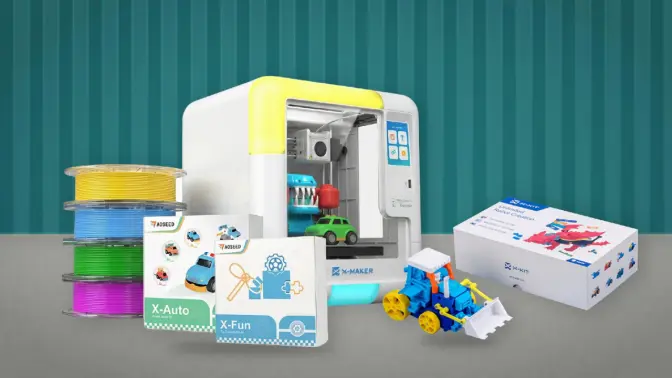
Christmas STEM Activities for Kids: 15 Easy Ideas by Grade
Christmas STEM activities turn December supplies like candy canes, gumdrops, ornaments, and wrapping paper into small experiments. Kids can test which water melts a candy cane first or how many pennies a gumdrop bridge holds. Most of the 15 ideas below take under an hour, and none needs a kit.
With time for only three, start with the candy cane dissolving race, the gumdrop tree tower, and the jingle bell sound test. Each activity below lists the supplies, the steps, the question kids are testing, and a harder version for older siblings.
Christmas STEM Activities at a Glance
Find your child’s grade in the table first, then look at the time column, because a free Saturday afternoon fits different projects than the twenty minutes before dinner. Families who tried our Thanksgiving STEM activities will recognize the format, and only the shopping list changes for December.

|
Activity |
Grade |
Time |
Materials |
STEM Skill |
|
1. Candy cane dissolving race |
K to 2 |
20 min |
Candy canes, three clear cups, cold and warm water, a timer |
Science: dissolving |
|
2. Gumdrop tree tower |
K to 2 |
20 to 30 min |
A bag of gumdrops, toothpicks, and a paper plate |
Engineering: shapes |
|
3. Jingle bell sound test |
K to 2 |
20 min |
Jingle bells, small cups with lids, cotton balls, felt, and foil |
Science: sound |
|
4. Ornament ramp race |
K to 2 |
20 min |
Shatterproof ornaments, a strip of cardboard, a stack of books, and tape |
Physics: slopes |
|
5. Christmas tree cup tower |
K to 2 |
15 to 30 min |
20 to 50 plastic cups and a pack of index cards |
Engineering: stability |
|
6. Gumdrop bridge |
3 to 5 |
30 to 45 min |
Gumdrops, toothpicks, a stack of books, a paper cup, and pennies |
Engineering: forces |
|
7. Reindeer zip line |
3 to 5 |
30 to 45 min |
A length of string, a paper cup, a pipe cleaner, a toy reindeer, and two chairs |
Physics: friction |
|
8. Fizzing Christmas trees |
3 to 5 |
20 to 30 min |
Baking soda and vinegar, food coloring, Christmas cookie cutters |
Chemistry: reactions |
|
9. Christmas card that lights up |
3 to 5 |
45 min |
Cardstock, copper tape, a coin battery, and an LED |
Technology: circuits |
|
10. Wrapping paper math |
3 to 5 |
30 min |
A small box to wrap, a roll of wrapping paper, a ruler, tape |
Math: area |
|
11. Present drop challenge |
6 to 8 |
45 to 60 min |
One raw egg, a small box, padding such as straws, cotton balls, and bubble wrap, and wrapping paper |
Engineering: impact |
|
12. Santa’s route math |
6 to 8 |
45 min |
A calculator or a spreadsheet, plus a world time zone map |
Math: rates |
|
13. Binary code garland |
6 to 8 |
30 to 45 min |
Red, green, and white pony beads, string, and an ASCII binary chart |
Technology: code |
|
14. Gift box with a lid that fits |
3 to 8 |
30 min design, 1 to 3 hr print |
A ruler, a 3D printer, AOSEED PLA filament |
Engineering: tolerance |
|
15. Candy cane holder that stands up |
3 to 8 |
30 min design, 45 min to 2 hr print |
6 candy canes, a 3D printer, and AOSEED PLA |
Engineering: balance |
Christmas STEM Activities for K to 2nd Grade
Kindergarten through 2nd grade kids learn the most when they change one thing at a time and watch what happens next. Rounds of about 20 minutes work well at this age, and drawing the results is easier for them than writing. Our easy STEM activities with things you already have keep the same pace going into January.
1. Candy Cane Dissolving Race
This race uses two candy canes and two cups of water to see which cane loses its stripes first. You need two or three candy canes, clear cups, ice water, warm tap water, and a kitchen timer. Have your child pick a winner before anything goes in.
• Fill one cup with ice water and the other with warm tap water, and check the warm cup yourself first. It should feel like cocoa you could sip, not hot.
• Your child drops both canes in at the same moment, one in each cup.
• Start the timer, and every 5 minutes your child makes a quick sketch of how much stripe is left on each cane. Rough lines are fine, since the point is to compare, not to draw well.
Warm water or cold — which dissolves candy faster? That is the question underneath the race. Older siblings can add a third cup at room temperature and note the minute each red stripe disappears, which gives them three numbers to compare instead of a guess.
2. Gumdrop Tree Tower
The challenge is a gumdrop Christmas tree that stands on its own on a paper plate while everyone counts to 10. Kids need a bag of gumdrops and a box of toothpicks.
• Make a flat triangle from 3 gumdrops and 3 toothpicks to use as the base.
• Next, poke a toothpick into each corner gumdrop, tilt all three toward the middle, and press their tips into one more gumdrop on top, which turns the flat triangle into a small pyramid.
• Each new level makes the tree taller and a little wobblier, so keep building until it starts to lean, then let go and count to 10 out loud.
Building one tree from triangles and another from squares shows kids which shape holds up a taller tower. For a tougher second round, hand over only 20 gumdrops, or ask for a jingle bell star on top that has to stay put until the count reaches 10.

3. Jingle Bell Sound Test
A jingle bell is built to be loud. Making one as quiet as possible — without taping it shut — takes some real testing. Gather a few bells, small cups with lids, cotton balls, felt, tissue paper, and a square of foil, and clear a table.
• First, shake a bare bell and give it a loudness score from 1 to 5. That number is your starting point.
• Pack one material around the bell inside a cup, then shake it exactly the same way, the same number of times, and give it a new score.
• Once every material has had a turn, line the cups up from loudest to quietest and see what changed.
Underneath the noise, the question is which material soaks up the most sound. Older kids can skip the guessing, read the volume on a free sound meter app, and rank the materials by number instead.
4. Ornament Ramp Race
Shatterproof ball ornaments roll a surprising distance down a cardboard ramp, and whichever one goes farthest wins the round. You need ornaments in two or three different sizes, one sheet of cardboard, a few hardcover books, and masking tape to mark the spot where each ornament stops.
• Prop the cardboard on 2 books to make the ramp.
• Let each ornament go from the top without a push, then put a strip of tape where it stops — no nudging it further.
• Round two: slide a third book under the ramp and race them all again.
The question is whether the size of the ornament matters more than the height of the ramp. For the math part, measure each distance in inches and color in a simple bar graph to show the winner.
5. Christmas Tree Cup Tower
Nothing on this list needs less setup than stacking cups into a Christmas tree. Grab 20 to 50 paper or plastic cups — green ones if you have them — and a few index cards, and you are ready.
• Line up the bottom row of upside down cups on the floor.
• Build each new row with one less cup until a single cup sits on top.
• Count the rows and take a picture before the tower comes down.
The question is whether a wider bottom row lets the tree grow taller. Slipping index cards between the rows makes it harder. So does a limit of 15 cups — suddenly every cup counts.

Christmas STEM Challenges for 3rd to 5th Grade
Third graders can measure, count, and compare a first try with a second one. Plan on 30 to 45 minutes for each challenge, and have them write down at least one number per test, even if it is just a penny count.
6. Gumdrop Bridge Challenge
Stack two piles of books 6 inches apart and bridge the gap — the bridge has to hold as many pennies as possible. Kids build it from gumdrops, toothpicks, a small paper cup, and a jar of pennies.
• Build a flat bridge from squares and lay it across the gap.
• Set the cup in the middle and add pennies one at a time until the bridge sags.
• Rebuild it with triangles along the sides, then run the same test.
Keep score against the square version — the triangle one should hold more pennies, and how many more is the number to beat. A budget of 30 gumdrops and 50 toothpicks makes it tougher, and so does widening the gap to 8 inches.
7. Reindeer Zip Line
The goal is a zip line that gets a toy reindeer from one chair down to another quickly without dumping it out. Collect about 10 feet of string, a paper cup, a pipe cleaner, tape, two chairs, and a stopwatch.
• Tie one end of the string to the back of a tall chair and the other end to the leg of a short one.
• Bend the pipe cleaner into a hook, tape it to the cup, and hang it on the line.
• Time three rides, change the slope, then time three more.
Kids see pretty quickly that the steeper the string, the faster the reindeer slides down to the low chair. Once that is clear, challenge them to rig a brake from a clothespin or a rubber band that stops it before the bottom.

8. Fizzing Christmas Trees
When vinegar hits a baking soda tree, it fizzes, and the challenge is to keep that fizz going as long as possible. Set out baking soda, water, green food coloring, tree cookie cutters, a baking tray, vinegar, and a spoon.
• Mix the baking soda with a little water and coloring until it feels like wet sand.
• Press the mix into the cutters on the tray and lift the cutters off.
• Pour one spoon of vinegar over a tree while someone runs the timer.
Does extra vinegar make the fizz last longer, or just fizz faster? That's what they're testing. Turn it into a real experiment by testing 1, 2, and 3 spoons on three matching trees and graphing the times.
9. Christmas Card That Lights Up
Inside this card is a paper circuit, so the star on the front lights up when your child presses one corner. You’ll need cardstock, copper tape, a CR2032 coin battery, one small LED, and a binder clip.
• Draw a tree on the front and push the LED legs through the star.
• On the inside, run a strip of copper tape from each leg to the same corner.
• Set the battery in that corner, fold the paper over it, clip it, and press.
Once it works, kids can test what happens when there’s a gap in the copper path. A second LED, or a paper flap that acts as a switch, makes the harder version.
An adult should handle the coin battery from start to finish. The CPSC’s button and coin battery safety advice explains why these batteries are dangerous for children 6 and younger, so keep finished cards out of reach of little siblings.
10. Wrapping Paper Math
Wrapping a box with almost no leftover paper takes more math than kids expect. Give them a box, a roll of wrapping paper, a ruler, tape, and scissors, and allow only one cut.
• Measure the length, width, and height of the box.
• Work out how much paper it needs, then make the cut and wrap.
• Measure the scraps that were trimmed off.
Success means getting as close to zero waste as possible. Older kids can find the surface area with 2lw + 2lh + 2wh and compare that number with the paper they actually used.
Christmas STEM Projects for Middle School
Middle schoolers stay with it longer when there’s a real problem to solve and a limit on materials or time. Each of these three Christmas STEM projects takes 30 to 60 minutes, so one fits into a class party or a long afternoon at home.
11. Present Drop Challenge
A raw egg, wrapped like a present, has to survive a drop from 6 feet. Builders get raw eggs, small boxes, wrapping paper, tape, and padding such as straws, cotton balls, and bubble wrap — and a trash bag on the floor, just in case.
• Give everyone the same supply — for example, 10 straws and 10 cotton balls — so nobody wins by hoarding padding.
• Pad the egg inside the box, then wrap it so it looks like a gift, ribbon and all.
• An adult drops each box from 3 feet, then 6 feet, onto a trash bag spread on the floor. No peeking until it lands.
After the drops, kids compare which padding spread out the force of the landing best. For a harder round, the goal is the smallest box that still brings the egg back in one piece.

12. Santa’s Route Math
In this activity, kids work out how far Santa has to fly — and how fast — to reach every home in a single night. All they need is a calculator or a spreadsheet and a world time zone map, plus a willingness to argue about the numbers.
• Start by estimating the number of homes, from a population figure and an average household size. The first guess is usually wildly wrong.
• Then use the map to count the hours of darkness as midnight moves across the time zones — Santa chases it west all night.
• Divide homes by seconds, pick an average distance between homes, and convert the answer to miles per hour. The number is always bigger than anyone expects.
Answers come out in homes per second and miles per hour — numbers big enough to make the room go quiet. Building every step into a spreadsheet makes it harder, since changing one guess then has to update every answer down the line.
13. Binary Code Garland
Every letter a computer stores is a string of 1s and 0s. This garland spells a name the same way, bead by bead. Use red, green, and white pony beads, string, and an ASCII binary chart, and pick a short name to start.
• Look up each letter on the chart — every one is 8 digits long, no shortcuts.
• Red beads stand for 1, green beads stand for 0, and a white bead goes between letters, like a space you can see.
• Swap garlands with a friend and decode each other’s message, chart in hand.
It works if a friend can read the message using only the chart — no hints. To make it harder, spell MERRY XMAS and hide one wrong bead for them to find.

Two Christmas STEM Projects With a 3D Printer
Both printer projects follow the same design steps as the activities above — measure, print, then try again — with a second try built in. Ornaments already have a separate guide on 3D printed Christmas ornaments kids can design, so we kept these two practical.
14. Gift Box With a Lid That Fits
Your child designs a small box for a tiny gift, with a lid that slides on snugly and stays put when the box gets shaken. Gather the gift, a ruler, a computer, a 3D printer, and AOSEED PLA filament, which is a plastic made from plants — and measure the gift twice, because the lid will not forgive a guess.
• Measure the gift and add about 3 mm of room on every side, so the gift slides in without a fight.
• In a free browser tool such as Tinkercad, design the box and lid, with the lid opening 0.3 to 0.5 mm wider than the box on each side. That tiny gap is the whole trick.
• Print both parts — a box about 2 inches across takes roughly 1 to 3 hours, so start it before lunch.
• Put the lid on, turn the box upside down, and give it a shake over the table, not the floor.
A lid that falls off means the gap should shrink by 0.1 mm on the second print; a lid that jams means it should grow. Engineers call that small gap tolerance, and they set it on every part that has to fit another part — drawers, lids, phone cases, all of it.
Of all 15 projects, this is the one where a kids’ 3D printer earns its spot on the table, since the finished box is a real gift built to your child’s own measurements.
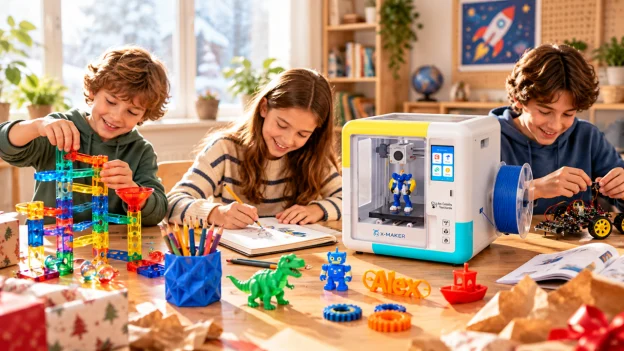
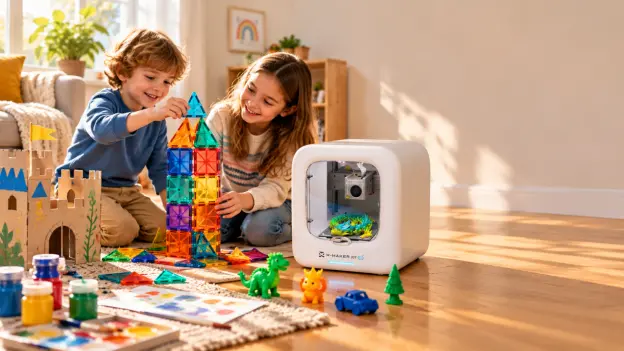
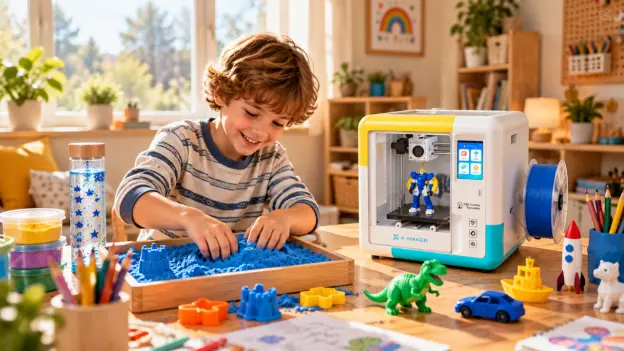
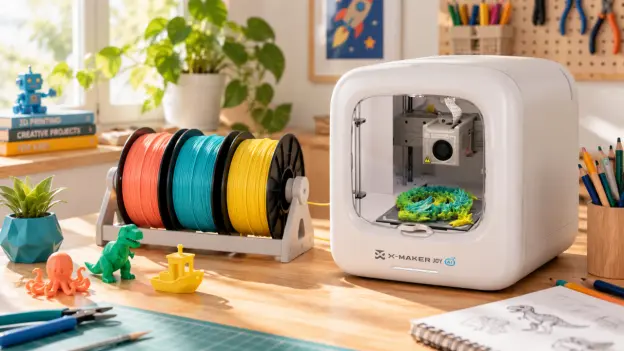
The AOSEED X-MAKER JOY AI+ is made for ages 4 to 12 and prints at up to 400 mm/s inside a fully enclosed frame with a magnetic door.
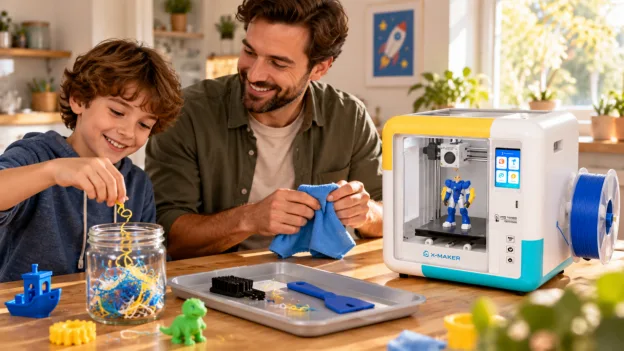
Tinkercad files go to the printer through AOSEED’s X-PRINT software on a Windows computer. Your child handles the measuring and designing; you load the AOSEED PLA and pop the parts off the plate. And yes, the first lid will probably need a second print — that is the lesson, not a failure.
15. Candy Cane Holder That Stands Up on Its Own
A good holder keeps 6 candy canes hooked on without tipping, even when all six hang on the same side — which is exactly how kids will hang them. Kids need 6 small candy canes, a ruler, a 3D printer, and AOSEED PLA filament.
• Sketch a base and a post with hooks, slots, or a rim, on paper first, before anyone opens the design tool.
• Design it, and write down the base width — you will need that number when it tips.
• Print it. Most small holders take 45 minutes to 2 hours, so this one is an after-lunch job.
• Hang canes on one side, one at a time, and count out loud until it tips. Someone always gasps at number five.
For the second try, kids can widen the base, center the post, or raise the infill — the setting that controls how solid the inside of a print is. A heavier, wider base keeps the center of gravity low and the holder upright, which is the point of the whole test.
Kids who want more control over print settings can run this one on the AOSEED X-MAKER AI+, which is made for ages 9 to 16 and has a touchscreen with a child lock.
It also prints at up to 400 mm/s, and it shares the JOY’s library of 20,000+ designs that are ready to print.

Running These Projects in Class
For teachers, our guide to 3D printing for elementary STEM has lesson formats that fit inside one class period.
How to Run a Christmas STEM Countdown Over 12 Days
A Christmas STEM countdown runs one activity a day from December 13 to Christmas Eve. Lay out the supplies the night before and tape that day’s question to the fridge, and kids will already be guessing at breakfast.
• Day 1 is the candy cane race, which takes about 20 minutes and three cups of water.
• On day 2, the gumdrop tree tower fills about half an hour.
• Day 3 brings the jingle bell sound test, a quick 20 minutes.
• Ornaments race down a cardboard ramp on day 4.
• Day 5 is the cup tower, which needs almost no setup.
• Put a baking tray down for day 6, because the fizzing trees get messy.
• On day 7, kids try wrapping a box with one cut of paper.
• Save 45 minutes on day 8 for the gumdrop bridge and a jar of pennies.
• Day 9 is the reindeer zip line, strung between two chairs.
• On day 10, kids make a card that lights up, which takes about 45 minutes.
• The present drop on day 11 needs about an hour, counting cleanup.
• Day 12 is redesign day, when kids rebuild whichever project they liked best.
Middle schoolers can trade days 3 and 4 for Santa’s route math and the binary garland. If you add the two printer projects as bonus days, pick up AOSEED PLA filament in two or three colors before you start.

FAQs
What Are Some Christmas STEM Activities?
Good Christmas STEM activities include a candy cane dissolving race, a gumdrop tree tower, a cup Christmas tree, a reindeer zip line, and a card that lights up. All five use holiday supplies, and each one tests a single question in under an hour.
What Is a Good Christmas STEM Challenge for Kindergarten?
The Christmas tree cup tower is a good Christmas STEM challenge for kindergarten, since it needs no reading, no cutting, and no cleanup. Counting the rows is the measurement, and building a wider base gives kindergartners an easy second try.
How Do You Make a Christmas Activity STEM?
Add a question, a test, a measurement, and a second try. A gumdrop tree stays a craft until a kid predicts how tall it will get, measures it, and builds a taller one. For older kids, the engineering design process from Science Buddies lays out the same steps in more detail.
What Can Kids Build With Candy Canes?
Kids can build towers, small cabins, and bridges with candy canes as long as an adult handles the hot glue. Candy canes also make good weights for a balance test like project 15, and they’re the main ingredient in the dissolving race.
Pick One Activity and Start This Week
This week, pick either the candy cane race or the cup tower to start with, then let the countdown carry you through the days before Christmas. Once the tree comes down, our winter STEM activities pick up where this list stops.
|
FOR THE 3D PRINTER PROJECTS |



Further reading
Christmas STEM Activities for Kids: 15 Easy Ideas by Grade

Stocking Stuffers for Kids (2026): 30 Ideas by Age That Get Used
Christmas Gifts for 12 Year Olds (2026): 15 Picks for Almost Teens