

3D Printed Animal Games Adventure for Kids Who Love Stories
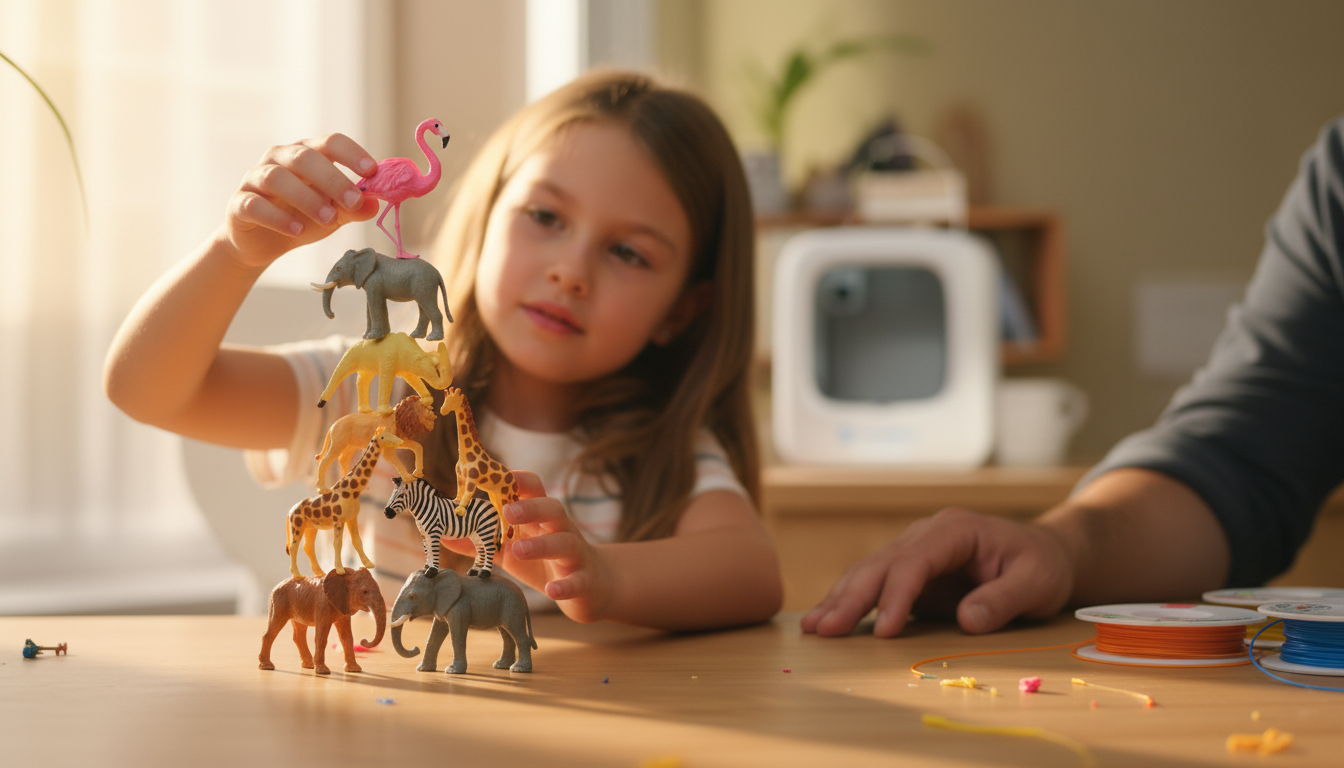
Six elephants. One tiger. A flamingo balanced on the back of a hippo, somehow. By the third tower of the night my daughter's named every animal and given them backstories that span at least two continents. None of these came from a store. They came off the 3D printer in the corner of our living room, and the only money I spent that week was a $24 roll of filament from the local hobby place.
Printed animal games have quietly become one of our family's favorite weekend projects. Pieces are cheap to replace when they break. They stack. They make kids invent things — and kids tend to invent more around objects they've handled and painted themselves than around anything pre-packaged. If you've been hunting for a screen-light activity that doesn't get boring inside a week, AOSEED's family-friendly 3D printing platform was built for exactly this kind of project.
|
Quick read. Best 3D printed animal game to print: Jungle Jumble, Stack-a-Zoo, and Animal Upon Animal. Use PLA or PETG for rough handling, print around 4–7 hours for round shapes, and plan a starter budget under $5 in materials. |
Why 3D Printed Animal Games Are Perfect for Kids

Animal stacking games hit a sweet spot between four and ten. Old enough to follow a rule. Young enough to still narrate the rule out loud while playing it. The games are tactile, they're structured (turn-taking, balance, basic sequencing), and they don't end — which is the part that's hard to find anywhere else. A kid who masters Jungle Jumble at five is running rival zoos at seven and writing actual dialogue for her animals by nine. The game grows with the kid.
The AAP has been saying this for years: self-directed prop play does more than keep kids busy. Their Power of Play clinical report makes the case that prop play actually wires up the prefrontal cortex — which, in parent language, means planning, emotional control, and bouncing back when things don't go their way. Three of the hardest skills to teach. All in one game.
Hands-On Learning and Motor Skills
Balancing a wobbly tortoise on a leaning camel uses the exact same muscles a kid needs to button a shirt or pour orange juice without flooding the kitchen table. Same hand-eye routine, rehearsed without anyone calling it homework. The best part is watching the calculation happen in real time. The wobble. The held breath. The little tongue at the corner of the mouth. The release.
The CDC's developmental guide for preschoolers puts pretend play and tabletop games right on the recommended list — same level as reading aloud, same level as outdoor running-around time. You'll see the progress in months, not years. The tower that fell apart Tuesday somehow holds together by Sunday morning. Nobody really explains how. It just happens.
Storytelling and Imagination
Get the animals out of the box and the stories follow within about ninety seconds. In our house the elephant turned into a forgetful grandfather who's always misplacing his glasses. The crocodile is the villain every time, no exceptions. The frog — small, green, slightly cross-eyed because of how I painted his face — is the surprise hero who saves the day with genuinely terrible jokes.
Open-ended pretend play is one of the strongest predictors of language growth and executive function in early childhood — peer-reviewed research at PMC/NIH has tracked this across multiple preschool studies. The catch with screen-based games: the story is already written. The catch with printed animals: it isn't. Whatever the kid invents, that's the story. Handling the object, painting the object, naming the object — every step in the loop adds another layer to what the toy becomes.
|
What we've noticed at home: the day after we paint a new animal, my daughter's vocabulary jumps a notch. Last month it was "stampede," because her wildebeests were running from a lion. The month before that, "camouflage." Naming a thing teaches the name of the thing. Painting it teaches the word twice. |
Best 3D Printed Animal Games Ideas For Kids to Try at Home

Three stacking games keep coming up across family forums and printable model libraries — and there's a reason. They're fast to print, hard to break, and friendly enough for small fingers. All three run on a standard FDM printer with beginner-grade filament. You don't need a workshop or a heated enclosure. A corner of the kitchen counter is enough. The starting point most families pick: kid-friendly 3D printers that come ready to print straight out of the box.
Here's how the three compare at a glance:
|
Game |
Difficulty |
Print time |
Ages |
Why families pick it |
|
Jungle Jumble |
Easy |
~6 hours |
4+ |
Big shapes, low frustration |
|
Stack-a-Zoo |
Beginner |
~4 hours |
3+ |
Forgiving geometry, fast prints |
|
Animal Upon Animal |
Moderate |
~7 hours |
5+ |
Adds a dice-rolling strategy layer |
Jungle Jumble

Jungle Jumble is the classic safari stacker. Players take turns balancing tigers, zebras, and rhinos into a tower that gets visibly absurd by round four. PLA or PETG holds up well to floor drops. Print at 25–30% infill — that gives each animal enough weight to feel real in a kid's hand, but not so dense the layers crack when the tower finally goes.
Tip from someone who's printed this set twice: print the elephant first. It's the widest base in the kit, and once it's on the table you can eyeball the rest of the herd against it for scale before you commit to a full batch.
Stack-a-Zoo
Stack-a-Zoo skips the realism and goes for round, chunky shapes that print quick and balance easy. The geometry is forgiving in a way Jungle Jumble isn't. It's the best first project for younger kids, or for parents printing animals for the first time. Multi-color filament is great if you've got it. If you don't — print everything in one color and spend Saturday afternoon painting them. That stretches the project into a two-day thing, which is half the fun anyway.
Animal Upon Animal
Animal Upon Animal is the strategic one. A die roll decides which animal you add next, so the puzzle resets every turn — you can't plan two moves ahead. The customization angle is what makes it stick around. Kids pick the color schemes, paint stripes with cheap acrylics from the craft drawer, or print every species in a different filament and end up with what one of my daughter's friends called a "rainbow zoo."
If you've got siblings in the house, print two sets and let them race. The strategic layer is what makes this game age well. Older kids — eight, nine, ten — will sit through longer rounds with Animal Upon Animal than they ever will with Jungle Jumble. Eight-year-olds want a real game. This one is.
Printing Tips for Safe and Fun 3D Printed Animal Game Pieces
A few small decisions at the print stage decide whether your animal collection lasts six weekends or sixteen months. Material choice. Color strategy. A small amount of post-processing. None of it is technically hard. Each one matters more than first-time parents tend to expect.
|
Quick start checklist. Use food-safe PLA from a trusted brand on the first roll. Set infill at 25–30% for stacking pieces. Level the print bed before every project, even if the printer auto-levels. Place the printer in a low-traffic area, out of direct sunlight. Supervise the first 5–10 minutes of each print until you trust the setup. |
Choosing the Right Filament

PLA is the default for kid-friendly prints, and it's the right default. Plant-based, non-toxic once it's cooled, no ventilation drama. PETG is the step up for pieces that take rough handling — it bends a little before it breaks, which matters when an excited five-year-old throws a hippo across the room. (Mine has. Multiple times.)
If you're brand new to filament, do yourself a favor and skip the cheap mystery rolls from marketplace sites. Spend the extra $5 on a recognized brand for your first order. That one small upgrade saves you a week of jams, three failed prints, and one bewildered family meeting about whether the printer was a bad idea in the first place. AOSEED's starter toy-making 3D printer ships with kid-safe PLA already loaded and the temperatures preset, so parents don't have to memorize filament charts the first weekend.
Multi-Color and Detailing Techniques

Color isn't just decoration. In a multi-player round, color tells kids which animals are theirs — and ends about 80% of the arguments before they start. A single-extruder printer can still produce a colorful set. Print each animal in a different filament, or pause mid-print to swap colors for the eyes and stripes. (The mid-print swap is more work than it sounds. Test it on one small animal before committing to a whole batch.)
For the painting route, cheap craft-store acrylics work perfectly fine. Don't skip the matte topcoat though — $4 at any craft place, and it does two real things. One: it protects the finished animal from sticky fingers. Two: it makes the colors pop in photos, which matters if you're shipping a printed animal to a grandparent as a gift (a use case I didn't predict but now we do all the time). AOSEED's guided design app also lets kids customize their animals before printing. The lion they sketched on Tuesday becomes the lion they play with on Wednesday. That feedback loop is the part kids actually care about.
From STL file to game night, in six small steps:
Pick one game. Jungle Jumble is the easiest first run.
Download the STL files from a reputable model library (or use AOSEED's own Toy Library).
Load the slicer with PLA settings and 25–30% infill.
Print the elephant first as your scale reference, then run the rest of the herd.
Clean up — remove the brim, sand any rough edges, lightly bevel sharp corners.
Paint or detail with acrylics. Add a matte topcoat. Let dry overnight before play.
Troubleshooting Common Print Issues
Most first-print failures come down to four causes. None of them need an engineering background — just a little patience and a steady five minutes at the printer.
|
Issue |
Likely cause |
Quick fix |
|
Animal won't sit flat on the table |
Uneven first layer |
Re-level the bed, reprint just the base |
|
Layers separating along the body |
Print speed too high for layer height |
Slow the print by 10–15% and retry |
|
Corners lifting off the bed |
Cold bed or drafty room |
Heat the bed to 60°C for PLA, close the enclosure |
|
Stringy threads between details |
Retraction setting too low |
Increase retraction distance by 1mm in slicer |
|
Pro tip from a parent of two. If a print fails halfway through, don't toss it. Save the half-printed animal for a craft project — kids will often paint, decorate, or repurpose a "broken" print into something else. We have a one-armed gorilla in the living room that gets more story time than any of the perfect prints. |
||
Making 3D Printed Animal Games a Story Adventure

Once you've got a herd of printed animals, the temptation is to dump them in a basket between game nights and call it done. Don't. Small extras turn a stacking set into a story-driven activity that runs for weeks, not just one afternoon.
Using Props and Environments
A shoebox lid? That's a savanna. A green felt square from the craft drawer? Jungle. Three LEGO walls stacked together? Instant zoo enclosure. Kids who set up environments around their printed animals stay engaged longer — sometimes by 20 minutes, sometimes by an hour — and the spatial setup is quietly teaching sequencing, story structure, and the difference between a setting and a scene. None of which feels like teaching to them.
The AAP's Power of Play parenting resource on HealthyChildren.org makes the case that prop-based pretend play helps kids work through emotion as well as concepts — that kids who actively run scenarios with toys tend to process stress more easily than kids who only listen to stories. The proof shows up the first time a tower falls in the middle of a child's narrative. Watch what happens. Most kids will pause, shrug, and restart with a small twist — "okay, this time the crocodile is the king" — instead of melting down. That pause-and-restart move is executive function happening in real time, on your kitchen table.
Engaging Siblings and Friends

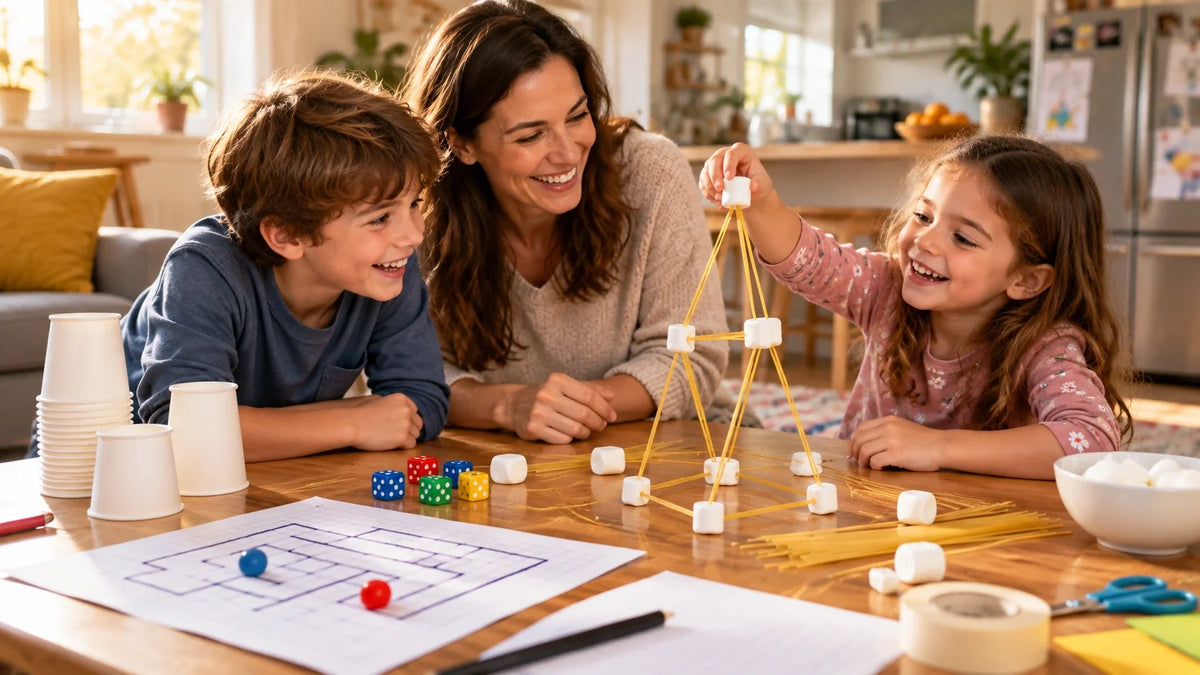
Group play around printed animals is one of the easier paths to teaching turn-taking and negotiation, partly because the games are physically slow. You can't yell at your sister and stack a giraffe at the same time. Older siblings tend to coach younger ones through balance challenges. Visiting friends usually split the herd and run rival zoos within five minutes of arrival. Parents get to sit out and just watch — which, in my experience, is when the best storytelling actually happens. The kids forget you're listening.
A trick that's worked at our table: hand out a "game master" role each round. The role rotates. Whoever's the game master makes one rule for that round — the elephant goes first, no stacking until everyone's at the table, the loser has to invent a story about the fallen tower. Everyone follows. It teaches kids that rules can be fair without being permanent, which is a lesson that has uses far beyond a stacking game. And it ends most of the fights before they even start.
Conclusion
Animal stacking games are a small, useful proof of what a 3D printer can do for a family. They're cheap to make, easy to learn, and almost impossible to outgrow. Kids who start with a wobbly Jungle Jumble at five are still rearranging their zoo at nine — just with bigger stories.
We've got a basket of animals on top of our bookshelf right now. Some are perfect, some are missing legs, and two ended up under the couch as a separate adventure to recover. The whole collection cost under $10 in filament over the course of a year. My daughter still asks for a new one every other Saturday — sometimes a giraffe with a different paint job, sometimes a brand-new species she saw in a book that morning. The asking is the win. It means the printer didn't become another forgotten gadget on the shelf.
If you've been looking for a calmer kind of game night that doesn't end with eye strain or another disposable toy, printing a handful of animals is a strong first move. Pick a kid-friendly printer, choose one of the three games above, and let the story start at the kitchen table. Worst case, you end up with a small herd of plastic animals. Best case, you've handed your kid a hobby they own — and a reason to keep coming back to the table.
|
THE PRINT-AND-PLAY MINDSET Pick one stacking game. Print it in PLA at 25–30% infill. Let your kids paint or customize the pieces. Play the 3D printed animal game today, then bring it out again next weekend. The animals that collect the most stories at the table usually become the favorites. |
FAQs
What is the coolest 3D printed animal?
Honestly, whichever your kid names first. Realistic lions and elephants look impressive on a shelf, but stylized chibi axolotls and cartoon penguins are usually the ones a four-year-old actually picks up and plays with. Start with whatever your printer handles cleanly, then let the kid take it from there.
Is 3D printing Warhammer 40k illegal?
It's a gray area. Personal-use prints rarely catch any heat, but selling or distributing copies of Games Workshop's trademarked figures is clearly infringing — that's where the lawsuits live. For home play, stick to fan-made designs or models released under permissive licenses.
Does Hobby Lobby have 3D printed animals?
Not really, no. Hobby Lobby's animal aisle is mostly painted resin figurines and craft supplies, not 3D-printed toys. Families looking for actual printed animals usually do better with an online STL library or printing at home — way more control over scale, color, and finish.
Why is 3D print failing?
Four usual suspects: poor bed adhesion, wrong temperature, a clogged nozzle, or filament that's absorbed moisture. Before you touch slicer settings, do two things — re-level the bed and check whether your filament's been sitting out in humidity. Those two fixes solve roughly half of all first-print failures.
What is the holy grail of 3D printing?
Depends who you ask. Hobbyists usually mean a machine that hits high resolution, fast speeds, and reliable results at a sane price. For families with kids, the goal's a lot simpler — a printer that succeeds on the first try and ships with software a seven-year-old can actually navigate.
Can you legally sell 3D printed items?
Yes — as long as the design is your own, or you've got a commercial license for it. Avoid selling anything that copies a trademarked character or a branded toy without permission; that's where copyright gets thorny. Original designs and Creative Commons commercial-use files are the safest road to take.
How much does it cost to run a 3D printer for 1 hour?
Roughly $0.05 to $0.30 an hour, all in — electricity plus filament. FDM printers running PLA sit at the cheap end. Resin printers cost more because the resin itself is pricier than spool filament. For perspective: a full set of stacking animals usually runs under $2 in materials. The printer pays for its own weekend habit pretty quickly.
Can you legally 3D print Legos?
For personal use, yes — LEGO's original stud-and-tube patent expired years back. What's not okay is selling printed bricks marketed as "LEGO" or copying their protected designs (specific minifigure shapes, branded sets, named characters). For a kid replacing a lost piece or printing custom shapes that work with an existing LEGO set, you're fine.
Sources
- American Academy of Pediatrics — The Power of Play: A Pediatric Role in Enhancing Development in Young Children.
- Centers for Disease Control and Prevention — Positive Parenting Tips: Preschoolers (3–5 years old).
- Vidal Carulla, Christodoulakis, Adbo — Development of Preschool Children's Executive Functions through Play-Based Learning.
- HealthyChildren.org (AAP) — The Power of Play: How Fun and Games Help Children Thrive.
- Centers for Disease Control and Prevention — Positive Parenting Tips: Toddlers (2–3 years old).
- AOSEED — 3D Printer for Kids Collection.
- AOSEED — X-MAKER JOY 3D Printer for Kids.
- AOSEED — AOSEED Design App.



Further reading

Graduation Gifts for Kids: Keepsakes for Kindergarten to Fifth Grade

How to Clean a 3D Printer: A Routine for Families

3D Printer Filament Holder: Options, Setup and a Version You Can Print


