

The Complete Guide to 3D Printer Filament Types
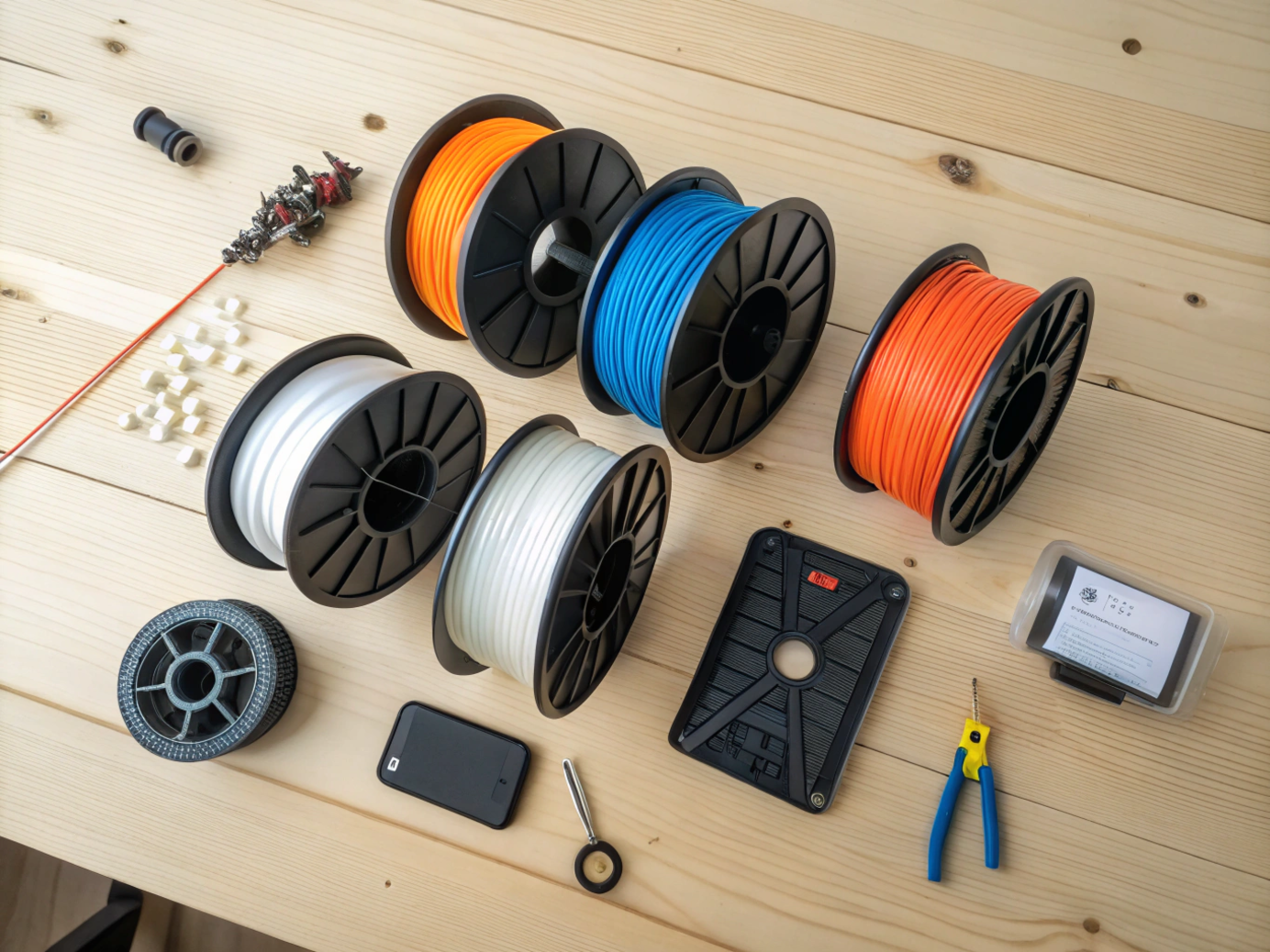
Picture this. There's a spool of plastic that looks a bit like a weed-whacker line and your printer grabs the end of it, drags it up into a heated nozzle, and melts it down. Then it starts drawing. Thin little lines of soft plastic, laid down side by side, layer over layer. Come back later and there's a solid object sitting on the bed. That's the whole trick.
People call that plastic "filament." Walk into the hobby and you'll see dozens of kinds for sale, which is honestly more confusing than helpful. The truth is most of us live on five: PLA, ABS, PETG, TPU, and nylon. Carbon fiber, PEEK leave those to the people with engineering jobs and the printers to match. Glow-in-the-dark, wood-filled, the silky rainbow stuff? Fun to mess with on a slow weekend. But ask anyone who's been printing a couple years and they'll admit they keep reaching for the same two or three rolls.
What I want to do here is keep it practical. What's each filament actually decent at. Where people screw it up. And what to buy for the thing you're trying to make.
What Is 3D Printer Filament?
Plastic thread on a spool. That's the short version.
A roll usually runs about a kilo, and there's something like 330 meters wound up on it. You'll see two thicknesses out there 1.75 mm covers nearly every desktop printer sold today, and 2.85 mm shows up on the older gear and some industrial machines. Check which one your printer takes before you buy. People forget. It's an annoying mistake.
Here's the part that actually matters though not how much filament you've got, but which kind. PLA's easygoing; it'll print fine even if your printer doesn't have a heated bed. ABS is the opposite. Leave a window cracked nearby and it'll warp on you out of spite unless it's sealed up in an enclosure. Pick wrong for the job and you'll watch a perfectly good $25 spool turn into a bird's nest two hours into the print. Pick right and the machine mostly just gets on with it.
How Does Filament Actually Print?

Three parts are doing the work:
- Extruder — this is the grabber. Pulls filament off the spool, feeds it down toward the heat.
- Hot end — where it melts. Anywhere from 190°C up to 400°C, totally depends on what you've loaded.
- Nozzle — the tip it squeezes out of. The line that comes out is about a third of a millimeter wide. Tiny.
Your slicing software already mapped out the path before anything started moving. So the printer just follows it — dragging the nozzle around, dropping plastic, and each fresh layer fuses into the still-warm one underneath it. Do that a few thousand times and the part exists.NIST sums the process up as melt, extrude, weld, solidify, which is tidier than how it looks in person.
Load your spool, pick a model, press print. The printer takes it from there. That's the "plug-and-play" everyone talks about — and this is one of the rare times the phrase mostly holds up.
What Are the Main Types of 3D Printer Filament?

Five filaments cover roughly 95% of what people print at home.
|
Filament |
What It Is |
Best For |
|
PLA |
Plant-based plastic, easy to print |
Toys, prototypes, beginner projects |
|
ABS |
Same plastic as LEGO, tougher |
Mechanical parts, tool handles |
|
PETG |
Halfway between PLA and ABS |
Containers, brackets, outdoor signs |
|
TPU |
Flexible, rubbery |
Phone cases, gaskets, wearables |
|
Nylon |
Strong, wear-resistant |
Gears, hinges, moving parts |
Past those five, things get specialized fast. Carbon fiber nylon for stiffer drone frames. Polycarbonate for industrial enclosures. ASA for anything that lives outside year-round. PEEK and PEI show up in aerospace and surgical implants — places where price doesn't matter as much as performance. Most home users will never need to touch any of them.
PLA vs ABS vs PETG: What's the Difference?

The three filaments people actually choose between. The differences explain why one lives in classrooms and another lives in garages.
|
Property |
PLA |
ABS |
PETG |
|
Print temp |
190–220°C |
220–250°C |
220–250°C |
|
Heated bed |
Optional |
Required |
Recommended |
|
Smell during printing |
Faintly sweet |
Strong, plasticky |
Mild |
|
Heat resistance |
~60°C |
~105°C |
~80°C |
|
Outdoor use |
Bad |
Mediocre |
Good |
|
Cost per kg |
$20–25 |
$20–30 |
$25–30 |
Quick way to think about it. PLA's the friend who always shows up sober. ABS is strong but argues with the neighbors. PETG just kind of works.
For most home prints, PLA. For mechanical parts that need heat or impact resistance, ABS or PETG.
Do People Still Use ABS Filament?
Yeah. Just not where they used to.
ABS hasn't been the newest plastic on a 3D printing shelf since around 2014. Doesn't matter. Nothing else takes a beating quite the same way. LEGO is made from it. Tool handles. Snap-fit assemblies. Car interior parts. Comparative emissions research found ABS releases more ultrafine particles and a wider mix of VOCs than PLA — which is why workshops still buy it by the spool, and apartment dwellers mostly don't.
Where ABS earns its spot:
- Mechanical parts that take impact.
- Anything sitting near an engine or in a hot garage.
- Tool handles, drill jigs, custom hardware.
- Snap-fits that need to flex without cracking.
Skip ABS for:
- Anything indoors without ventilation.
- Kids' rooms.
- Decorative prints.
- Projects where smell is a dealbreaker.
Rule of thumb: if the part has to survive a parking lot in July, ABS. If it just has to look nice on a desk, PLA.
When Would You Need Each Filament Type?

The "which filament" question collapses fast once you know what the part actually does.
|
Use Case |
Pick This Filament |
|
Visual model, miniature, prototype |
PLA |
|
Toy for a kid, school project |
PLA |
|
Phone case, soft grip, gasket |
TPU |
|
Mechanical bracket, container, outdoor sign |
PETG |
|
Tool handle, car part, mechanical housing |
ABS |
|
Gear, hinge, moving part |
Nylon |
|
Drone frame, structural jig |
Carbon fiber nylon |
|
Aerospace, medical, industrial |
PEEK / PEI |
The honest reason most people stick with PLA isn't cost or strength. It's friction. Low print temp. No heated bed required. Doesn't really warp. Smells faintly sweet instead of like burning rubber. For a printer sitting in a shared family space, nothing else gets close.
WHERE OTHER FILAMENTS START LOSING TO PLA
Engineering filaments weren't built for living rooms. They want ventilation. Enclosed chambers. Hardened nozzles. Quiet rooms and operators who already know what they're doing. None of that fits a kitchen counter.
For a printer that prints next to a kid, PLA is the only answer that doesn't come with caveats. An easy starter 3D printer for younger kidsships ready for PLA out of the box — enclosed, low-temperature, app-driven — so the material side stays simple and the kid handles the creative side.
Filament vs Resin vs Powder: Which 3D Printing Format Wins?

Three printing formats. Three different jobs.
|
Format |
Best For |
Watch Out For |
|
Filament (FDM) |
General home use, toys, prototypes, functional parts |
Layer lines visible, long prints |
|
Resin (SLA/DLP) |
Ultra-fine detail, jewelry, miniatures |
Toxic liquid, post-curing, not kid-safe |
|
Powder (SLS) |
Industrial prototyping, complex geometries |
Expensive printers, professional only |
Filament wins for general home use. Resin's better for dental models, jewelry casting, miniatures with eyebrow-level detail — but it's a liquid photopolymer that smells weird, needs UV curing, and demands gloves. Powder is a factory tool. Six-figure printers in separate rooms.
For homes — especially homes with kids — filament's the obvious pick. A beginner-ready 3D printer for kids running PLA delivers low-mess creativity without the resin chemistry homework.
How Much Filament Do You Need for a Project?
Slicer software tells you before you start. Some rough benchmarks:
|
Project |
Filament Needed |
|
Phone stand |
30–50 g |
|
Small toy or figurine |
20–80 g |
|
Medium cosplay prop |
200–500 g |
|
Large vase |
200–400 g |
|
Full helmet |
800 g – 1.5 kg |
A 1 kg spool covers a ton of small prints. Costume work burns through spools — a single helmet can eat a kilo by itself. Buy by what you're actually printing, not by whatever's the biggest number on the shelf.
How Fast Can You Print With Each Filament?
Speed comes down to the filament, the printer, and the nozzle size. With a standard 0.4 mm nozzle, you're looking at:
|
Filament |
Typical Print Speed |
|
PLA |
40–80 mm/s (modern printers push 200+) |
|
PETG |
30–60 mm/s |
|
ABS |
30–60 mm/s |
|
TPU |
20–40 mm/s |
|
Nylon |
30–50 mm/s |
|
Carbon fiber composites |
30–50 mm/s |
PLA prints fastest. TPU's slow because it's flexible and weird in the feed path. Carbon fiber goes slow because the abrasion limits how hard you can push.
QUICK BENCHMARK
A 50 g phone stand in PLA finishes in roughly 90 minutes. Same shape in TPU runs 3–4 hours. In carbon fiber nylon, plan 2–3 hours plus a hardened nozzle. The filament you pick is also the time you pick.
How to Use 3D Printer Filament for Beginners

Five steps. The whole thing.
- Mount the spool on the holder so it spins freely as the printer pulls.
- Push the filament into the extruder. Most modern printers have a "load filament" button — let it do the work.
- Set the nozzle temp from the spool label. 200°C for PLA, 230°C for PETG. Guessing here is how prints fail.
- Start the print. Stay close for the first layer — if the first layer's right, the rest usually follows.
- Don't touch anything until it's done. Pulling a print mid-job ruins it.
When the print's finished, run the load process in reverse to eject the spool. That's it.
Are There Filaments You Should Avoid?
None permanently. Use them carefully:
- ABS without ventilation. Fumes aren't catastrophic. Aren't pleasant either.
- Carbon fiber on a brass nozzle. The fibers grind it to nothing in hours.
- Damp nylon. Pulls moisture from the air and prints with a hiss and bubbles.
- PEEK on a desktop printer. Your printer can't hit 360°C. Don't pretend it can.
- Cheap unbranded spools. The diameter wanders. Failures pile up.
Match the filament to what the printer can actually do. Skip anything outside that envelope.
How Long Does Filament Last If Not Used?
Sealed PLA — 1 to 2 years. Maybe longer if it's stored cool and dry. Open spools degrade faster as they pull moisture out of the air, and damp filament prints poorly.
Nylon's the worst offender. A week sitting open in a normal-humidity room is enough to ruin the next print.
What actually helps:
- Sealed bins with desiccant packs.
- Vacuum bags between uses.
- A filament dryer for spools that have been sitting.
- Cool, low-humidity storage — not the attic.
Filament's not archival. A 5-year-old spool from a hot garage isn't reliable. A sealed spool in a drawer probably prints fine.
Are Filament Fumes Safe?

PLA's the cleanest. Faint sweet smell while printing. Lowest VOC emissions of any common filament.
PETG sits close behind. Fine for indoor use with normal airflow.
ABS, nylon, and ASA release more — styrene from ABS especially. EPA research on 3D printer emissions found ABS releases higher particle counts and a wider VOC mix than PLA.
PEEK and carbon fiber composites need real ventilation. Not the kind a home printer typically has.
For shared family space — PLA. PETG's fine too. Anything else needs a workshop with airflow.
How to Choose the Right Filament for Your Printer
Five things to check before you buy a spool:
|
Criteria |
What to Look For |
|
Nozzle max temperature |
PLA needs 220°C, ABS needs 250°C, PC needs 300°C |
|
Heated bed |
Required for ABS, helpful for PETG |
|
Enclosed build chamber |
Required for ABS, helps with ASA and nylon |
|
Extruder type |
Direct-drive prints flexibles like TPU better |
|
Nozzle material |
Brass for PLA/PETG, hardened steel for abrasives |
Match the filament to the machine first. Then pick the spool that fits the file size, the space, and the person running the printer. A $15 PLA spool that prints reliably beats a $40 nylon spool that doesn't.
For reference, ASTM F42 standards via NIST cover the polymer specs most reputable filament brands follow. The technical data sheet on the spool label is worth reading before you commit — especially for engineering-grade materials.
Conclusion
Filament is just plastic, melted and stacked into a shape. And honestly? The basics haven't moved much since FDM got patented back in 1989 — same handful of materials, same physics, the printers have only gotten quieter and a little smarter.
Here's the part that trips people up: they overthink it. They read a guide like this, see PEEK and carbon fiber and nylon, and assume they need the strong stuff. They don't. Nine times out of ten, PLA does the job. It's cheap. It forgives your mistakes. It barely smells. You can run it on a desk three feet from where a kid is doing homework and not think twice.
The other filaments aren't better — they're just specialized. PETG when something has to live outside. ABS when a part takes real abuse. TPU when it needs to bend. You reach for those when PLA actually hits its limit, and for most people printing toys, models, and household odds and ends, that moment never really comes.
So start simple. Buy a roll of PLA, print a few things, break a few things, learn what your machine likes. The fancy materials will still be there later if you ever need them.
And if the printer is going into a family space, the material is only half the equation — the machine matters just as much.AOSEED's family-ready 3D printer lineup pairs PLA-first printing with guided apps, ready-made projects, and a fully enclosed design that keeps small hands well away from the hot end.
FAQs
Is PLA the same as 3D printer filament?
PLA is one type of filament. Not the only one. Filament is the general term for plastic on a spool that feeds into an FDM 3D printer. PLA is the most common variety — easy, cheap, beginner-friendly — but ABS, PETG, TPU, and nylon all qualify too. When someone says they need filament, they usually mean PLA unless the project says otherwise.
Why would I need different filament types?
Different filaments handle different jobs. PLA prints toys and prototypes cleanly. PETG holds up to mild heat and outdoor air. TPU bends without snapping, which is why it shows up in phone cases. Nylon takes wear and goes into gears. ABS resists impact and heat, which is why it's used for car interiors and tool handles. The right filament saves time, money, and a lot of failed prints.
How do you use 3D printer filament for beginners?
Load the spool on the holder. Push the filament into the extruder — most printers handle this with one button. Set the nozzle temp based on the spool label. Start the print and watch the first layer. Don't touch anything until it finishes. Modern printers walk you through every step in their app. Older ones need more babysitting.
Do people still use ABS filaments?
Yes. ABS has been around for decades and still wins for tough, heat-resistant parts. Car interior trim, tool handles, snap-fit mechanical parts — all ABS. The catch is fumes. ABS releases more emissions than PLA, so it lives in workshops more than living rooms. For home use with kids nearby, PLA is usually the better fit.
What has replaced ABS filament?
Nothing has replaced ABS completely. PETG handles a lot of what ABS used to do, with less smell and easier printing. ASA replaces ABS for outdoor parts because it resists UV better. For high-impact mechanical parts, ABS still has a place. The shift's been toward picking the filament that matches the job rather than defaulting to ABS for everything.
Why should some filaments be avoided?
None permanently. Just used carefully. ABS without ventilation isn't great. Carbon fiber on a brass nozzle wears it out fast. Wet nylon prints poorly. Cheap unbranded spools cause inconsistent diameter and failures. The smart move is matching the filament to the printer, the space, and the project — not avoiding any specific type.
How long does filament last if not used?
Sealed PLA lasts 1–2 years in decent storage. Open spools degrade faster as they pull moisture out of the air. Nylon's the worst — it can ruin a print within a week of being open. Sealed bins with desiccant packs extend shelf life. A filament dryer helps revive spools that have been sitting. Don't plan on prints from a 5-year-old spool running cleanly.
Are 3D printer filaments safe for kids?
PLA is the safest option for kids. It prints at low temperatures, releases the fewest VOCs of any common filament, and is biodegradable. Enclosed printers add another safety layer by keeping curious hands away from the hot end. ABS, nylon, and engineering-grade filaments need ventilation and adult supervision. For family use, the safest path is a kid-friendly printer that runs PLA out of the box.
sources
- Google Patents, "Apparatus and Method for Creating Three-Dimensional Objects." U.S. Patent 5,121,329, the original FDM patent, filed 1989.
- NIST, "Polymer Advanced Manufacturing and Rheology." Material Measurement Laboratory program page.
- NIST, "Additive Manufacturing Standards and Benchmarks." ASTM F42 polymer materials reference page.
- ASTM International, "Committee F42 on Additive Manufacturing Technologies." Standards for polymer feedstock and ISO/ASTM 52900 terminology.
- U.S. EPA, "EPA Researchers Continue to Study the Emissions of 3D Printers." Guidance on filament VOC and particle emissions.
- National Library of Medicine, "Characterization of Volatile and Particulate Emissions from Desktop 3D Printers." Davis et al., PLA vs ABS emissions study.
- National Library of Medicine, "Emission Profiles of Volatiles during 3D Printing with ABS, ASA, Nylon, and PETG." Stefaniak et al., emissions analysis.
- Columbia Engineering, "Hod Lipson Faculty Profile." Co-author of Fabricated: The New World of 3D Printing.





Further reading

Graduation Gifts for Kids: Keepsakes for Kindergarten to Fifth Grade

How to Clean a 3D Printer: A Routine for Families

3D Printer Filament Holder: Options, Setup and a Version You Can Print


