

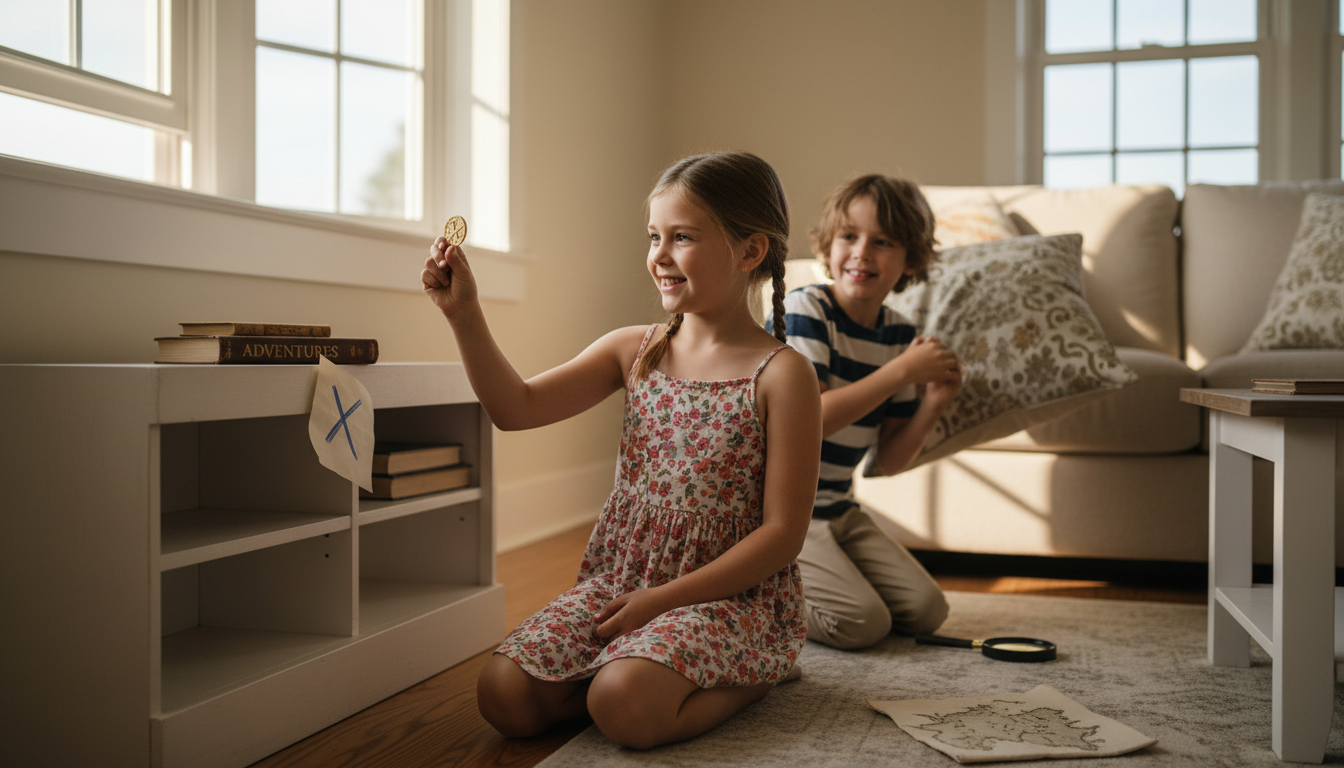
How to Create a 3D Printed Treasure Hunt for Kids
The first step is the print. The second is the route. The third is the clues. The fourth is sitting back and watching a 7-year-old solve a hunt you spent forty-five minutes setting up in roughly nine minutes flat.
This guide walks through what to print, how to plan the route, and how to write clues that don't melt anyone down — with the safety basics every family and classroom needs before handing a kid a printed token.
Why a Printed Treasure Hunt Hits Different

From Paper Clues to Hold-in-Hand Adventure
A folded paper clue works. A folded paper clue stuffed inside a 3D printed egg the kid has to unscrew is a different experience. The texture changes the game. Kids carry the props. They collect the coins. There's a small pile of stuff at the end that proves the hunt was real — and paper can't quite do that.
The setup also doubles as a theme generator. A pirate hunt has coins and a chest. A dinosaur hunt has eggs and bones. The props carry half the story, so the clues can stay simple.
What Kids Learn Without Noticing
Hand a 6-year-old a printed key and a printed lock and watch them figure out which way to turn the key. That's spatial reasoning, no worksheet needed. A puzzle-piece clue teaches problem-solving the moment the kid realizes the pieces only fit one way.
For older kids, a QR clue pulls up the next location on a phone — tech literacy stitched into the play. The lessons don't announce themselves. They're inside the hunt.
The Real Cost of a Home Hunt
PLA runs $20–$25 per kilogram. A flat coin uses about 4 grams, while a hollow egg uses 10–15 grams. A small chest is roughly 40 grams. That means a six-stop hunt with one chest, six eggs, twelve coins, a few clues, and small signs usually costs under $3 in filament.
For parents, that is cheaper than most single-use party favors and more reusable than a bag of plastic toys. The props can come back for birthdays, rainy afternoons, classroom games, or a new clue trail next month.
The props also reuse. Once they're printed, they're on the shelf for every birthday and rainy afternoon for the next year. AOSEED's Toy Library updates weekly with new chests, eggs, and tokens, so the next hunt always has a fresh prop ready to swap in.
Choosing the Right Props to Print

Start Small for a Fast Win
For a first hunt, the prop list is short: one chest, four hollow tokens, a handful of flat coins. That's it. Roughly 60 grams of PLA total. Print time on a starter machine is an afternoon, not a weekend.
A guided toy-making printer for younger kids like the AOSEED X-MAKER JOY handles slicing and bed leveling automatically, so the parent doesn't spend the first hour decoding software. Browse the AOSEED Toy Library and filter by "treasure" with the "no supports" tag for the fastest first-print success rate.
Hollow Tokens Hold the Whole Game
Hollow tokens are the workhorses of the hunt. Each one holds a folded clue. Kids twist open, read the clue, leave the empty shell behind, and move on. Look for screw-top eggs, twist-open capsules, or two-piece press-fit tokens.
Test the fit before printing four copies. If you're sanding for an hour to make the lid sit flat, the model isn't worth the time.
Match Props to the Child
Prop size matters more than detail. A flat coin works at any age. An articulated print-in-place lock works for 8 and up. Anything under 1.25 inches in any direction is a choking risk for toddlers — keep those out of the prop list for the youngest group.
|
Age |
Best props |
Avoid |
|
Under 5 |
Large hollow eggs, big chest, palm-sized signs |
Coins, small keys, anything under 3 cm |
|
5–7 |
Tokens, eggs, chunky coins, large arrows |
Tiny puzzle pieces, fragile hinges |
|
8–11 |
Print-in-place locks, smaller coins, map tiles |
Nothing major — most designs work here |
|
12+ |
Articulated chests, mechanical puzzles, QR-clue tokens |
— |
|
SMALL PARTS — CHECK BEFORE PRINTING For children under 3, any part smaller than 1.25 inches is a choking hazard. The CPSC small parts standard applies to 3D printed items exactly as it does to manufactured toys. Use a slicer's measurement tool to check every prop before queueing the print. |
Setting Up Before the Hunt Starts

The Right Filament for Treasure Hunt Props
PLA covers about 90% of treasure hunt prop work. When PLA isn't right, here's how the alternatives compare:
|
Filament |
Best for |
Watch out |
Difficulty |
|
PLA |
Coins, chests, eggs, tokens, signs |
Cracks under sustained drop impact |
Beginner |
|
PETG |
Outdoor props, multi-color builds |
Strings if retraction isn't tuned |
Intermediate |
|
TPU |
Squeezable clue eggs, flexible tokens |
Slow speeds only — tangles fast |
Intermediate |
|
ABS |
Outdoor weatherproof builds |
Fumes — needs enclosed printer with filter |
Advanced |
Two Settings That Decide Print Quality
Layer height and infill matter most in a kid-friendly 3D printer setup because they control how smooth the props look, how strong they feel, and how long kids wait before playing.
0.2mm layer height balances detail and speed for treasure hunt props. Drop to 0.16mm only for fine surface detail on the chest lid. Infill at 20% handles flat coins and signs; bump to 30–40% for tokens and chests that get dropped repeatedly. Print speed at 40–50mm/s gives cleaner curves than the default 60mm/s on most beginner machines.
Change one setting per failed print. Changing three at once means you'll never know which one mattered.
Workspace and Hot-Part Basics
Flat, stable table. Not a folding desk. Not a rolling cart unless the wheels lock. A printer table that wobbles when someone walks past is the wrong table.
PLA prints at 190–220°C. The hotend stays hot for ten minutes after the screen reads idle. Kids stay out of the build area during printing and immediately after. Adults handle filament loading, stuck prints, and nozzle cleaning — every time. Families comparing setups can browse beginner 3D printers for families filtered by age band and enclosure type. For setup walkthroughs, the AOSEED Learning Center has step-by-step project guides with bed-leveling and first-layer checks.
The Four-Step Hunt Plan

One weekend. Four steps. Each one builds on the last.
Step 1 — Print the Props
Start the print run Friday evening or Saturday morning. Lay out coins, signs, and small tokens together on the bed — they finish in 25–30 minutes as a batch. The chest is a longer print: roughly 2 hours for a small model, 4 hours for a larger one with a hinged lid.
Sand any rough seam before the kid touches it. Two minutes per piece with 200-grit paper.
Step 2 — Plan the Route
Sketch the route on paper before hiding anything. Walk it yourself, timing each leg. If the full walk-through takes under three minutes, add a stop. Over ten, cut one. Four to six stops is the sweet spot for ages 5 to 10.
Sample route for a living-room hunt: door (clue 1) → bookshelf (clue 2 in egg) → couch (clue 3 under coin) → houseplant (clue 4 by pot) → shoe rack (clue 5 in sign-shaped token) → closet shelf (chest with reward).
|
THE ROUTE MOMENT The hunt either works or doesn't at the route stage. Walk it once with a fresh eye before the kid runs it — if a clue could plausibly mean three different things, rewrite it before you hide the next token. |
Step 3 — Write the Clues

Match clues to age. Picture clues work for pre-readers. Two-line rhymes fit ages 6 to 8. Puzzle-piece clues or QR codes work for ages 10 and up. A good clue should take a child about 30–90 seconds to solve without needing adult hints.
Three working rhyme examples:
- "I hold your books and stand up tall. Your next clue waits beside my wall." → bookshelf
- "I'm soft, I'm wide, you sit on me. Look in the cushions, what do you see?" → couch
- "I drink the sun and grow up green. Beside my pot, your clue is seen." → houseplant
Keep rhymes to two lines for 6- to 8-year-olds. Don't try for four.
Step 4 — Run the Hunt
Hand the first clue to the kid at the start point. Watch. Don't help unless they ask twice. The pauses are part of the game — kids work through clues at their own speed, and stepping in too early cuts the satisfaction.
Set a soft time limit if the energy starts dropping mid-hunt. "If you can't crack the next one in two minutes, I'll give you a hint" keeps momentum without taking the game over.
Adding Themes and Challenges

Theme Ideas That Print Fast
Themes cut planning time in half. The props, clues, and reward fall into place once the theme is set.
|
Theme |
Props to print |
Clue style |
Reward idea |
|
Pirate |
Coins, gems, skull sign, key, chest |
Pirate-voice rhymes, map tiles |
Captain's badge + chocolate coins |
|
Dinosaur |
Eggs, bones, footprints |
Footprint trails, simple riddles |
Mini fossil + sticker pack |
|
Space |
Stars, rockets, planet tokens |
"Mission steps," picture clues |
Glow stickers + supply box |
|
Birthday party |
Coins (one per kid), badges, group chest |
Picture clues, group hunt |
Party favors in chest |

Rotating Challenges to Keep It Fresh
A printed prop set gets old if the game stays the same. Three quick variations keep the same props in rotation for months.
Timed hunt: the kid runs the whole route against the clock. Best time wins. Print a small printed trophy as a recurring prize. Sibling hunt: two parallel routes that share the same chest — older kid gets harder clues, younger kid gets pictures, they meet at the finish. Reverse hunt: the kid hides the props, the parent solves. This one teaches clue-writing fast.
Safety and Care for Treasure Hunt Props

Quick Inspection Before Play
Run a finger along every prop before handing it to a kid. Three quick checks:
- Rough seams where the print started or ended — sand flat with 200-grit paper.
- Stringing, the thin filament threads between features — snip off, then re-check by touch.
- Sharp corners on flat coins and signs — a nail file rounds them in 10 seconds.
If your finger catches, the kid's finger will too.
When to Reprint Instead of Repair
PLA cracks at predictable points — joints, thin walls, and the corners of flat pieces. Catching a hairline fracture early matters. A cracked token isn't a glue project; super glue on PLA rarely holds under play stress. A fresh replacement print takes 15–20 minutes.
Keep spares in a labeled bin. Three extra eggs and two extra coins per game prevents the entire hunt from collapsing when a single prop goes missing under the couch.
|
NO WEAPON-SHAPED PROPS Keep the prop list playful and clearly non-weapon: coins, keys, signs, eggs, gems, chests. The ATF covers privately made firearms — including 3D printed ones — under federal law. None of that touches a chest full of stickers, but it's the reason "no weapon-shaped props" is the rule rather than a suggestion. |
Conclusion
A 3D printed treasure hunt earns its place in the family rotation because the props live on the shelf and the game restarts in fifteen minutes. Once the chest, the tokens, and a coin set are printed, every birthday and every rainy afternoon has a ready-made activity.
Start small. One chest. Four tokens. Four clues. A route the kid can run in under ten minutes without losing the plot. The first hunt isn't the impressive one — it's the one that proves the format works. The second is when kids start asking to plan their own.
AOSEED's family creativity platform is built around exactly this loop — print, play, share, repeat. The Toy Library updates weekly so the next hunt has a fresh chest or token waiting. The Learning Center walks setup and troubleshooting in plain language. A guided STEM 3D printer for older kids and tweens isn't valuable because of its first print — it's valuable because of its tenth, when the kid is already designing their own clue tokens and asking which filament holds up best on a tile floor.
Print one chest this weekend. Let the kid pick the color. The hunt writes itself from there.
|
THE TREASURE HUNT MINDSET Print it Friday. Plan it Saturday. Run it Sunday. The printer that earns its shelf space isn't the one with the biggest build volume — it's the one used every weekend. |
FAQs
What is the most wanted 3D printed item?
Toys, fidget items, keychains, mini figures, and game pieces lead the lists across consumer libraries. For kids specifically, treasure hunt props sit at the playful-and-useful overlap — kids carry them around long after the hunt ends.
What is the quickest thing to 3D print?
Flat shapes win on speed. A flat coin prints in 10–15 minutes. A simple arrow sign or printed key takes about the same. Anything without overhangs prints fastest.
Why is my 3D print failing?
Most failures trace to one of four causes: a dirty build plate, wrong nozzle height, wrong temperature, or a model that needs supports printed without them. Watch the first three layers and stop early if anything is lifting.
Is there money in selling 3D printed items?
For a family-friendly treasure hunt, custom coins, clue tokens, and themed party props are usually a better fit than random toy prints because they solve a clear event need.
Can you legally sell 3D printed items?
You can sell your own designs and prints of files with commercial licenses. The trap is the non-commercial license — common on free libraries, and it bans selling printed copies.
What is the best thing to 3D print for money?
Personalization and bundled kits sell best — custom name tags, themed party sets, board-game upgrades, niche replacement parts. The value is the design or the curation, not the gram weight of plastic.
Can I legally keep found treasure?
For a home or classroom hunt, yes — the prize is placed by the host, so there's no ownership question. Genuinely found objects in the wild are different and rules vary by state and country.
Is it a felony to 3D print a firearm?
It depends on federal, state, and local law, and the legal risk is real enough that this isn't a casual project. For kids' 3D printing, keep everything clearly non-weapon.
Sources
- U.S. Consumer Product Safety Commission (CPSC), Small Parts and Choking Hazard Labeling FAQs
- U.S. Bureau of Alcohol, Tobacco, Firearms and Explosives (ATF), — federal guidance covering 3D-printed firearms
- Centers for Disease Control and Prevention (CDC), Safety, Health, and Injury Prevention Recommendations
- National Institutes of Health (NIH), 3D Print Exchange
- PubMed Central (NCBI), Injury Prevention Tips for Healthy Active Living at Home, School and in the Community


Further reading

Graduation Gifts for Kids: Keepsakes for Kindergarten to Fifth Grade

How to Clean a 3D Printer: A Routine for Families

3D Printer Filament Holder: Options, Setup and a Version You Can Print


