
Educational Christmas Gifts for Kids That Don’t Feel Like Homework
Educational Christmas gifts for kids work best when the kid thinks it’s just a toy. Magnetic tiles teach spatial thinking, a kids’ cookbook teaches fractions, and a 3D printer teaches kids to test a design, find what broke and fix it.
Our 12 picks are grouped by the skill they build: spatial thinking, measuring, design iteration and testing ideas. Age isn’t the sorting rule here. Each gift has one activity to try the week of Christmas, and none of them comes with a worksheet.
The list covers STEM gifts for kids, some of the best science gifts for kids who like experiments, and a couple of quiet puzzles for the drive to Grandma’s.
The 12 Educational Gifts at a Glance
One skill per gift. The activity column is what we’d do first, probably on December 26, when the wrapping paper is in the recycling bin and everyone is a little bored.
|
Gift |
Skill it builds |
First activity to try |
Age on the box |
|
Magna-Tiles Classic 32 Piece Set |
Spatial thinking |
Build a cube, then lay it flat to see its net |
3+ |
|
Kanoodle |
Spatial thinking |
Solve one puzzle a night and time it |
7+ |
|
ThinkFun Gravity Maze |
Spatial thinking |
Plan the marble’s path before placing a tower |
8+ |
|
America’s Test Kitchen Kids Cookbook |
Measuring |
Double a cookie recipe |
Not listed |
|
Thames & Kosmos Weather & Climate Lab |
Measuring |
Log rain and temperature for a week |
6+ |
|
Primary Science Mix & Measure Set |
Measuring |
Weigh a cup of rice against a cup of cereal |
3+ |
|
AOSEED X-MAKER 3D printer |
Design iteration |
Print a phone stand, test it, print version two |
9 to 16 |
|
Klutz Book of Paper Airplanes |
Design iteration |
Change one fold and measure the flight |
7+ |
|
Makedo Discover Kit |
Design iteration |
Build a cardboard bridge that holds a can of soup |
4+ with help |
|
National Geographic Junior Microscope Kit |
Testing ideas |
Guess, then compare salt and sugar up close |
Not listed |
|
National Geographic Mega Crystal Growing Lab |
Testing ideas |
Grow two crystals in two spots and compare |
Not listed |
|
Botley 2.0 Coding Robot Activity Set |
Testing ideas |
Predict the robot’s path, run the code, fix bugs |
5+ |
When Does a Learning Gift Stop Feeling Like Homework?
Three things, mostly. The kid picks the goal, something happens the same day, and nobody hands out a grade. Take away any one of those and a good kit starts to look like homework.
The Kid Picks the Goal
Kids will build “whatever you want” for an hour. They’ll build “page 4” for ten minutes. The best educational toys come with ideas but let a child wander off script, and the wandering is where a lot of the learning happens.
Something Happens the Same Day
A marble drops into the cup. A plane makes it across the room. Cookies come out of the oven. Each one gives a kid a reason to go again, while gifts that take three weeks to show anything usually go back in the box.
Mistakes Count as Progress
When a paper plane nosedives, your kid just learned something about that fold. Engineers think the same way. The engineering design process from TeachEngineering ends with test and improve, and then it starts over.
A Grown Up Sits on the Floor Too
The American Academy of Pediatrics’ advice on choosing toys leans toward simple things like blocks and puzzles. It also says kids get more out of playing with a parent than out of a screen. Twenty minutes counts.
Spatial Thinking Gifts That Feel Like Games
This group is about seeing shapes in your head. When a kid turns a puzzle piece mentally before trying it, that’s spatial thinking, and it comes back in geometry and map reading. Families with a printer can take it further with 3D printed geometry solids kids can hold and compare.
1. Magna-Tiles Classic 32 Piece Set: Flat Shapes That Become 3D
Thirty two magnetic tiles: squares and three kinds of triangles. The Magna-Tiles Classic 32 Piece Set costs $49.99. The box says ages 3 to 99, which isn’t far off. The magnets are riveted inside the plastic so they don’t work loose.

Nobody has to say “geometry.” Younger kids mostly build garages and towers for toy cars. Older ones try a pyramid, watch it cave in, and work out on their own that the triangles need to lean against each other.
First night: Snap six squares into a cube. Open it and lay it flat to see the cube’s net, a cross shape. After that, see how many other flat layouts they can find that still fold into a cube (there are 11, which surprises most adults).
2. Kanoodle, the Puzzle That Lives in the Glovebox
Small enough for a glovebox. Kanoodle from Educational Insights has 12 odd-shaped pieces, a booklet of 228 challenges and a case that doubles as the board. $13.99, ages 7+.
Each puzzle starts with a few pieces already placed. The rest have to be flipped and turned in your head before they’ll fit, and kids find out fast that jamming pieces in doesn’t work. One player, so it’s good while a sibling has the TV.
After dinner: Do one puzzle a night and time it on a phone. Write the times inside the box lid. By the second week the numbers drop, and nobody had to call it practice.
3. ThinkFun Gravity Maze for Kids Who Like Marble Runs
In the box for ThinkFun Gravity Maze you’ll find a grid, nine towers, three marbles and 60 challenge cards. A card tells you where a few towers go, and your kid works out where the rest belong so the marble reaches the target. Rated 8+, around $24 to $30.
The marble only goes where the towers send it. If they just start stacking, the marble usually rolls off the side, and after a few of those most kids begin running a finger along the path first.
Quick rule: no tower goes on the grid until your kid has said where they think the marble will end up. Then let it go. A wrong call isn’t a problem. It just points to the tower they need to look at.
Measuring Gifts That Turn Numbers Into Real Things
Measuring sticks when the thing being measured matters to the kid. Cookie dough. Last night’s rain. These three gifts give numbers an actual job, and for more ideas there’s our list of measurable experiments families can run at home.
4. America’s Test Kitchen Kids Cookbook: Fractions You Can Eat
More than 740 kids tested the recipes in The Complete Cookbook for Young Chefs from America’s Test Kitchen Kids. It has 100+ recipes over 208 pages. List price is $19.99, and the ATK store had it for $15.99 this week.

Cooking is a lot of math that doesn’t look like math. Reading a recipe, leveling off a cup, counting teaspoons, watching the timer. The cookies are why they come back.
Saturday baking: Double a cookie recipe. Your kid works out that 3/4 cup of sugar turns into 1 1/2 cups and measures it. If they get it wrong, the cookies will say so.
5. Thames & Kosmos Weather & Climate Lab: Turn the Backyard Into Data
Rain gauge, thermometer, wind vane, compass and anemometer, all on one stake. The Thames & Kosmos Weather & Climate Lab is $19.95 at Target and rated 6+. The 32 page manual has 8 experiments.

It goes in the yard and gets checked every morning. No battery, no screen, just a notebook. After a week or two most kids start guessing tomorrow’s numbers before they look.
One week log: Write down the rain and the temperature every morning for seven days. Draw a bar chart on paper. Then ask which day was the wettest, and whether the cold days were the windy ones too.
6. Primary Science Mix & Measure Set: Real Measuring for Little Hands
A real scale, plus measuring cups and spoons, two liquid cups, a bowl and 10 activity cards. That’s the Primary Science Mix & Measure Set from Learning Resources. Kaplan sells it for $43.95, ages 3+.
The pieces are big enough for preschool hands. The questions aren’t babyish, though. Which cup holds more, which one weighs more, and why those two answers don’t always match.
Kitchen table test: Fill one cup with rice and one with cereal. Put both on the scale. Same cup, different weight, and your kid gets to explain it.
Design Iteration Gifts: Build It, Test It, Fix It
Make it, test it, change one thing, try again. Engineers work in that loop all day, and it’s good for kids to see that a first try that flops is normal.
|
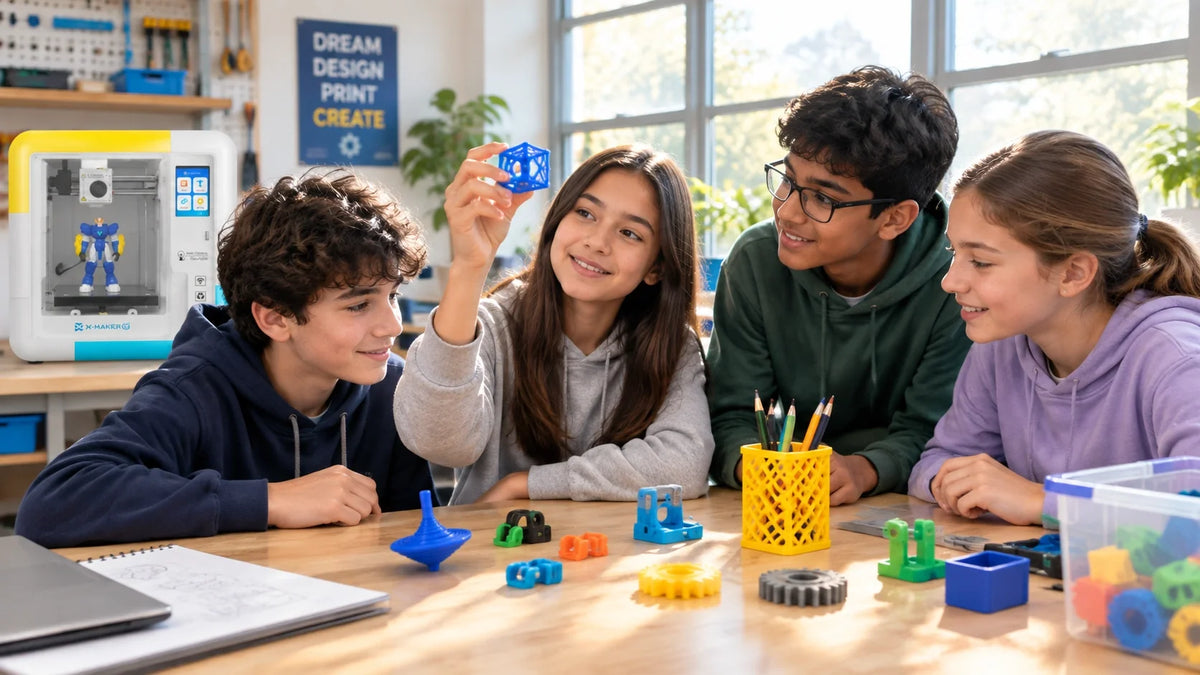
WHY A 3D PRINTER FITS THIS GROUP A 3D printer fits that whole loop into one afternoon. Kids design a part, print it, hold it, notice what’s wrong and print version two. A small print uses cents of filament, not dollars. If you’re comparing printers for different ages, start with this educational 3D printer for kids lineup from AOSEED. |
7. AOSEED X-MAKER: A 3D Printer for Real Design Projects
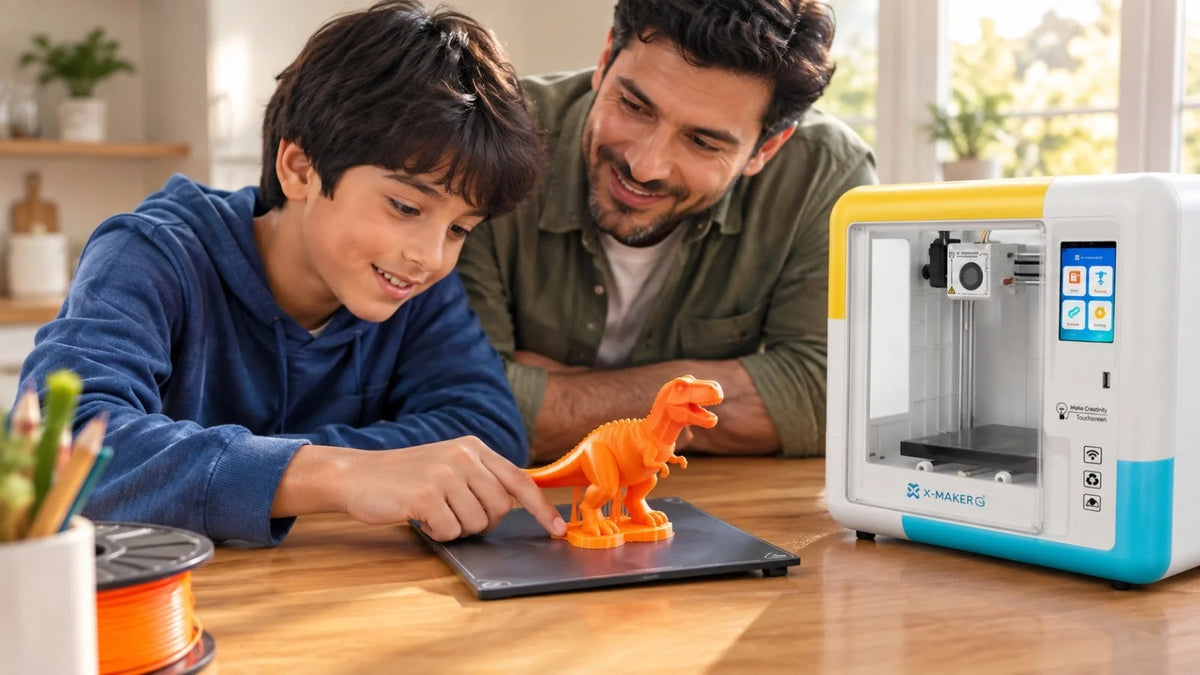
The AOSEED X-MAKER, made for ages 9 to 16, has its own touchscreen and also runs from the AOSEED app on a phone or tablet. Kids print from thousands of ready-made models or build their own with game-style design tools. It handles PLA and ABS.
Each print is basically a test. A wall that’s too thin bends, and a lid that’s too tight won’t close. The kid finds out by holding it, changes one setting and goes again.
AOSEED lists the motor at under 50 dB, so it can sit on a bedroom desk without bothering anyone.
Home project: a phone stand that actually holds a phone
1. Design a simple wedge-shaped phone stand with the design tools in the AOSEED app.
2. Print it in PLA, the plant-based plastic most kids’ printers use.
3. Put the phone on it and write down what happens. It might tip back, slide forward or lean too flat to read.
4. Pick just one fix, for example, a steeper angle or a taller lip at the front, then print a second stand.
5. Line the two up, try the phone on each, and keep whichever one works better.

You’ll still load the filament and pop prints off the plate. The first print might need a redo. A lot of kids ask for a third version straight away, usually in a different color.
8. Klutz Book of Paper Airplanes and a Roll of Painter’s Tape
$9.20 at Walmart. The Klutz Book of Paper Airplanes is a 56 page spiral book with 10 plane designs and 40 sheets of patterned paper to fold. Target lists it for ages 7 to 10.

Paper planes are about as cheap as engineering gets. A plane that dives is telling you something about the fold. Bend the back edges up a bit and it might glide.
Hallway contest: Put painter’s tape on the floor as a start line. Throw one design three times and measure each flight. Change a single fold, throw it three more times, and see if the average went up.
9. Makedo Discover Kit: Cardboard Engineering With Real Tools
Cardboard isn’t in the box, and that’s on purpose. The Makedo Discover Kit gives kids 126 pieces: two kid-safe saws, a screwdriver and 120 reusable plastic screws. The pile of holiday boxes becomes the building material.
On age, the company suggests kids from 4 can use it with an adult helping, and from about 7 on their own. First builds usually sag. That’s when kids work out that a wall needs a brace and a flat roof needs a fold.
Bridge challenge: put two kitchen chairs a little apart and ask for a cardboard bridge between them that can hold a can of soup. The first one will probably bend in the middle. Ask what single change might stop that, and let them rebuild.
Science Gifts for Kids Who Like to Test Things
These are the best science gifts for kids who keep asking “what if.” Each one lets them guess, test and check. It’s the scientific method, minus the lab report.
10. National Geographic Junior Microscope Kit: Look Closer at Everyday Stuff
Walmart sells the National Geographic Junior Microscope Science Kit for $32.99. Magnification runs from 50x to 250x, there’s a light above and below the slide, and you get 6 prepared and 6 blank slides.

Salt stops being “white stuff” the first time a kid sees the little cubes. After that, the whole kitchen turns into samples, including a few things you’d rather not see on a slide.
Guess first: Ask whether salt and sugar look the same up close. Write the guess down. Put a few grains of each on a blank slide and check.
11. National Geographic Mega Crystal Growing Lab: An Experiment That Takes Days
Six colors of crystal powder, one of them glows in the dark. The National Geographic Mega Crystal Growing Lab ($29.99) also has 6 seed rocks, 4 real specimens and a light-up base that runs on USB. Blue Marble, the maker, says crystals form in 3 to 4 days.
This one is slow, and that’s fine. Most kids end up looking at the jar every morning before school, and writing down what changed gives them something to compare later on.
Two jar test: grow two crystals of the same color, one in a warm room and one in a cooler spot like the garage. A ruler reading each morning shows which one grows faster.
12. Botley 2.0, a Coding Robot With No Screen at All
No app and no screen. The Botley 2.0 Coding Robot Activity Set from Learning Resources has 78 pieces, follows up to 150 coded steps, and needs 5 AAA batteries you’ll have to buy. It’s $99.99, ages 5+.
Kids plan a route, press go and watch Botley bump into a block. Then they hunt for the wrong step. That’s debugging, and a lot of kids will happily do it for an hour.
Maze night: Build a short maze with the pieces in the box. Your kid predicts Botley’s path out loud, then runs the code. If Botley ends up somewhere else, they fix one step at a time instead of starting over.
Choosing Educational Gifts for Kids by What They Like to Do
The easiest way in is to look at what your kid already does with free time, then match a skill to it. The age on the box still matters for safety, but interest is what gets a gift used.
Look at How They Spend a Free Saturday
Kids who build couch cushion forts tend to enjoy the spatial gifts. The one who always asks how far or how much will like measuring gifts. Kids who take apart pens and remotes usually want design iteration.
If your child already prints at home and wants the prints to move, AOSEED creative kits for kids who print turn the parts into race cars, music boxes and science projects.
One Skill per Gift
Kits that promise coding, chemistry, art and math in one box usually end up thin on all of them. When a gift is about one thing, you already know what to do with it on day one, and getting started is the hard part with most gifts.
Read the Box for Small Parts and Magnets
Check the age printed on the box, especially with a toddler in the house who might grab small pieces. Magnet sets need the most care, since the CPSC warns that swallowed magnets can pull together inside the body and often have to be removed with surgery.
Plan the First Activity Before Christmas Morning
Pick the first project ahead of time and have the batteries, flour or tape ready. For a weather gift, this rainfall activity from SciJinks uses a plastic bottle and takes about 15 minutes.
Final Thoughts on Educational Christmas Gifts
Starting with the skill makes the shopping easier. The gift is also more likely to get used if you plan one small activity for the week after Christmas, before school starts again.

If design iteration is what you’re after, a kids’ 3D printer hands your child a new problem with every print. You can see what families make with AOSEED’s design, print and play platform.
FAQs
What are good educational Christmas gifts for kids?
Anything that teaches one real skill while it feels like play. Magnetic tiles, logic puzzles, a kids’ cookbook, a weather station, a microscope and a 3D printer all fit, and none of them looks like school.
What are the best science gifts for kids this Christmas?
Ones where the kid runs the test. A microscope, a crystal lab and a weather station all give real results. If you have a 3D printer, the X-Science physics kit has kids print the parts for each experiment.
What are the best STEM gifts for kids right now?
It depends on the skill you’re after. For spatial reasoning, Gravity Maze and Kanoodle work well; Botley covers early coding, and a 3D printer covers design. For a robot project, there’s X-KIT, a robot kids design, print and code.
Which toys help kids build spatial skills?
Blocks, puzzles and board games. In a study of 847 children aged 4 to 7, kids who played with them more than six times a week did better on a spatial test. That’s a link, not proof the toys caused it.
How do I keep an educational gift from feeling like homework?
Skip the quizzes and play too. Let the kid pick the goal, and lean on everyday stuff like baking. These kitchen math ideas from SDSU Extension show how often fractions and measuring come up while you cook.
Is a 3D printer a good educational gift for kids?
Yes, for kids who like making things. Every print is a small design test with a result you can hold. Put the printer in a room with some airflow and follow NIOSH guidance on safe 3D printing.
Can younger kids use a 3D printer?
Yes, with the right model and a parent close by. The X-MAKER JOY for younger makers is built for ages 4 to 12, runs from an app and has an enclosed print area. You’d still load the filament.
Are educational toys actually worth it?
Only if they get played with. A $14 puzzle that comes out every week teaches more than a $200 kit on a shelf. Buy for the kid’s interests first and the label second.




Further reading

Big Christmas Gifts for Kids: Is a 3D Printer Worth It as the Main Gift?

Science Gifts for Kids: 12 Kits That Teach Something Real
Educational Christmas Gifts for Kids That Don’t Feel Like Homework