

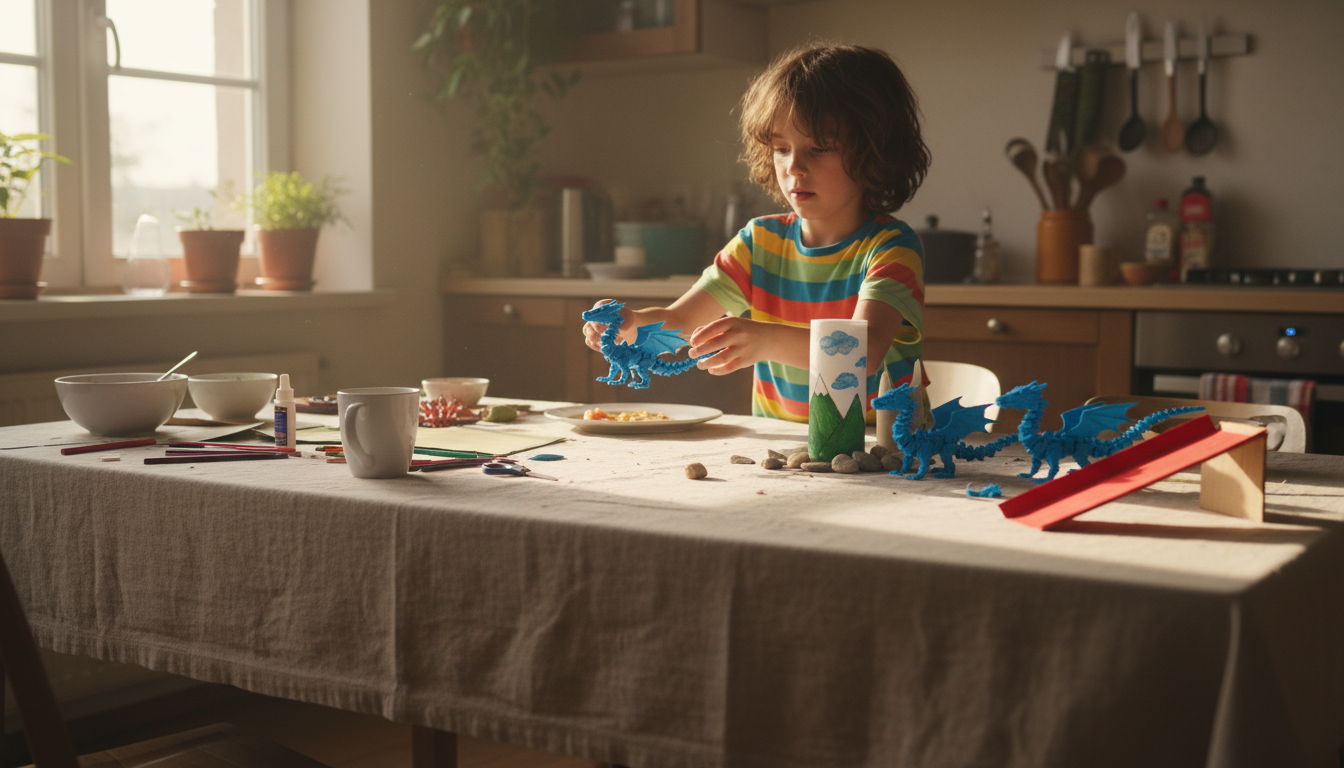
How to Extend a 3D Printed Toy: One Model, Three Ways to Play
A 3D printed toy starts hot. The kid plays with it all weekend, drags it to the dinner table, names it twice, and then forgets it by Monday The fix isn't another print. It's extending the toy you already have — turning one model into three different ways to play. Same plastic, three times the use.
This guide shows how to extend a 3D printed toy across story play, game challenges, and remix projects so one print becomes more than a one-time build.. Most extensions cost zero filament. All of them work better than queuing a brand-new print every weekend.
Why One 3D Printed Toy Should Earn More Than One Use

Most printed toys peak in the first 48 hours. The novelty fades, the kid moves on, and the model joins a bin under the bed. That's a filament problem. It's also a habit problem.
Extension breaks the cycle. A wolf figurine becomes a story character, then a target piece in a hallway race, then a half-painted display piece by Sunday. Same toy, three lives. Families planning prints from a beginner 3D printer for families can pick first-time models with extension in mind — not just first-print thrill.
|
Play mode |
What changes |
What it costs |
|
Story character |
Add a name, role, mission. Pretend play takes over. |
Zero filament |
|
Game challenge |
Add rules, scores, time limits. Sibling-friendly. |
Zero filament |
|
Remix project |
Paint, sand, add printed accessories, decorate. |
A few craft supplies |
The 'Extend Before You Reprint' Idea
Ask one question before queuing the next print: what else could this toy do?
A printed fox isn't only a fox. It can star in a homemade story, mark the path of a maze, or get painted into a gift by Saturday. The shift is from 'what should I print next' to 'what could this print become next.' Cheaper. Slower. Better.
Why Moving Parts Make Extension Easier
Hinges, joints, wheels, chains. Anything that moves keeps kids interested longer than a static figure.
Print-in-place toys are the easy win. The model comes off the build plate already articulated. Snap a flexi snake, bend a chain, spin a gear. The toy stays fresh because it can do new things every time the kid picks it up.
What 'Extension' Actually Means
Extension isn't replay. It's reused with a new frame.
Day one, the toy is a printed dragon. Day five, it's the boss of a sibling board game. Day twelve, it's wearing a new printed hat and acting as a paperweight on the homework pile. Same physical object, three different roles. That's an extension.
Way 1 — Extend the Toy Into a Story Character

Story play is the cheapest extension. Zero filament. Zero supplies. Just a kid willing to give the toy a name and a problem to solve.
The figure stops being plastic and starts being a character with a mission. That shift is what gives a printed toy a long second life — and it usually takes about thirty seconds to start.
Name, Role, Mission
Names first. Captain Shell the turtle. Bolt the robot. Ember the dragon.
Then a role — hero, guard, explorer, racer. Then a mission — cross the paper-towel-roll bridge, find the missing keyring, rescue a sibling's stuffed animal. Three sentences are enough to launch an hour of pretend play.
Print Small Props or Scenery
Props extend story play without burning a full spool. A bridge, a treasure chest, a tiny shield — each one takes minutes to print and changes the whole scene. Mix printed scenery with cardboard, books, and household items. A printed cave next to a couch-cushion mountain works fine. Kids browsing AOSEED's step-by-step project guides can pick props that match the story they're already telling.
Stop-Motion or Photo Story
Stop-motion turns the toy into a movie star. Pose, photo, nudge, photo again. Free apps stitch frames into a 10-second clip. Articulated figures with movable parts work best.
Three-shot photo stories are the gentler version. Beginning, problem, ending. Done in five minutes. No editing software needed, just a phone and a willingness to take pictures of plastic.
Way 2 — Extend the Toy Into a Game Challenge

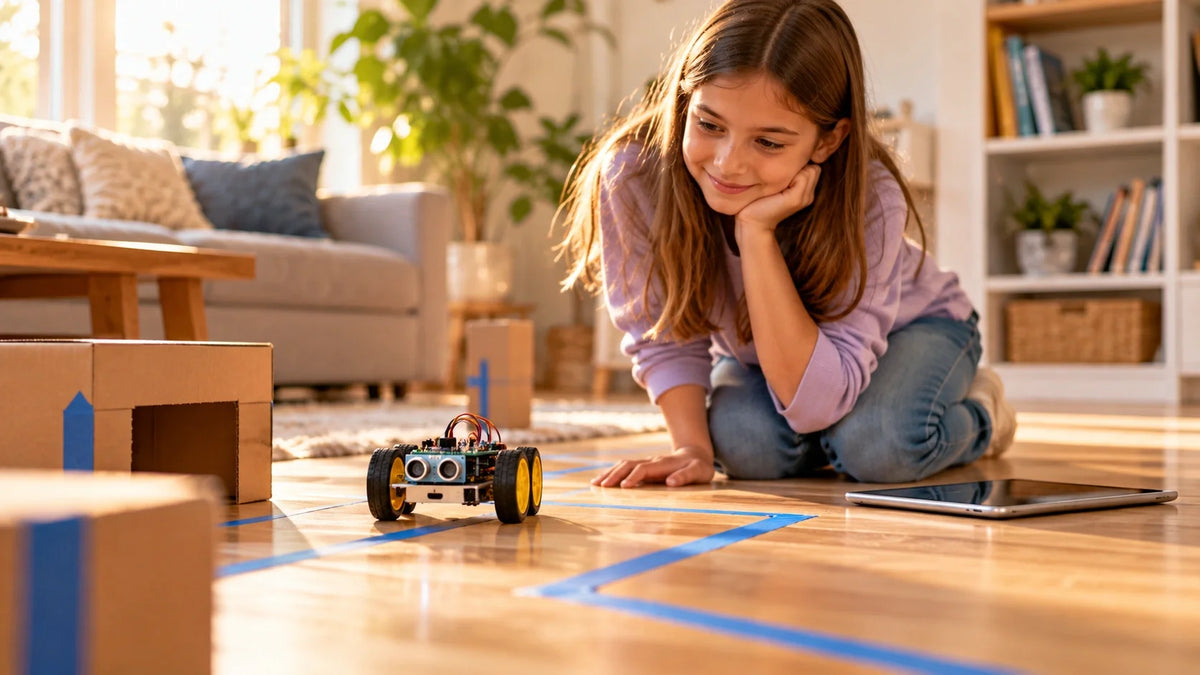
Add rules and a toy becomes a game. The same wolf figurine that played hero on Sunday is a target piece in a hallway race on Wednesday.
Game extension also fixes the 'two kids, one toy' problem. Short rounds, fair scoring, escalating difficulty. The toy stays in play long after the novelty wears off.
Balance, Toss, or Target Game
Balance games are easiest. Stack the toy on blocks, place it on a tilted book, time how long it stays upright before the table wobble takes it down.
Toss games only work with smooth, sturdy models. Printed rings, beanbag-shaped tokens, rounded pucks. Sharp toys and hard throws don't mix. Target games can stay gentle — slide a printed car toward a finish line, roll a marble through a printed gate, knock a printed standee over with a soft beanbag.
Add Points, Rounds, and Time Limits
Points turn a backyard rule into a real game. Close target: 1 point. Far target: 5 points. Trick shot off a ramp: 10 points.
Rounds keep things fair — same toy, same number of turns. Time limits add urgency. Sixty seconds to build a bridge before the wolf has to cross it. Cap the round so siblings don't fight over the last attempt.
Solo, Sibling, or Family Versions
Solo play is quiet play. Beat your own score. Build a harder maze. Time how fast the car crosses three ramps in a row.
Sibling games need rules everyone agrees on before turn one. Family versions can split roles — one builds the course, one sets the rules, one tests the toy. Rotate after each round so nobody gets stuck refereeing.
Way 3 — Extend the Toy With Add-Ons and Remixes

Remixing is where a 3D printed toy becomes a design project. Change the look. Add gear. Print new parts. Same model, new identity.
Remixes don't have to be big. A new hat. A different colored tail. A name tag glued to a stand. Small edits teach kids that designs aren't finished — there's always one more thing to try.
Paint, Sand, Decorate
Sanding comes first. Fine-grit paper, light pressure, focused on support marks and any edge that catches a fingernail.
Acrylic paint sticks to PLA without primer in most cases. Stripes, eyes, armor plating, team colors. A thin clear-coat spray seals the finish. Stickers, washi tape, and printable labels work too — just keep them away from moving joints, or the toy stops moving.
Print Hats, Tools, Stands, Connectors
Accessories turn one toy into a set. A saddle for an animal. A tool belt for a robot. A printed stand to keep the figure upright between play sessions.
Connectors are the secret weapon. A clip, peg, or bracket lets the toy attach to building blocks, ramps, or other printed pieces. Test fit before printing twenty copies. Filament tolerances drift between brands and between spools.
Change Size, Color, or Texture
Scale up. Scale down. Print the same model at 80% and 120% to make a toy family — parent, kid, pet. Kids assign roles in about thirty seconds once the sizes exist.
Color carries meaning if you let it. Red pieces are obstacles. Blue pieces help. Green pieces give a power-up. Same physical model, three different game roles depending on which spool is loaded that day.
Best Toy Types to Extend (and Which to Skip)

Print-in-place toys and flexible 3D printed toy ideas for kids usually work best because they survive repeat play, support new game rules, and hold up during remix activities.Not every model extends well. Fragile display pieces don't survive a kitchen-floor game. Featureless tokens don't carry a story. The best extension candidates have a clear shape, sturdy parts, and at least one moving element.
|
Toy type |
Story |
Game |
Remix |
Best for ages |
|
Fidget / sensory |
●● |
●●● |
●● |
5+ |
|
Articulated animal / figure |
●●● |
●● |
●●● |
6+ |
|
Puzzle / maze / brain teaser |
●● |
●●● |
●● |
7+ |
|
Board game piece / miniature |
●●● |
●●● |
●●● |
8+ |
|
Display-grade mini |
● |
● |
●● |
10+ (skip if extension is the goal) |
Articulated figures and board game pieces stretch across all three modes. Fidgets win on games and quick remixes. Display-grade minis usually flunk extension — they're built to be looked at, not handled.
Setting Up the Extension — Materials and Safety
Extension is mostly free. Pretend play, paper props, a few craft supplies. Where extension does cost money is when you're adding new printed accessories. That's where filament choice and safety basics matter.

SMALL PARTS — CHECK BEFORE EXTENDING
For children under 3, any printed part smaller than about 4 cm is a choking hazard. The CPSC small-parts rules apply to 3D printed pieces exactly as they do to manufactured toys. Store small accessories in a sealed bin and supervise the under-5 crowd during paint and remix sessions.
|
Filament |
Best for |
Watch out for |
Kid-friendly? |
|
PLA |
Most toys, accessories, gifts |
Softens above 60 °C; brittle on thin parts |
Yes — default choice |
|
PETG |
Toys that need flex or rough handling |
Stringing common; slower print speed needed |
Yes — durable upgrade from PLA |
|
ABS |
High-impact parts, advanced makers |
Strong odor; emits VOCs without ventilation |
Only with enclosed printer + ventilation |
|
TPU |
Soft fidgets and grips |
Tricky to print; slower jobs |
Yes for older kids |
Ventilation matters either way. The EPA notes that 3D printing can release gases and ultrafine particles, including VOCs, that may affect indoor air quality. For families just starting out, a guided toy-making printer for young kids is safest and easiest when it handles extension projects in PLA. Choose an enclosed printer in a shared, well-ventilated family space so adults can supervise prints and keep safety guidance consistent.
Common Extension Mistakes
Most of these are well-meaning. All of them are fixable.
|
Mistake |
Why It Fails |
Better Approach |
|
Printing more before extending what's there |
Filament cost climbs, toys pile up unused |
Try three game ideas with the toy first |
|
Extending fragile display models |
They snap on the first game attempt |
Pick sturdy print-in-place models for extension |
|
Painting before sanding |
Paint shows every support mark and ridge |
Sand first, prime if needed, then paint |
|
Adding tiny accessories for young kids |
Choking hazard, lost pieces, frustration |
Use chunky add-ons for under-6; sealed bin for storage |
|
Skipping the first extension plan |
Toy gets played with once, then forgotten |
Plan one story, one game, one remix before printing |
Conclusion
The best extension is the one your kid can repeat without help. Tools, time, permission to make a mess.
That last part is the one most parents underestimate. Permission. Most maker kids don't quit a project because the printer broke — they quit because someone reorganized the kitchen table they'd claimed as their workshop, or because a sibling moved their half-finished build "out of the way."
Same model. Three modes. That's the whole pitch. Story play costs nothing — a name, a role, a mission, and the kid's running with it. Game challenges add rules and a score sheet. Remixing turns the toy into a small design project the kid can take their time with. Together they stretch one print across weeks instead of days.
You won't get every mode every weekend. Some Saturdays the wolf figurine is a hero saving the cushion fort. Other Saturdays it's a paperweight on a half-finished homework pile. Both count.
For families ready to build extension into the routine,AOSEED's family creativity platform pairs an age-banded printer ladder with a weekly-updated Toy Library — the next project is always queued before the last one cools. The same setup runs in over 5,000 schools and training institutions, which means the weekly-project rhythm isn't a guess. It's field-tested on classrooms full of seven-year-olds who'd rather be doing literally anything else, and it still holds up.
A guided STEM 3D printer for older kids and tweens isn't valuable because of its first print. It's valuable because of its fiftieth. The fiftieth print is the quiet one — the one where your kid stops asking you for help, stops asking for permission, and just heads downstairs to start the job before breakfast.
That's the gift. Not the machine. The habit.
THE EXTENSION MINDSET
Tools, time, permission. The toy that earns its shelf space isn't the prettiest one out of the box — it's the one your kid is still inventing new uses for on a quiet Wednesday in March.
FAQs
Are 3D printed toys safe to play with?
Yes, when models are smooth, strong, age-appropriate, and printed in PLA or PETG. Skip parts under 4 cm for the under-3 crowd.
How long do 3D printed toys last?
Months or longer with thick walls, 25–35% infill, and labeled storage. Thin tails and narrow swords often snap on day one.
Do 3D printers give off toxins?
Some materials release VOCs and ultrafine particles. Ventilate the room and keep kids away from the print bed during long jobs.
Why is my 3D print failing?
Usually poor bed adhesion, wet filament, wrong nozzle temp, or fast speeds on detailed parts. Slow down and re-level the bed first.
What items should I avoid 3D printing for kids?
Tiny toys for toddlers, sharp toy weapons, paper-thin walls, food-contact items, and pet chew toys.
How much does it cost to run a 3D printer for 1 hour?
That is why extending a 3D printed toy through story, game, or remix play is often cheaper than printing a brand-new toy every time interest fades.
Can you wet a 3D printed toy?
A damp cloth is fine. Soaking isn't — water sits in layer lines and slowly weakens the print.
What if my kid is bored of a printed toy already?
Try one extension before reprinting. Name it, give it a game, or paint it. Most 'boring' toys come back with a five-minute reframe.
Sources
- U.S. Consumer Product Safety Commission —federal toy safety standards and small-parts guidelines for children under 3
- U.S. Environmental Protection Agency —research on emissions, VOCs, and indoor air quality from consumer 3D printing
- Cleveland Clinic —medically reviewed first-aid and prevention guidance for childhood choking
- Autodesk Tinkercad —free browser-based 3D design tool for kids, classrooms, and beginner makers
- Printables.com — Toys & Games —community-verified STL library of kid-friendly toys, fidgets, and family projects
- AOSEED Kids 3D Printer Collection —full lineup of enclosed kid-friendly 3D printers sorted by age range


Further reading

Graduation Gifts for Kids: Keepsakes for Kindergarten to Fifth Grade

How to Clean a 3D Printer: A Routine for Families

3D Printer Filament Holder: Options, Setup and a Version You Can Print


