

Family Creativity Night: A Simple Weekly Plan for Parents and Kids
Family creativity night is the small, repeated version of all those “we should do more together” plans that never quite land. This weekly creative family time works best when it stays simple, short, and easy to repeat.
This guide covers what to pick, how to set up, and how to turn fifteen minutes of glue and paper into a weekly habit your kids actually ask for — with the realistic shortcuts every busy parent needs before sitting down at the table.
Why One Weekly Night Builds a Real Family Habit
This weekly loop turns family creativity night into a simple weekly tradition, where creative family time feels easy enough to repeat instead of too big to start.
The Weekly Loop That Actually Works
Most parents try "more crafts" out of ambition. Big Saturday plan, hour-plus block, perfect supplies. Saturday never happens. The supplies sit in a cabinet. Three months later, nothing has changed.
A weekly loop fixes that. One night, fifteen to sixty minutes, same day every week. Predictable enough that kids stop fighting it and start asking what the theme is. Short enough that tired parents actually show up. The repetition is where the connection forms — not the ambition of any single night.

What Kids Pick Up Without Noticing
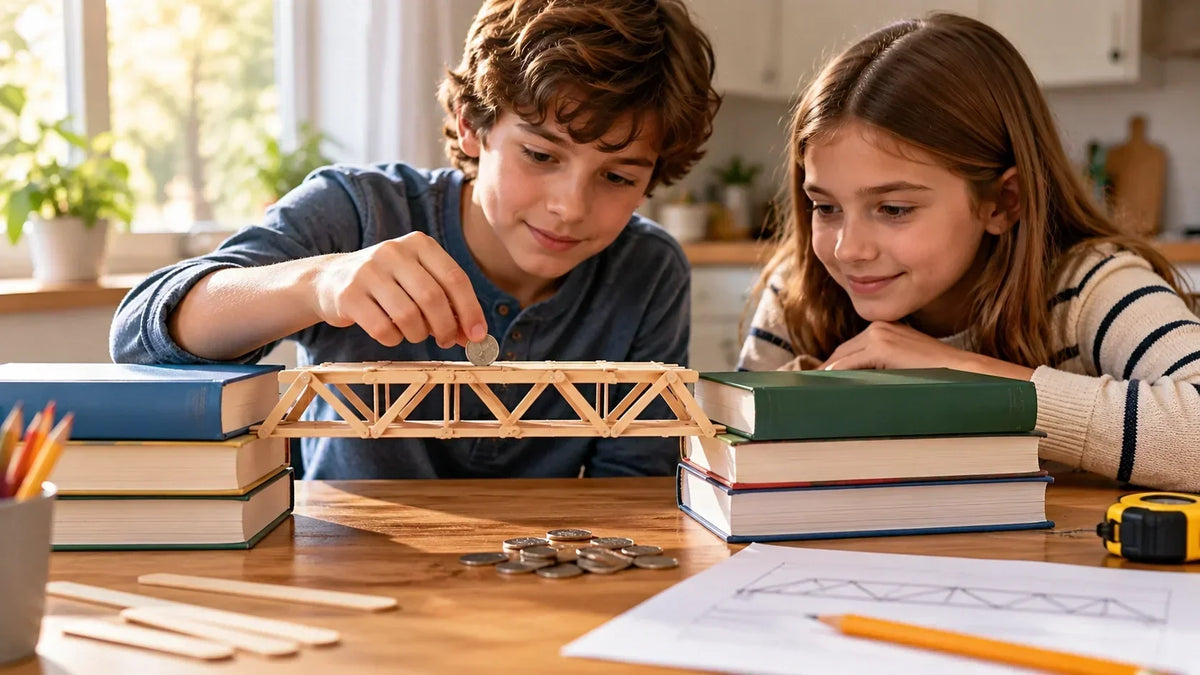
Sit a six-year-old down with cardboard, tape, and three toy cars and ask them to build a bridge. Within ten minutes they're problem-solving — which beam is too floppy, which angle holds weight, what happens when the tape wraps the other way. That's an engineering lesson with no worksheet attached.
Drawing the same still-life as your kid teaches color choice and proportion without correcting their crayon. Storytelling night builds vocabulary. The American Academy of Pediatrics has long argued that play isn't a break from learning — it's how kids build planning, social skills, and emotional control. A weekly slot gives that learning a regular home.
The Real Cost of Family Creativity Night
Crayons, washable markers, glue sticks, kid scissors, paper, tape. The full starter kit runs under $25 once. Most weekly nights cost zero after that — recycled cardboard, kitchen-drawer scraps, magazines, household objects. Even a full year of weekly nights stays under $50 in fresh supplies.
For families ready to grow into bigger projects, AOSEED's family creativity platform extends the same weekly rhythm with guided design apps and a Toy Library that refreshes — so the next project is always ready when one finishes. There's no blank screen to stare at.
Choosing the Right Activity for Your Family
Start With a Win, Not a Project
For the first month, choose simple family night ideas that finish in 15–30 minutes instead of long builds that end in frustration. Paper-plate animals, kindness cards, sock puppets, sponge-painted flowers, and other creative activities for families start fast, finish clean, and look done.

A finished project by 7:30 PM teaches everyone — kids and adults — that the night actually works. For STEAM-leaning families with younger kids, a guided toy-making 3D printer for younger kids like the AOSEED X-MAKER JOY handles most of the setup so the activity stays at "design and play" rather than "fiddle with settings." Either way, save the long builds for week ten, not week one.
Activities With Movement Hold Attention Longer
Static crafts — coloring sheets, finished templates — get five minutes. A flexible cardboard claw, a marble run made from paper-towel tubes, a sock puppet with a working mouth: those hold a child's attention for twenty.
The pattern is consistent across ages. Things that move, fold, or test invite repeat handling. The four-year-old plays with the motion. The ten-year-old starts asking why it works. The activity earns its time because the kid keeps coming back to it.
Match the Activity to the Child
Complexity should follow attention span, not just birthday. Here's a quick reference:
|
Age Group |
Best Activities |
Avoid |
Session Length |
|
Ages 3-5 |
Sensory play, tearing, gluing shapes, sponge-painting, playdough |
Small parts, detailed cutting, perfect outputs |
15-20 min |
|
Ages 6-9 |
Brief-based crafts, building challenges, sock puppets, comic strips |
Open-ended "make anything" prompts |
30-45 min |
|
Ages 10-13 |
Design challenges, stop-motion video, comics, game design |
Anything labeled "craft" without a real problem to solve |
20-60 min (their call) |
The CDC's positive parenting guidance for preschoolers points to pretend play and safety scissors as the right tools for ages 3-5. That's exactly the right toolkit.

SMALL PARTS — CHECK BEFORE GLUING
For children under 3, any piece smaller than 1.25 inches is a choking hazard. Apply the same standard to crafts as to manufactured toys. Buttons, googly eyes, beads, and small caps should stay off the table until the youngest kid at it is past three.
Setting Up Before the Night Starts
The Right Supplies for a Family Routine

The full toolkit is short. Eight items cover most of what the family will ever do.
|
Category |
Must-Haves |
Storage |
|
Basic art |
Crayons, washable markers, glue sticks, kid scissors, masking tape, plain paper, construction paper |
One clear bin |
|
Recycled |
Cardboard, paper-towel tubes, egg cartons, magazines, bottle caps |
Shoebox in closet |
|
Household |
Foil, string, coffee filters, cups, straws, clothespins, dried beans |
Kitchen drawer |
|
Cleanup |
Wipes, table cover, trash bag, paper towels |
Under the sink |
Paint, fancy paper, and themed kits can come later, once the routine sticks. Most "family creativity" failures aren't about supplies — they're about overcomplicating supplies before the habit forms.
Two Habits That Save Every Night
Prep five minutes early. Pick the theme on the way home, set the tray before kids sit down, put only what the night needs on it. Everything else stays put away. This single habit closes the tired-parent escape hatch — the moment supplies are on the table, you commit.
Set a clear screen-free rule, every week. The AAP's Family Media Use Plan recommends families create defined times and places where screens don't come. Family creativity night is one of those slots. Music is the exception — pick the playlist before kids arrive at the table so no one disappears down a feed.
Workspace and Cleanup Basics
Dedicated surface. Not the dining table you're about to eat at, not a folding desk, not somewhere you'll have to clear in fifteen minutes. A clear corner with a table cover ready to roll out fixes the constant "where do we work?" friction.
Cleanup rule lives at the start, not the end. Five minutes, everyone helps, no exceptions. One drying zone for wet pieces. One scrap bag for everything tossed. Race a timer if kids resist. After three weeks, the cleanup becomes part of the activity instead of the thing they dread when it ends.
The Five-Step Family Creativity Night Routine
These five steps turn family creativity night into a repeatable screen-free family time routine. The theme can change each week, but the flow stays the same, so kids know how the night starts, moves, and ends.
Step 1 — Choose a theme
Pick it on the way home, at breakfast, in the car — anywhere except at the table when the project should already be starting. Themes shut down blank-page anxiety: space, animals, gifts, kindness, the changing season, a book your kid is reading. Even "what color is tonight?" works.
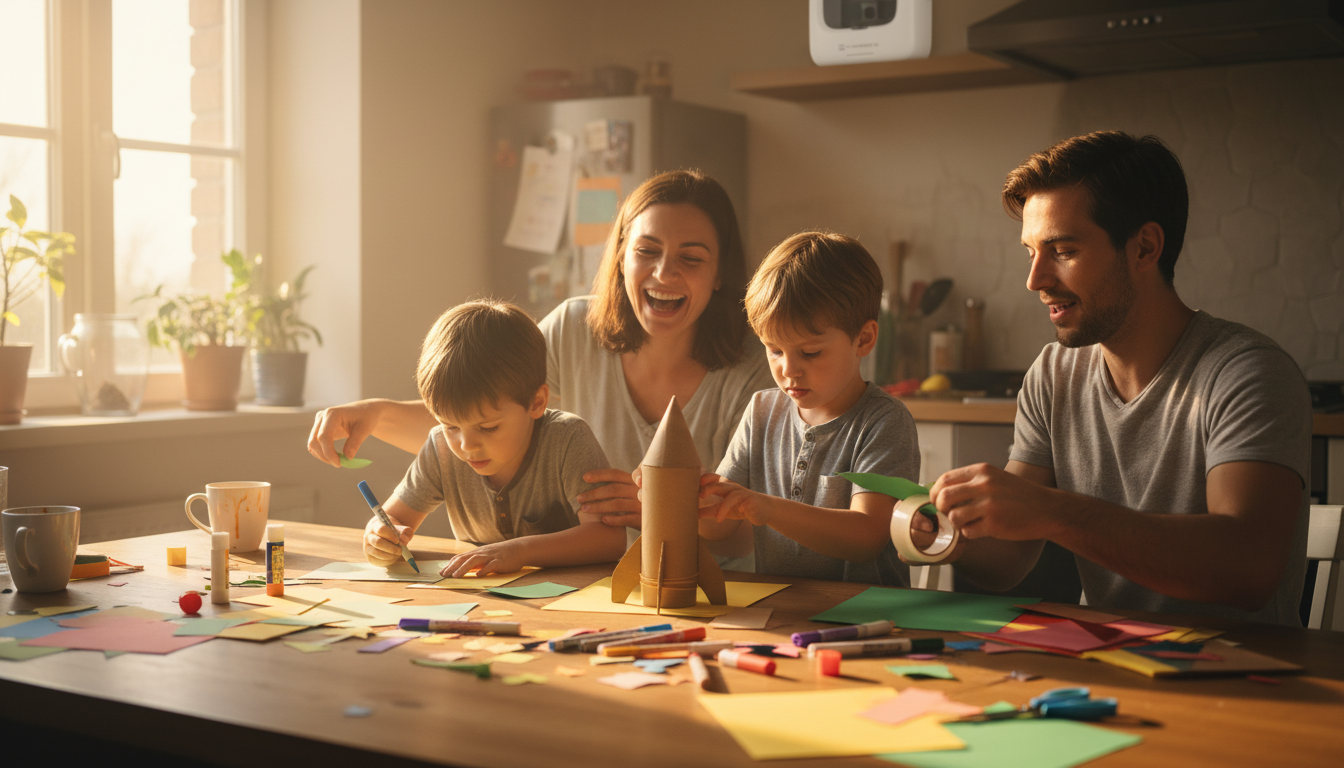
Once the theme is named, every choice the kid makes hangs off it. "Space Tonight" turns a paper-towel tube into a rocket without anyone deciding it formally. Browse step-by-step project guides for themed ideas when the family pool runs dry.
Step 2 — Prep supplies early
Five minutes of setup saves twenty minutes of marker-hunting. Tray, basket, or shoebox on the table — only what the project needs for tonight. The rest stays away.
Hidden benefit: the tape and scissors are already out when you're at your most tired. That's when "we'll do it next week" usually wins. Pre-set supplies close that door.
Step 3 — Set a screen-free rule
Phones off the table. Tablets in another room. Older kids who push back get to pick the music in exchange. The defined slot is what makes the time feel different from any other hour of the day.
If a phone has to be on the table — for a recipe, for a timer — flip it face down. Notifications mid-craft are how a fifteen-minute session quietly becomes forty-five minutes of distraction.
THE CONNECTION MOMENT
This is when kids stop seeing the night as a parent-directed activity and start treating it as their own. Don't rush past it. The fifteen quiet minutes when a six-year-old is fully absorbed in their cardboard creature are often the closest you'll get to them all week.
Step 4 — Create together
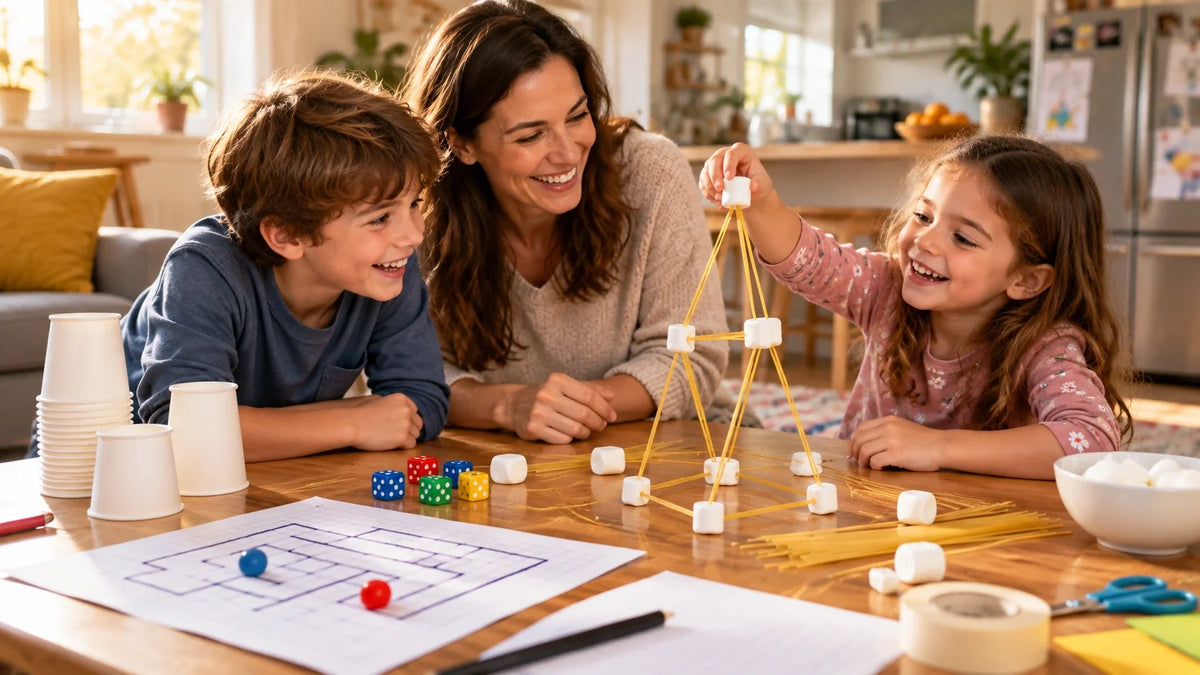
Pick up scissors. Make a worse version of what your kid is making. The unspoken rule kids notice: are you actually making something, or just managing them?

Ask small questions while you work — "what's that for?", "what happens next?", "should this one have a tail?" Not "tell me about your day." The project is the path to the conversation. Don't reverse them.
Step 5 — Share or display the finished work
Go around the table. Each person holds up what they made, says one sentence about it. Then put one piece somewhere visible — fridge, hallway nail, kitchen shelf.
Don't keep everything. Save one piece per month for a memory box. Volume kills the meaning of a keepsake. Educators at NAEYC note that displaying family-made work helps children see their own learning — and that's exactly the function of the shelf.
Extending the Habit Through Themes
Quick STEAM Ideas at Home

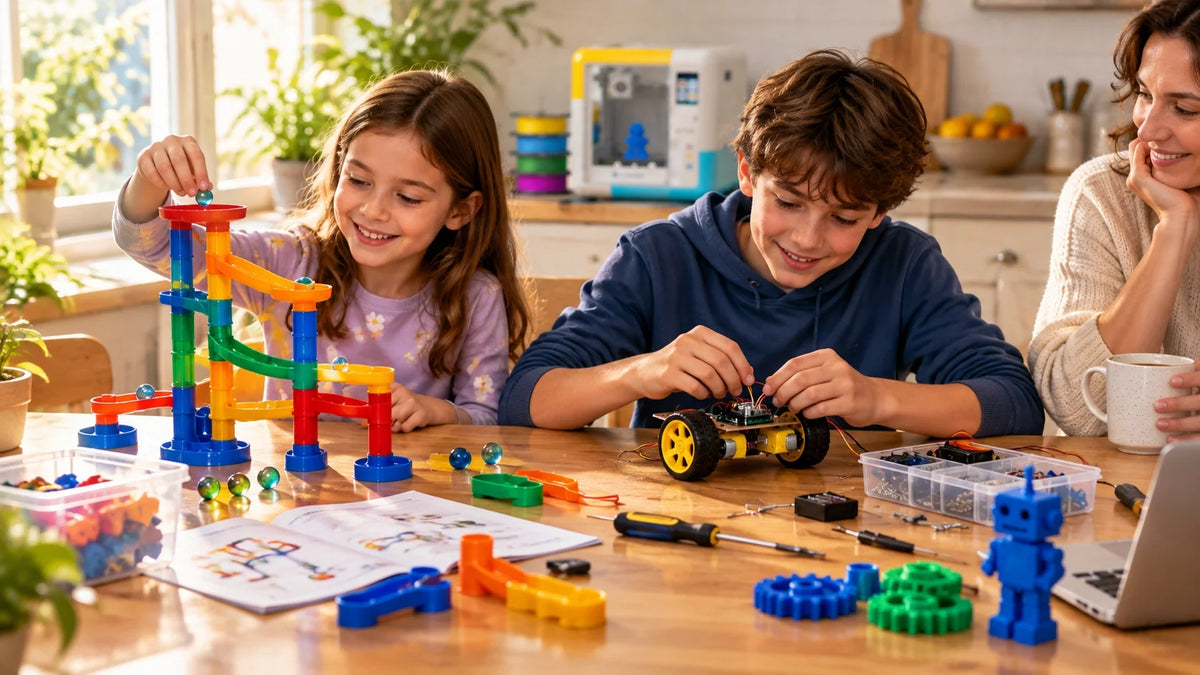
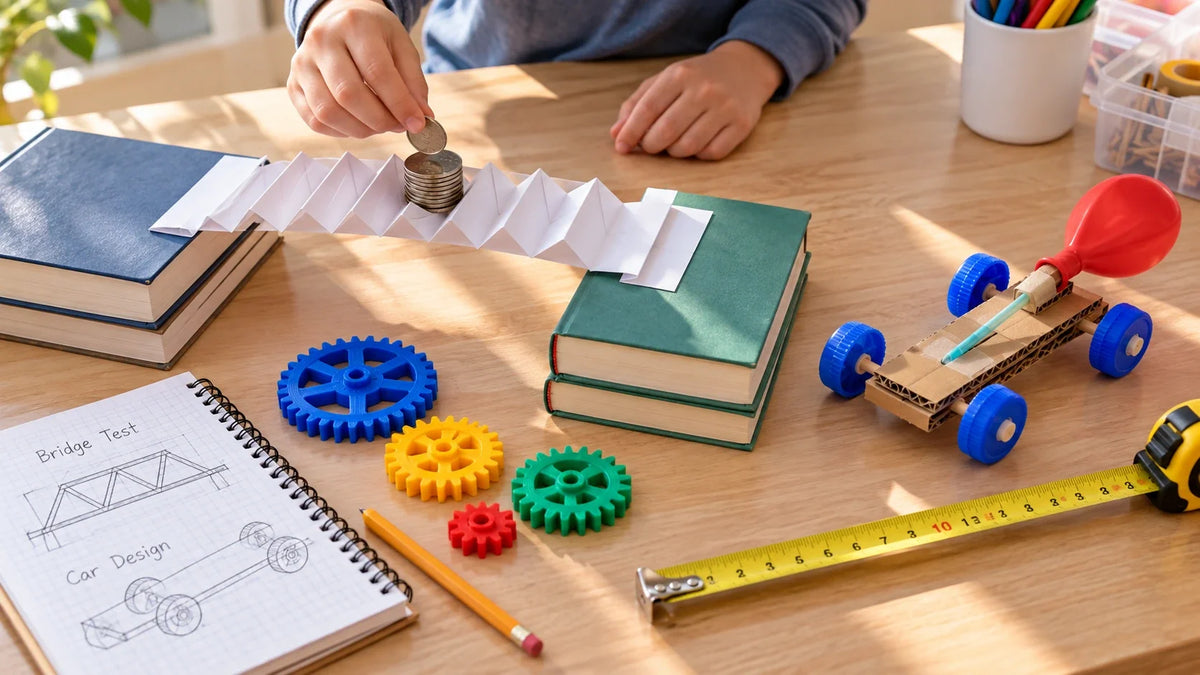
Build a bridge that holds three toy cars. Race marbles down a ramp made of paper-towel tubes. Fold paper airplanes from four different patterns and time-trial them across the room. STEAM nights work especially well for kids who think "art is boring" — the problem-solving framing pulls them in without the word "craft" anywhere near the table.
Families ready for bigger weekend builds can browse beginner 3D printers for families once the weekly habit is steady. The build queue gives kids a project to come back to between nights.
Storytelling and Challenge Formats
Start with a prompt: "One night, our toaster turned into a dragon." Each person adds the next part. Younger kids act it out with toys. Older kids write or record it. The story doesn't have to make sense — the Tuesday-talking-dog can become president by paragraph four.
Rotate challenge formats to extend any craft's life. Timed assembly. Distance-carry. Obstacle course from shelf items. Same materials, different problems every session. AAP's play tips for preschoolers note that kids absorb more from problems they invent than from tasks adults assign.
Keeping the Night Fun, Not Perfect
Connection Over Results
The most-repeated nights aren't the best-looking ones. They're the ones where someone laughed too hard at a melted-glue accident, or a four-year-old declared their cardboard tower "a house for sad bugs," or a tween actually stayed at the table past forty minutes.
You can hang the prettiest art on the wall. The wonky castle and the half-painted mask are usually the keepers in memory.

Quick Weekly Checks
Every few weeks, look at the bin. Supplies stocked? Anything dried out? The cleanup tools where they should be? The bin running low is the first sign the habit is working — a problem worth having.
If the night starts to feel routine in a stale way, swap two things at once: the theme and the supply mix. The same five-step flow with new materials reads as fresh.
|
Issue |
Most Likely Cause |
Quick Fix |
Time |
|
Kid loses interest at 10 min |
Activity too open-ended |
Add a constraint or theme on the spot |
Mid-session |
|
Cleanup runs over 15 min |
No table cover, scattered supplies |
Use a cover next week + one scrap bag |
Next session |
|
Tween won't show up |
"Craft" framing |
Switch to design challenges or stop-motion |
Next week |
|
Tired parents skip the night |
Setup takes too long |
Pre-prep the tray the night before |
This week |
Conclusion
A family creativity night isn't a craft. It's a habit. The craft is just the thing the habit is wrapped around.
Pick a night. Block fifteen minutes if that's all you have. Put basic supplies on the table. Make something — anything — alongside your kids, not for them. Some weeks the night will be calm and sweet. Others will be loud, messy, and a little embarrassing. Those are the ones kids remember.
Over a year, the small habit becomes a fixed point on the family map. AOSEED's family creativity platform is running in over 5,000 schools on exactly that rhythm — design weekly, build something tangible, play with what you made. The same logic scales down to a kitchen table. A guided STEM 3D printer for older kids and tweens earns its shelf space not on the first print but the tenth — that's when the routine sticks, the questions get better, and the machine becomes part of the household instead of a gadget on a shelf.
Most parents don't believe how fast this becomes the night kids look forward to. Six weeks in, you'll catch them asking on Tuesday what Wednesday's theme is — and that's the signal the habit has actually landed. The other side of the win nobody mentions: you'll start looking forward to it too. The hour stops feeling like another thing to plan and starts feeling like the calmest hour of your week.
Skipped weeks happen. A late meeting, a sick kid, a school project that ate the night. Don't moralize them. Move the night, don't cancel it, and pick up the following week as if the gap wasn't there. Years from now, your kids won't remember the perfect crafts. They'll remember the rain hitting the kitchen window while you both built something together. The small repeated nights are what stack into the memories that stay.
Start this week. Pick the simplest activity in the cabinet. Let your kid name the night before it begins.
THE WEEKLY MINDSET
Plan it Tuesday. Make it Wednesday. Show it Thursday morning at breakfast. The family creativity night that earns its slot isn't the biggest one — it's the one you actually do, week after week.
FAQs
What to do for family night at home?
For family creativity night, simple family night ideas work best because the goal is shared attention, not a perfect finished project.Pick one simple activity — drawing, cardboard building, sock puppets, or charades — and keep it to 30 minutes. The activity matters less than the shared attention.
What are some family night ideas?
Craft night, movie-fort night, pizza-making, board games, dance, puzzle, STEAM build, scavenger hunt. Pick one focus per night and rotate themes weekly.
What are good family projects?
A cardboard city, painted rocks, kindness cards, sock-puppet show, homemade board game, paper-tube marble run. Pick projects with clear roles for every age.
What activities bring families together?
Cooking, crafting, storytelling, board games, music, and team-building challenges. The best ones give everyone a hands-on role.
What are easy crafts to do at home?
Paper-plate animals, coffee-filter flowers, sock puppets, collage cards, painted rocks, cardboard houses, paper-tube binoculars. Use washable supplies for short cleanup.
What are some unique family day ideas?
Backyard art lab, family photo walk, home museum, DIY carnival, nature scavenger hunt, or culture-inspired art day. Add one creative task to make the day memorable.
What is the 9 minute rule for kids?
The 9-minute rule focuses on being fully present during three key moments daily: the first three minutes after waking, the first three after school, and the last three before bed.
Practical tip: Family creativity night extends this idea into one larger weekly block of focused time.
What is the 10-10-10 rule for parenting?
Pause before reacting. Ask how the moment will feel in 10 minutes, 10 months, and 10 years. Most daily struggles shrink at the longer scale.
Sources
- American Academy of Pediatrics — The Power of Play: How Fun and Games Help Children Thrive, HealthyChildren.org
- American Academy of Pediatrics — How to Make a Family Media Use Plan, HealthyChildren.org
- Centers for Disease Control and Prevention — Positive Parenting Tips: Preschoolers (3-5 years), CDC Child Development
- American Academy of Pediatrics — Play Tips for Preschool-Age Children, HealthyChildren.org
- National Association for the Education of Young Children — Talking with Parents about Play and Learning, NAEYC
- AOSEED Kids 3D Printer Collection — 3D Printers for Kids, AOSEED.com


Further reading

Graduation Gifts for Kids: Keepsakes for Kindergarten to Fifth Grade

How to Clean a 3D Printer: A Routine for Families

3D Printer Filament Holder: Options, Setup and a Version You Can Print


