

Screen-Light Weekend Activities That End With Something Kids Can Hold
These screen-light weekend activities use a short screen prompt to start the project, then move kids into choosing, making, playing, and sharing something real.Saturday morning is the design — what to make, what color, what for. Saturday afternoon is the making. Sunday is the showing — to siblings, to grandparents, to the fridge. Done with a little structure, a single basket of supplies holds a whole weekend without anything new.
This guide covers what to put in the basket, how to prep on Friday night, and how to stretch one weekend into a habit kids actually ask for — with the safety basics every family needs before unscrewing the glue stick.
Why One Activity Box Can Fill a Whole Weekend
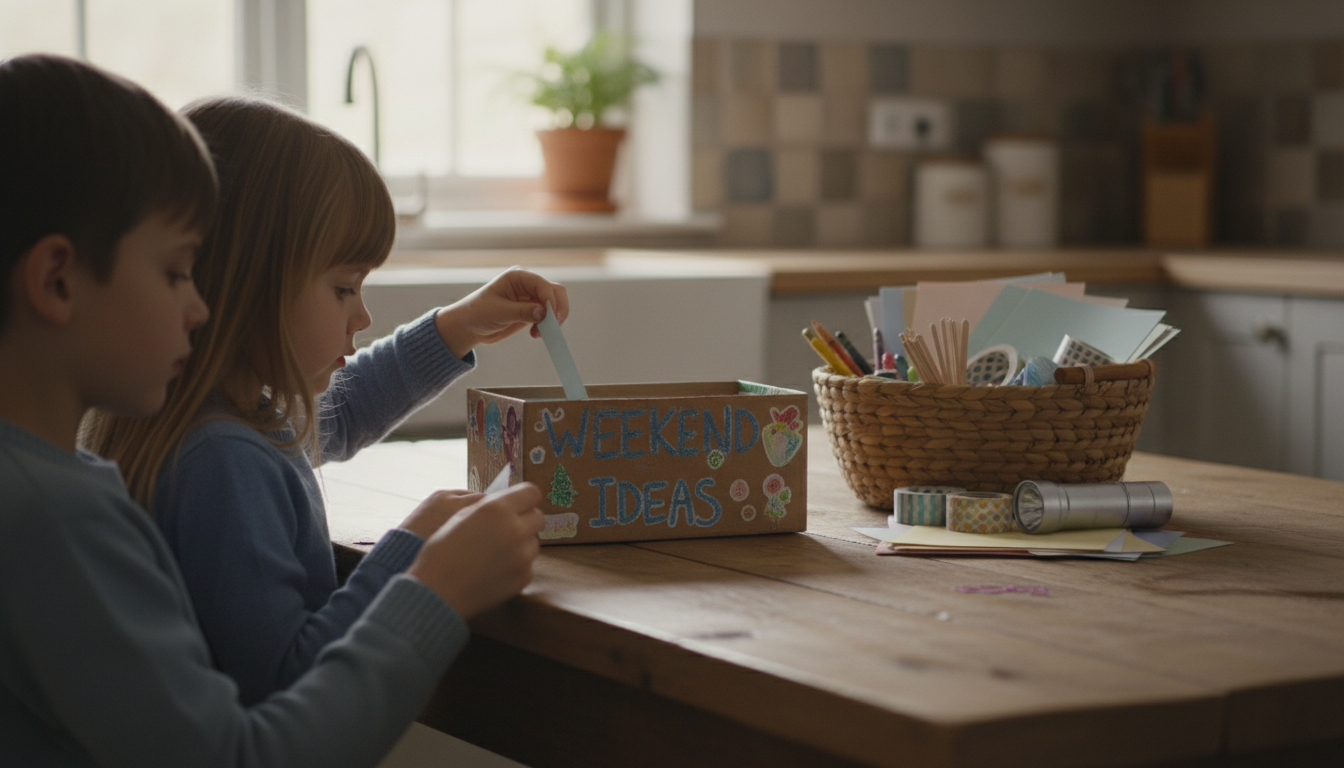
A weekend activity box works because the structure repeats even when the project changes. For families trying screen-light or screen-free activities, the box gives kids a familiar rhythm they can return to every weekend.
The Weekend Loop That Actually Works
This two-block loop creates a simple screen-light weekend activities plan that keeps kids busy with hands-on work instead of asking for another screen. Most craft supplies get used once, then sit in a drawer. The reason isn't the supplies — it's the missing structure. Two short blocks change that.
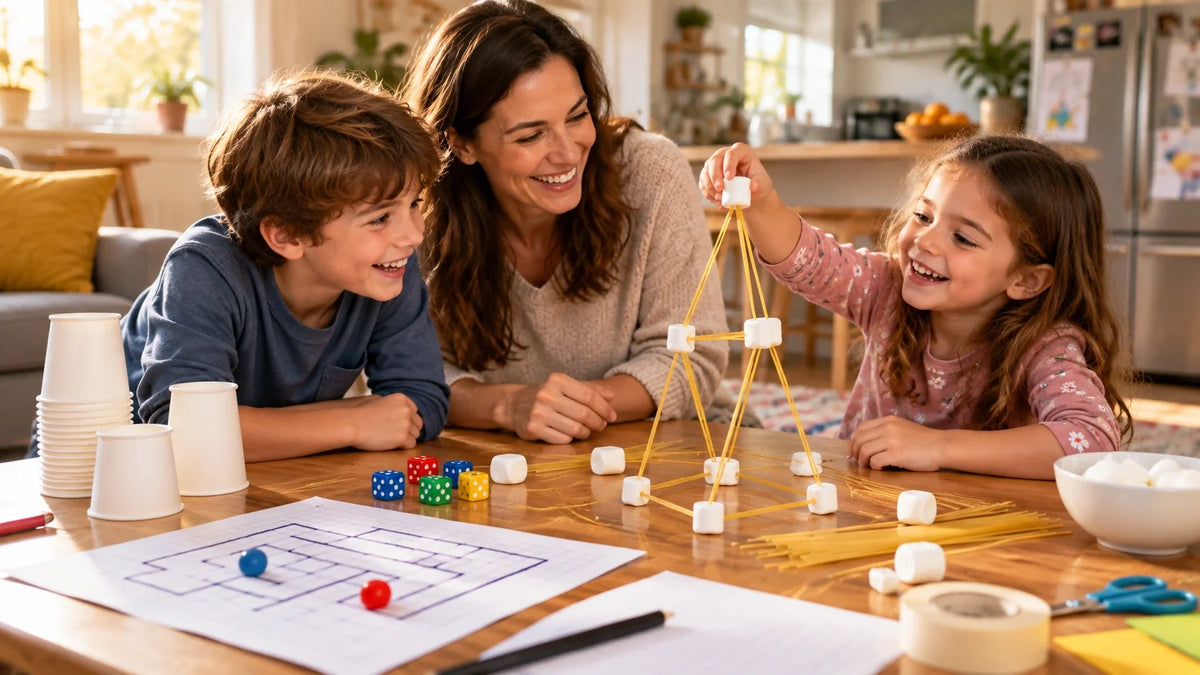
Block 1 is creative: pick a slip, choose colors, decide what to make. Block 2 is hands-on: build, finish, show. Each block runs 45 minutes. Each ends with something a kid can hold. The afternoon in between is free. The loop is what makes a screen-light Saturday stick.
What Kids Pick Up Without Noticing
Hand a child a stack of cardstock and ask them to make five bookmarks for the school library. Within ten minutes they're choosing designs, picking which marker bleeds on what paper, sorting which one is for which teacher. That's editorial decision-making with no worksheet attached.
Painting rocks teaches color choice. Building a cardboard shop teaches inventory and price math. Writing a thank-you note teaches who deserves one. The learning sticks because it's chasing the project's behavior, not a grade. The American Academy of Pediatrics recommends families build a media plan that fits each child — short hands-on blocks fit that plan without becoming another rule.
The Real Cost of a Screen-Light Saturday
Crayons, tape, glue sticks, and a shoebox cost under $15 total. A flashlight is $8. A jump rope is $6. Most weekends use under a dollar in fresh supplies once the basket is built. The biggest real cost is fifteen minutes of setup on Friday night.
Choosing the Right Activity to Build
Start With a Win, Not a Long Project

For a first weekend, the goal is one finished thing by lunch — not an all-day craft that ends in tears at 3 p.m. Bookmarks, painted rocks, paper puppets, and recipe cards all finish in under thirty minutes. They look good on the first try. They give a child the rare experience of: I made something, and it works.
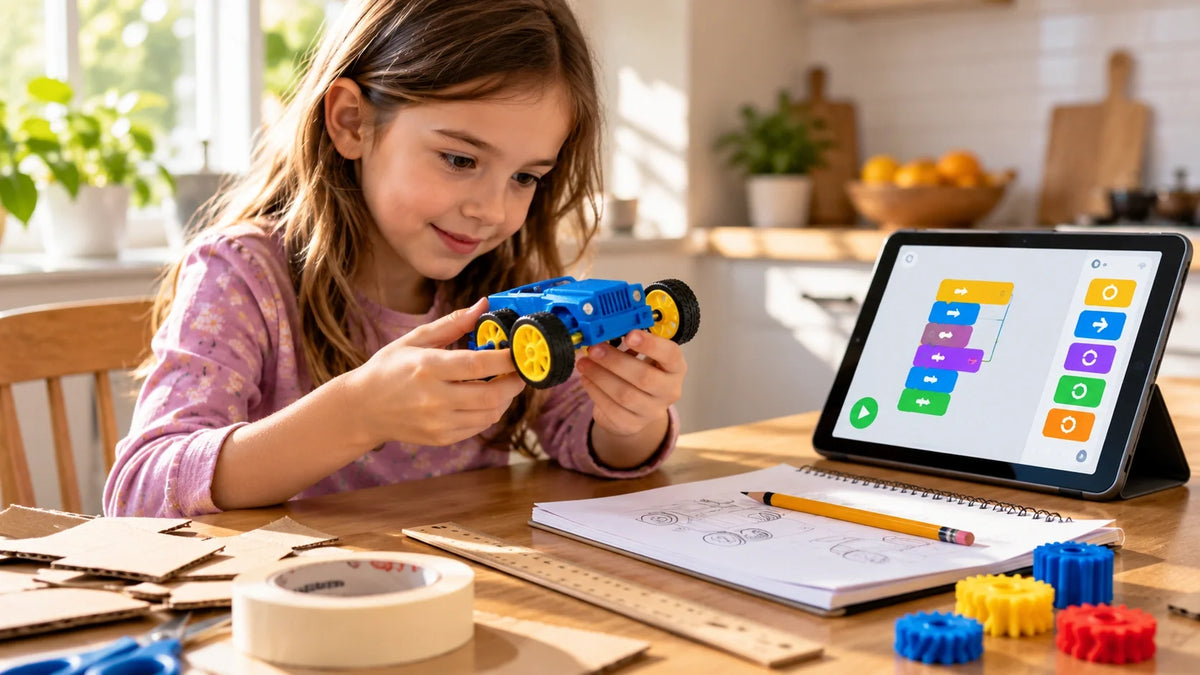
A guided toy-making printer for younger kids like the AOSEED X-MAKER JOY runs the same loop with 3D-printed toys — one finished object, one afternoon, one thing the kid carries to school Monday. For paper crafts, beginner-tagged designs from community sites give the same low-friction starting point.
Activities That Hold Attention Longer
Cardboard mini-cities and shadow puppet plays are a different category. A pretend shop invites refurbishing — a new sign next weekend, a new menu the weekend after. A puppet cast adds a villain. A Family Olympics adds an event. These designs hold up over time too. A six-year-old plays with the shop; a ten-year-old runs its inventory.
Look for activities tagged "open-ended" or "expandable." They invite the kid back without needing new supplies each session — jump rope challenge cards, dance party props, recipe books that grow across weekends.
Match the Activity to the Child
Complexity should follow attention span, not just age. Here's a quick reference:
|
Age Group |
Suitable Activities |
Avoid |
|
Under 6 |
Stickers, leaf rubbings, sidewalk chalk, simple cookies, finger puppets |
Anything with parts smaller than a thumb, sharp scissors, multi-step assembly |
|
Ages 6–9 |
Cardboard cities, shadow puppets, decorated cookies, painted rocks, paper puppets |
Crafts that need an hour of focus before something visible happens |
|
Ages 10–14 |
Family Olympics with scoring, recipe books, mini storybooks, kindness card runs |
Nothing — most ideas work; let them lead the planning |
|
14+ |
Sibling-led activity nights, designing the weekend basket themselves |
— |
|
SAFETY — CHECK BEFORE STARTING For children under 3, any item smaller than 1.25 inches is a choking hazard. The CPSC toy safety guidelines apply to home craft supplies as they do to manufactured toys. Skip glow sticks for kids who still mouth toys. Liquid glue and sharp scissors stay in adult hands until age 7–8. |
Setting Up Before the Weekend Starts

The Weekend Activity Box
A weekend activity box for screen-light weekends gives kids a clear offline choice, making it easier to stretch one screen-free hour into a full screen-free block. A shoebox or oatmeal tin works. Inside go 15–20 index cards or folded paper slips, one activity per piece. Sort them into four labels: Indoor, Outdoor, Quiet, Active. Let each child add three of their own slips. Saturday morning, the kids pick from the box. No decision fatigue. No "what should we do" debate.
The Right Supplies for Kids' Crafts
Most kid crafts run on five things: paper, tape, crayons, glue, and one light source. Here's how the basics compare:
|
Supply |
Best For |
Watch Out |
Cost |
|
Index cards (100-pack) |
Idea slips, bookmarks, recipe cards |
Bend easily — store flat |
$3 |
|
Cardstock + construction paper |
Puppets, medals, sturdy crafts |
Heavier — needs glue stick, not tape |
$5 |
|
Washi tape + masking tape |
Fast bonding for paper crafts |
Loses stick after 24 hours on cardboard |
$4 |
|
Glue sticks (5-pack) |
Layered crafts, cardboard joinery |
Dry in 2 minutes — work in small batches |
$3 |
|
Crayons + washable markers |
Coloring, labeling, signs |
Markers bleed through thin paper |
$8 set |
|
Two small flashlights |
Shadow puppets, evening hunts, indoor camping |
Batteries — keep spares |
$8 each |
Workspace and Safety Basics
Flat, stable, dedicated table. Not a folding desk. Not the dining table during dinner. A craft surface that's expected to get marker on it is the right one.
Adults sit at the table for under-6s. Two steps away for 7–9. In the next room for 10+. Sharp scissors, liquid glue, candle flames — adult hands only. Families adding a 3D printer to the same supervised setup can browse beginner 3D printers for families sorted by age band and enclosure type.
The Two-Block Weekend Plan
One basket. Two blocks. The day in between is free. Each block teaches something the next one builds on.
Block 1 — Saturday Morning Design and Make

Let the child drive. Open the basket, pick a slip, gather the supplies it needs. For ages 8 and up, hand them planning entirely — they decide what to make, what's needed, and which sibling does what.
Keep the session to 30–45 minutes for younger children. Decision fatigue is real. End the block with the project finished — even if "finished" means a half-painted rock or a paper puppet with one arm. The win isn't perfection. It's done. For step-by-step setups, AOSEED's step-by-step project guides in the Learning Center walk through similar structured family activities from start to finish.
Block 2 — Saturday Evening Show and Tell

Start the second block after dinner. Lights down. One soft light source — a flashlight, a battery lantern, a string of fairy lights. Forty-five minutes of quiet, warm activity that ends with the kid showing what they made.
A shadow puppet show. An indoor camping setup with a lantern map. Decorated cookies eaten by candlelight. A dance party with paper award ribbons. The room feels different from the morning room. That's the trick.
|
THE SHOW MOMENT This is when a child slips the bookmark inside the book, sets the puppet on the windowsill, hangs the paper medal on the bedpost. Don't rush it. Those ten quiet seconds of pride are why the loop holds for next weekend. |
Sunday — Play and Push It
Don't plan Sunday. Introduce a constraint instead. "Can you build a tower for it using what's on the shelf?" or "Who is your friend from the toy box?" A constraint gives a child something to solve rather than something to consume.
A painted rock becomes a character with a name. A bookmark gets gifted to a grandparent. A puppet stars in three different shows. The basket is the prop. The play is the point.
Extending Learning Through Play
Mini STEM Moments Hidden in Crafts
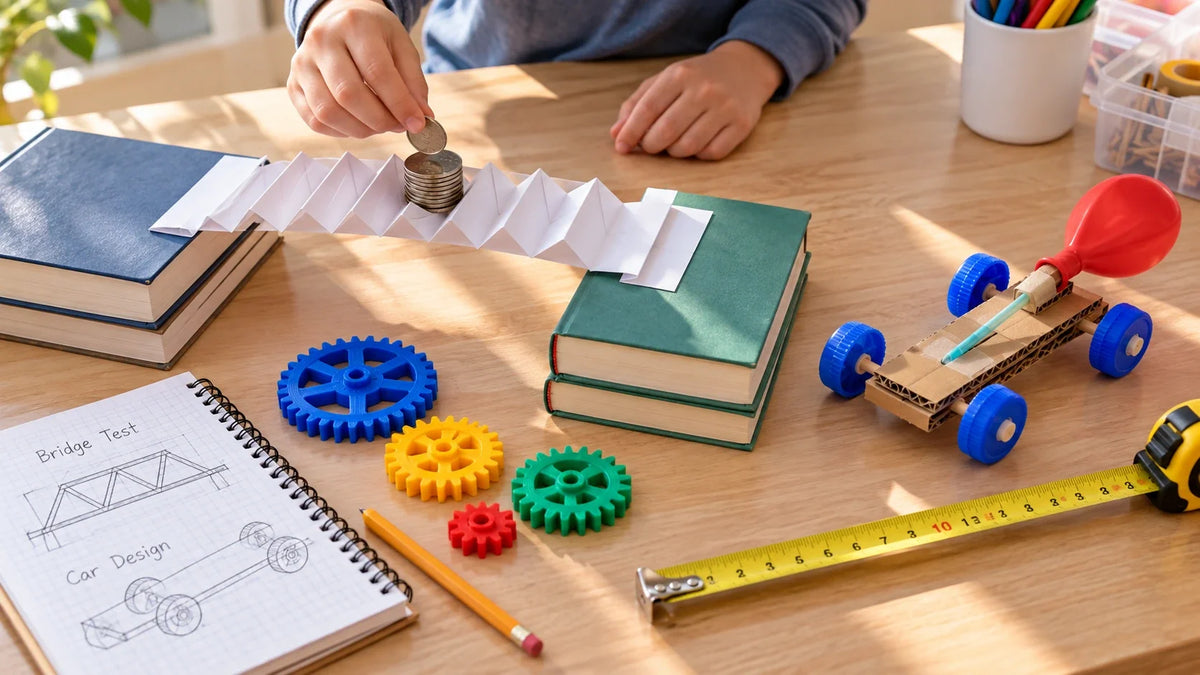
A paper airplane folded three different ways becomes an aerodynamics test — ask which fold flies farthest and why. A cardboard ramp at four heights becomes physics: time the marble, plot the heights. Layer dry rice, lentils, and beans in a clear jar and you've taught density on a kitchen counter. Materials under $2. No worksheet required.
Storytelling and Challenge Formats
A character a child watched themselves draw carries more narrative weight than anything bought off a shelf. Ask: What's its name? What does it need to solve? Simple paper props — a tiny door, a chair, a treasure chest — expand the play without permanent clutter.
Rotating challenge formats stretches one activity across weekends: timed assembly, distance-carry, obstacle course from shelf items. The same project, a new problem each session.
Caring for Finished Projects

Display and Storage
Bookmarks live in books. Painted rocks live in basil pots or on the windowsill. Paper puppets go back in the activity box for next weekend's reuse. Children 8 and up handle the sorting themselves; younger kids need prompts.
Store articulated paper projects loosely — not stacked. Sustained pressure crumples joint folds within a week. Label storage bins once the collection hits ten items. The finished-projects shelf becomes the family's screen-light yearbook.
Quick Inspection Checks
Every few weeks: look for torn corners on the bookmark stack, check that puppet sticks haven't loosened from their characters, run a hand along any edge a kid would grip. Paper crafts fail predictably at stress points. Catching a torn corner early lets the kid fix it themselves with a strip of washi tape.
|
Problem |
Most Likely Cause |
Quick Fix |
Time |
|
Kid lost interest mid-craft |
Activity too long or too vague |
Cut it short. End with what's done. |
0 min |
|
Sibling fighting over same task |
One project, two kids, same job |
Split the project — one designs, one labels |
2 min |
|
"This is boring" |
Tired, hungry, or screen-deprived |
Snack first. Activity second. |
5 min |
|
Bookmark or card tearing |
Thin paper, weak tape |
Reinforce with washi tape or cardstock backing |
3 min |
Conclusion
A screen-light weekend isn't about the rule. It's about the loop — design, build, show — and the question a child asks at the end of Sunday: What can we make next?
That question is the whole point. Not the cleanliness of the craft. Not the finish of the bookmark. The moment a child starts thinking of the activity basket as theirs rather than an alternative to screens — that's when something shifts.
Most families don't get there because nobody told them the activity needs structure. They scatter craft supplies once, run one project, declare it done. Two blocks fix that. Block one builds anticipation. Block two builds the project. Sunday builds the habit.
The projects don't have to be impressive. A bookmark a five-year-old chose the color of will get more daily use than a precision craft a parent picked. Ownership starts at the basket, not the finished shelf. Let the child decide what gets made — even if the choice surprises you.
Some of the best weekends start with a craft that fails. A puppet that falls apart on its first show is a problem a curious kid will spend twenty minutes trying to solve. That's not a setback. That's the lesson.
AOSEED's family creativity platform runs in over 5,000 schools on exactly that rhythm. The Toy Library updates every week so there's always a next project ready. The Learning Center walks through setup, supplies, and troubleshooting in plain language — no manual required. A guided STEM 3D printer for older kids and tweens isn't valuable because of its first project — it's valuable because of its tenth. That's when the routine sticks, the questions get better, and the basket earns its spot on the family shelf for good.
Start this weekend. Pick the simplest activity in the basket. Let your child name what they're making before they touch a single crayon.
|
THE WEEKEND MINDSET Plan Friday. Make Saturday. Show Sunday. The basket that earns its shelf space isn't the one with the most supplies — it's the one used every weekend. |
FAQs
What is the 3 6 9 12 rule for screen time?
A French pediatrician's framework: no screens before 3, no consoles before 6, no internet before 9, no social media before 12. It's not an official medical guideline, but a tiered-by-age starting point families adopt.
What are some screen-free activities?
These screen-free activities can fill the outdoor, quiet, or active slots in a screen-light weekend activities plan, so kids have clear choices before they ask for a device. Fort-building, paper puppets, baking cookies, rock painting, card games, puzzles, scavenger hunts, jump rope, and gardening. The ones that hold up end with something a kid can hold or eat.
What are some light activities?
Two meanings: low-effort crafts (reading, drawing, puzzles, cards) or activities using soft light (flashlight scavenger hunts, shadow puppets, glow-stick jars, indoor camping with lanterns).
What activities do you do on weekends?
Indoor crafts, outdoor walks, family cooking, simple chores, active games, and small kindness projects. The best rhythms mix movement with calm and finishing things with starting things.
What are 5 examples of activities?
Shadow puppets, painted garden rocks, handmade bookmarks, Family Olympics paper medals, and recipe cards. Each gives a kid one job and one finished item.
What are the 5 C's of screen time?
Child, content, calm, crowding out, and communication. The framework asks beyond "how many minutes" — who's watching, what they're watching, and what screens are replacing.
What is the 20 minute rule for screens?
The 20-20-20 eye-comfort rule: after 20 minutes of screen use, look at something about 20 feet away for 20 seconds. Reduces digital eye strain during long screen blocks.
What are some creative weekend ideas?
Cardboard mini-cities, family restaurant nights, shadow puppet shows, indoor campsites, mini storybooks, and kindness card runs. Each ends with a physical thing kids can hold.
Sources
- American Academy of Pediatrics — How to Make a Family Media Use Plan
- Mayo Clinic — Screen time and children
- American Academy of Pediatrics — Media and Children.
- American Association for Pediatric Ophthalmology and Strabismus — pediatric eye health guidance on the 20-20-20 rule for screen-related eye comfort and online learning breaks.
- AAP HealthyChildren.org — Kids and Screen Time: Using the 5 Cs of Media Guidance
- AOSEED Kids 3D Printer Collection — full lineup of enclosed kid-friendly 3D printers sorted by age band,



Further reading

Graduation Gifts for Kids: Keepsakes for Kindergarten to Fifth Grade

How to Clean a 3D Printer: A Routine for Families

3D Printer Filament Holder: Options, Setup and a Version You Can Print


