

Why “Make, Play, Share” Works Better Than Another Passive App
A make play share activity gives kids a simple path: make something with their hands, play with it, then share the result with another person.
Your three-year-old just snatched the red marker from his sister. Again. You’ve already shown him the cartoon about sharing twice this week, and he can sing the song. He still snatches.
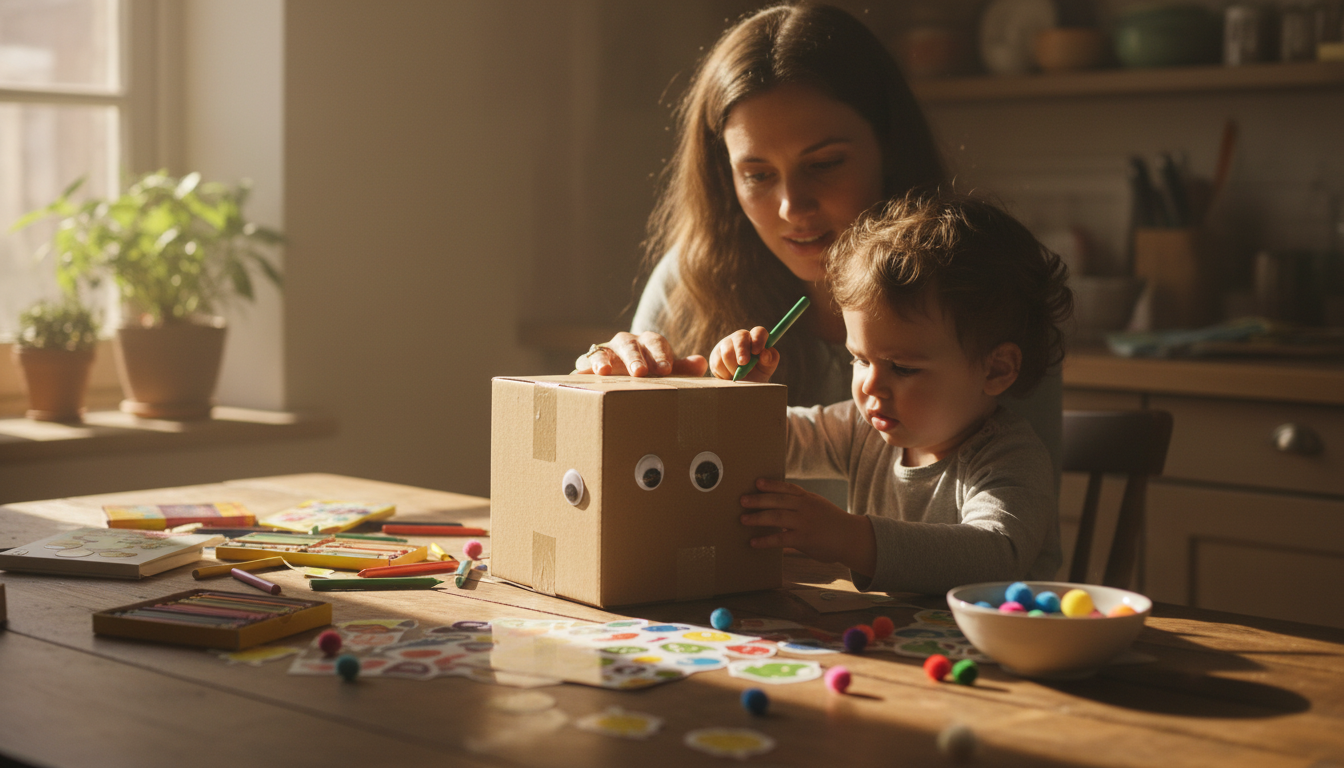
Sharing isn’t something a child watches. It’s something a child does — with another person, holding a real object, in a moment when they didn’t want to.A make play share activity sets up that moment on purpose, before it happens in front of grandma. Three steps. Ten minutes. A cardboard box and a handful of pom-poms.
This guide covers what the routine actually is, why it works better than another passive app, which activities to pick by age, and the three or four mistakes most parents make in the first week.
Why “Make, Play, Share” Beats Another Passive App
What Kids Pick Up When They Make, Play, and Share
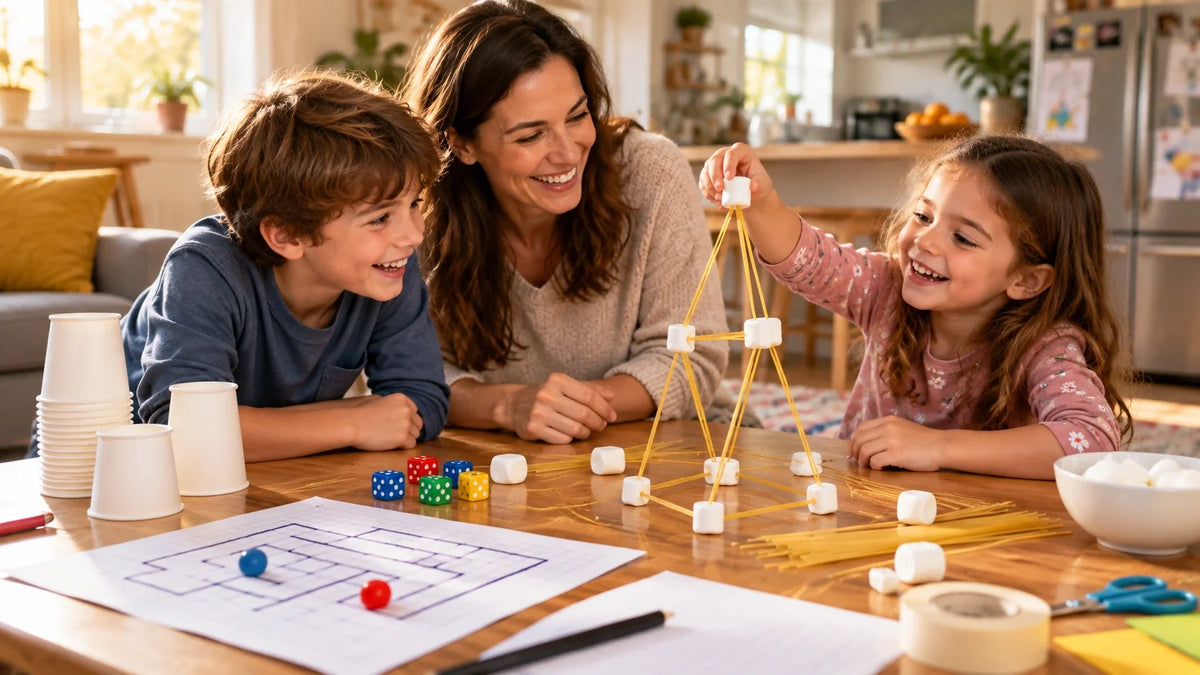
Hand a child a tissue box, some googly eyes, and a glue stick. Within five minutes they own the project. Add pom-poms and a rule — one pom-pom per turn, drop it in the alien’s mouth — and they’ve walked into a turn-taking practice they didn’t notice signing up for.

That’s the trick. Sharing taught directly feels like a rule. Sharing taught through a game feels like keeping the game going. The skill sticks because the child is chasing the play, not a lesson.
Why Screens Can Show It But Not Teach It
A screen can show a cartoon mouse handing a cookie to another mouse. That’s a useful starter image — it gives you something to point at later. But the screen does the action. The child doesn’t.
The missing piece is the moment of choice. A child still has to hold the toy, hear another child ask for it, feel the urge to keep it, and practice a different choice. That moment cannot happen inside a passive app. The American Academy of Pediatrics notes that media affects how children feel, learn, think, and behave — which is exactly why the part the media can’t do (give a child practice with a real person reacting in real time) is the part you have to plan.
The Hidden Cost of Default Screen Time
A passive app fills time. It doesn’t build the back-and-forth skills that show up at the playground. Side-by-side:
|
What's happening |
Passive app |
Make, Play, Share activity |
|
Who performs the action |
A character on screen |
The child, with their own hands |
|
Feedback from the other "person" |
Pre-recorded smile or sound |
A real face reacting in real time |
|
After a mistake |
The level resets |
The adult coaches; the round continues |
|
Practice with disappointment |
Mostly avoided |
Built into every turn |
What a “Make Play Share” Activity Routine Looks Like
This make play share activity routine has three steps: make something together, use it in play, then share it with another person.
Step 1 — Make (Create Together)

The make step gives the child ownership before sharing even enters the room. Decorate a tissue box. Stack four blocks. Color a card. Fill a bowl. It needs to be easy to hold, move, and pass. Simple wins — paper cups, cardboard boxes, crayons, stickers, blocks, pom-poms. When the setup takes two minutes, you’ll do it again on a Tuesday. For step-by-step family activity guides that walk through setup and materials by activity type, the AOSEED Learning Center is a good starting library.
Step 2 — Play (Turn It Into a Game)
The made thing earns its keep when it turns into something fun. A box becomes a monster that eats pom-poms. A drawing turns into a story card. A block tower becomes a team challenge with a falling-down ending the kids actually look forward to.
Play gives the child a reason to stay involved that a lecture about fairness never will. The CDC’s parenting guide for toddlers 2–3 years lists pretend play and taking turns as core early-childhood skills — a structured game is the easiest way to practice both at once.
Step 3 — Share (Practice the Words)
This is where social skills become visible. Short phrases on repeat — “my turn,” “your turn,” “can I have it next?”, “you can use this one.” The phrases give the child a safer way to ask instead of grabbing.
Expect them to need a lot of chances. A child can understand a rule on Monday and forget it on Tuesday. That’s not failure. That’s how the skill is being built. The phrase comes before the rule.
Choosing the Right Activity for Your Child
Start With a Win, Not a Lecture
First activity goal: something finished in under ten minutes, with a real game at the end. Feed the Alien, snack sorting, a tiny block tower. The point is one full round of turn-taking, not a craft fair. For families who want a creative anchor that turns the “make” step into a steady supply of new objects to play and share with, a guided make-and-play setup for younger kids like the AOSEED X-MAKER JOY handles the design side automatically and gives the routine fresh material every week.
Activities That Hold Attention Longer
Activities with a tiny mystery hold attention best. A treasure hunt where each clue depends on the last. A group story where the next sentence only makes sense if someone heard the previous one. A poster everyone draws on at once, but with different tools so nobody fights over the red marker. Mystery + a clear role = a child who keeps playing.
|
Activity |
Setup |
Best ages |
Why it works |
|
Feed the Alien Box |
3 min |
5–7 |
Tiny turns; no favorite toy at risk |
|
Collaborative Art Poster |
5 min |
7–8 |
Shared space, separate tools = less conflict |
|
Group Story Cards |
10 min |
8–9 |
Listening + imagination + turn structure |
|
Treasure Hunt with Clues |
8 min |
9–10 |
Rotating jobs; team success |
Match the Activity to the Child
Complexity should follow attention span, not just age. Here’s the quick reference:
|
Age |
What they can usually do |
What to focus on |
Common pitfall |
|
3–4 yrs |
Trade toys, wait with reminders, use a timer |
Visual timers, job cards, clear turn order |
Skipping praise for small wins |
|
4–5 yrs |
Take turns in games, follow group rules |
Team activities, coaching a younger sibling |
Assuming they can self-manage conflict |
|
5+ yrs |
Negotiate, compromise, understand fairness |
Designing rules together, group projects |
Expecting adult-level patience under stress |
Setting Up Before You Start
Materials That Work for Family Activities
Most activities run on what’s already in the house. Cardboard boxes. Pom-poms. Crayons. Blocks. A bowl of dry pasta. Print-and-play game pieces work too — vehicles, animals, puzzle parts. Families who want to expand the “make” step into a longer routine can browse kid-friendly 3D printers for families sorted by age and ease of use.
Two Things That Control Most of the Outcome
Round length and turn order. That’s most of it.
Round length: five to ten minutes for toddlers, ten to fifteen for preschoolers. End while they’re still having fun, not after the first sign of trouble. Turn order: name it out loud before the round starts. “Ava goes first, Ben goes next, then Dad.” Predictable order means fewer mid-game negotiations.
Setting the Space and the Script
A flat surface. One small box of materials. Everyone seated at the same level — floor or low table. And the three or four phrases you’ll repeat every single round: “my turn,” “your turn,” “you can have it when I’m done,” “thanks for waiting.” Same words every time. Children learn faster when the script doesn’t keep changing.
The Make Play Share Activity Plan
These make play share activities teach sharing and social skills through screen-light activity, using quick hands-on play instead of long lectures.
Feed the Alien Box

Grab a tissue box, paper cup, or any small cardboard container. Cut a mouth shape. Let the kids add eyes, stickers, marker scribbles — the uglier the alien, the more they love it. Put pom-poms or dry pasta in a bowl. The play part: one turn each, one pom-pom per turn, sound effects mandatory. The part: “my turn” and “your turn” out loud before every drop.
Build-and-Share Block Tower
Make a small plan together — tower, bridge, zoo, garage. Give each child a few blocks. Each child adds one block at a time. When the tower falls, everyone helps rebuild. The fall stops being a failure and becomes the punchline.
Collaborative Art Poster
Tape a large sheet of paper to the floor. Sketch a simple scene — a road, an ocean, outer space. Hand each child a different tool: one gets crayons, another stickers, another rubber stamps. They share the space, but each has their own tool. Nobody fights over the one red marker because nobody else is using a marker.
Group Story Cards
Draw simple pictures on a stack of index cards — dog, house, ball, tree, rocket. Kids can help color them. One player places a card and adds a sentence. The next player adds a card and continues. The deck moves hand to hand, and the story only continues if someone listens to the last line.
Snack Sorting Tray
Use safe, age-appropriate foods — cracker pieces, fruit slices, cereal, cheese cubes. Keep portions small; follow safe-eating rules from the CDC’s toddler parenting guide. Sort together — round in one cup, square in another. Each person picks one piece per round.
Treasure Hunt with Shared Clues
Make clue cards or picture clues. Hide small objects in one safe area. Each child gets a job: clue-holder, finder, basket-carrier. The team decides where to look next. Rotate jobs after each clue so nobody runs the whole game.
|
THE FIRST “MY TURN” Watch for the moment your child says “my turn” instead of grabbing. It happens earlier than you’d guess — sometimes in the second or third session. Don’t miss it. That tiny phrase, used at the right moment, is the whole point of the routine. |
Common Mistakes That Make Sharing Harder
Most sharing mistakes come from good intentions in stressful moments. The four below are the most common and the most fixable. None require new equipment — just a small shift in how you respond when things get tense.

Forcing the Toy Hand-Over
Taking a toy from one child to hand to another feels efficient and teaches the wrong lesson. The child who lost the toy learns to guard their things harder. The child who got the toy learns that whining works. Long turns again: “You can use it until you’re done. Then Mia gets a turn.” Both kids are protected from the snatching habit. Research from the National Library of Medicine on toddler sharing notes that giving up a valued item often feels like a real loss — recognizing that softens the whole interaction.
Long Lectures Instead of Short Scripts
Long talks ask too much of a young brain mid-conflict. When emotions are loud, kids need fewer words, not more. A handful of short scripts does the job: “stop, safe hands,” “ask for a turn,” “you can have it next.” Repeat the exact same phrases every single time. Children learn faster when the words don’t keep changing.
Ignoring the Small Sharing Wins
Adults often miss the small progress because they’re waiting for the big one. A child who waited two seconds, asked instead of grabbing, or passed one item has made progress. Name it. “You waited while I counted to five.” “You handed the spoon to your brother.” Specific beats general every time. Praise is information.
Defaulting Back to the Screen
Screens have a place in family life — just not at the center of social-skill building. Mayo Clinic, citing AAP guidance, recommends limited high-quality screen time for ages 2–5 and discourages solo media use for younger children. Make hands-on play the first answer when the goal is sharing, teamwork, or turn-taking. The app can come after.
|
Mistake |
What it teaches |
Quick fix |
|
Snatching a toy to hand it over |
Whoever is bigger gets the toy |
Use long turns: "you can have it when she's done" |
|
Long lectures mid-conflict |
Words don't matter when emotions are loud |
Three short scripts on repeat |
|
Praising only the big wins |
Small steps aren't worth noticing |
Name the specific action: "you waited five seconds" |
|
Defaulting to the tablet |
Sharing is something you watch, not do |
One ten-minute hands-on round first |
Caring for the Routine Long-Term

How Often, How Long
Once a day for five to ten minutes is more than enough. Some weeks the routine slides; some weeks you nail it three days in a row. Both are normal. Children pick up the script across weeks, not within a single session — so consistency matters more than intensity.
When to Move the Goal Forward
When the child starts saying the turn phrase before you do, raise the bar. Add a sibling. Try a longer turn. Introduce a timer. The AAP’s HealthyChildren guidance on preschooler social development notes that three-year-olds can begin working out disputes through taking turns or trading toys, with adult help. That “with adult help” is your cue — you’re still in the room, just stepping back a little.
What “Good” Looks Like
Not perfect sharing. A child who waits three seconds longer than last week. A child who uses the phrase once unprompted. A playdate that ends with both kids still smiling. By age five, the CDC’s 5-year developmental milestones list following rules and taking turns in games with other children as a typical social skill — the make-play-share routine is one of the most direct ways to get there.
Conclusion
A make-play-share activity gives kids the one thing a passive app can’t — practice with another human, holding something real, in a moment when they didn’t want to. They build, they play, they wait for a turn, they say the words, they watch how those words land on the other person’s face. That’s the loop. That’s the lesson.
For parents and teachers, this is one of the calmer ways to teach a social skill. Sharing stops feeling like a loss and starts feeling like the thing that keeps the game going. Start simple. A box, some blocks, a snack tray, three phrases on repeat — that’s the whole kit.
AOSEED’s family creativity platform is running this exact rhythm in over 5,000 schools — design, make, play, share, and then start again with a new project from the Toy Library that updates every week. For younger families just getting started, the X-MAKER JOY handles the make step in a guided, kid-led way. For tweens ready for bigger builds, a guided creative printer for older kids and tweens keeps the routine going as the kids grow.
Pick the simplest activity. Run it tonight. Watch what happens by Sunday.
|
THE TURN-BY-TURN MINDSET Three steps. Ten minutes. Two scripts. The routine that builds a child’s sharing skill isn’t the longest one or the fanciest one — it’s the one you actually repeat. Same phrases, same shape, slightly different game each round. |
FAQs
What are sharing activities?
These make play share activities help kids practice sharing in everyday routines because each game includes making, using, and passing something to another person.Short, structured games that give kids real practice with giving, waiting, trading, and taking turns. Block towers, snack sorting, group art, and ball-passing games are the most common starting points.
What are some examples of play activities?
Building blocks, pretend cooking, drawing, sorting objects, treasure hunts, story cards, and simple outdoor games. Anything that mixes hands, movement, and a clear task fits.
What are fun games about sharing?
Feed the Alien Box, Build-and-Share Tower, Pass the Ball, group storytelling, and collaborative poster art. Each one bakes the share moment into the rules of the game itself.
What are 5 examples of activities?
Block building, snack sorting, group art, story cards, and treasure hunts. Each one fits the make → play → share pattern with under ten minutes of setup.
What is the 3 3 3 rule for kids?
Not a formal child-development rule — just a planning shortcut: three materials, three turns per child, three specific praise moments. Keeps activities short, focused, and easy to repeat.
What is the 7 7 7 rule for kids?
Another casual planning frame: seven minutes of play, seven objects in the activity, seven kind words used during the session. A planning tool, not a rule with a research base.
What is the 10-10-10 rule for kids?
Ten minutes of setup, ten minutes of active play, ten seconds of specific praise after a real sharing moment. Forces realism on what one session can actually contain.
What are 10 good habits for kids?
Please, thank you, waiting a turn, sharing materials, cleaning up, asking before taking, gentle hands, listening, helping a sibling, and trying again after a mistake.
Sources
- Centers for Disease Control and Prevention — federal child development milestones and positive parenting guidance for toddlers and preschoolers
- American Academy of Pediatrics (HealthyChildren.org) — pediatric guidance on preschooler social development, turn-taking, and dispute resolution
- American Academy of Pediatrics — official AAP resource hub on how media use affects how children feel, learn, think, and behave
- American Academy of Pediatrics (Pediatrics journal) — peer-reviewed clinical report on the power of play in early childhood development
- National Library of Medicine (PubMed Central) — peer-reviewed research on toddler sharing in relation to ownership understanding
- Mayo Clinic — clinical guidance on screen time and children, citing AAP recommendations for ages 2–5
- AOSEED Learning Center — step-by-step family activity guides, project tutorials, and beginner-friendly setup support


Further reading

Graduation Gifts for Kids: Keepsakes for Kindergarten to Fifth Grade

How to Clean a 3D Printer: A Routine for Families

3D Printer Filament Holder: Options, Setup and a Version You Can Print


