

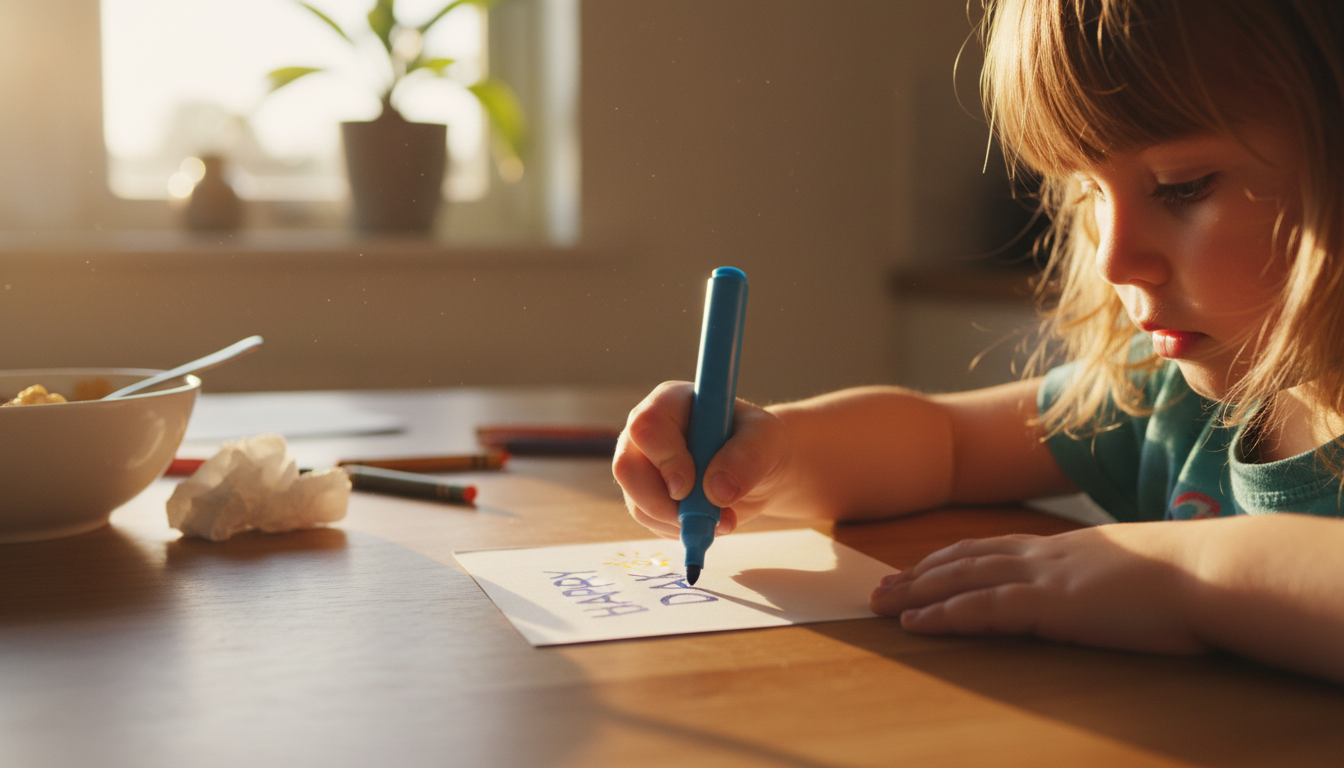
How to Use Project Cards for Low Frustration Creative Time.
The classic creative-time problem: you put paper and markers in front of a tired kid, and within two minutes everyone is frustrated. Crying over a blank page. Markers thrown. Art time over before it started. For kids who shut down easily, project cards for low-frustration creative time give them a visible starting point instead of an empty page.
This guide skips the full-blown art project. It focuses on project cards for kids — short creative sessions where the canvas is small, the prompt is visible, and the finish line appears in under ten minutes. Most of these calm creative activities for kids cost less than $10 to set up and work better than blank-page frustration.. Most cost less than $10 to set up. All of them end better than a blank-page meltdown.
Why Project Cards Beat the Blank Page

A blank sheet of paper is too much for a tired five-year-old. A blank 3 x 5 card isn't. That's the whole idea — shrink the canvas, narrow the choices, give the child one small task they can actually finish.
Project cards aren't a downgrade from real art. They're a different format that fits a different mood — the moods where energy is low, attention is short, and the kid needs a win they can hold in one hand.
The Difference Between a Project and a Card
A regular craft project comes with steps, examples, and a 'right answer' the child is supposed to copy. A project card has one prompt and one card. The child fills it in. That's the whole format.
One uses a 30-minute attention budget. The other uses ten. For tired kids, that gap is the whole game.
What Kids Actually Need
Tired kids don't need more options. They need fewer. A 3 x 5 card holds exactly one idea — not three, not a whole scene. That limit is a relief, not a restriction.
Watch a kid stall in front of an open art bin. The freeze is almost always a choice problem, not a creativity problem. Twenty markers, ten papers, five glues, and the brain stalls. Drop it to one card, one marker, three paper scraps. The stall ends.
The Blank-Page Wall
Most creative meltdowns happen before the marker touches the paper. The child looks at a sheet of paper, can't decide, gets frustrated, gives up. Project cards remove that opening problem by handing the child a card with one job already written on it.
The wall isn't a creativity problem. It's a scale problem. Drop the canvas, the wall comes down.
Eight Project Card Sessions That Actually Work
Eight session types, sorted by what they cost and what they unlock. Pick the one that matches the kid you have today — the tired one, the wired one, the quiet one — not the kid you're hoping to raise. These project cards for low-frustration creative time are designed for calm, low-pressure sessions that help kids start creating without feeling overwhelmed.
|
# |
Session |
Best Age |
Time / Cost |
What Makes It Work |
|
1 |
Five-Minute Card |
4–10 |
5 min · $0 |
Tiny prompt, instant finish. Lowest-stakes way to start. |
|
2 |
Birthday Card Mini-Session |
5–12 |
10 min · $0 |
Real audience, real reason. Writing happens naturally. |
|
3 |
Feelings Color Card |
4+ |
5 min · $0 |
Expression without words. One color, one feeling, done. |
|
4 |
Prompt Deck Pull |
6+ |
5–15 min · $0–5 |
Removes the blank-page decision. Pull a card, do the task. |
|
5 |
Sibling Co-Op Card |
5+ |
10–15 min · $0 |
Two kids, one card. Builds connection, reduces arguing. |
|
6 |
Monthly Memory Card |
5+ |
10 min · $0 |
One card per month for a year. Becomes a real keepsake. |
|
7 |
Holiday Card Sprint |
4+ |
15 min · $0–5 |
Bulk batch for christmas, valentine's, thank-you stacks. |
|
8 |
Kindness Card |
6+ |
10 min · $0 |
Thank-you, miss-you, encouragement. Art meets care. |

Why These Eight, and How to Mix Them
Each one solves a specific creative-time problem. Number 1 fixes the blank-page wall. Number 3 helps a quiet kid show how they feel without explaining themselves. Number 6 turns one tiny card a month into a year-long keepsake. Number 8 connects art with kindness.
Mix them across the week. Five-minute card on Monday before homework. Feelings color card on Wednesday after school. Holiday card sprint on a rainy Saturday. The variety keeps the format fresh; the format keeps the friction low.
Why a Small Canvas Hits the Sweet Spot
For a frustrated kid, a small canvas is a permission slip to think small. The child doesn't have to plan a poster. They have to draw one flower. One robot. One swirl of color. That's the whole job.
Art-making has another quiet benefit: it gives feelings somewhere to go when words don't come easily. A 2020 review in PubMed Central on art therapy with children notes that art-making can help children express feelings and concerns in a supported setting.
The Five-Minute Finish Line
Most cards take five to fifteen minutes. Kids feel the finish line from the first stroke, which is the opposite of how a full art project feels. Fast finishes build trust — the kid learns this kind of creative time always ends well, so they keep coming back.
One Card, One Mistake
A mistake on a card is tiny. Flip it. Cover it with a scrap. Toss it and grab another. Nothing about the format makes mistakes feel like failure. The same one-task-at-a-time logic carries into other formats kids enjoy — a child who likes a five-minute drawing prompt usually loves a five-minute printed toy from a template library. Families ready to add a hands-on tool that runs on the same low-stakes rhythm often start with a guided toy-making printer for younger kids that ships with ready-made templates kids browse like cards from a deck.

Why Familiar Supplies Win
Markers and crayons beat fancy art tools because kids already know how to use them. Glue sticks beat liquid glue because they dry in seconds. Index cards beat custom sketchbooks because nobody cares if one gets ruined.
|
GLITTER, BEADS, AND SMALL OBJECTS — CHECK BEFORE THE SESSION A quick safety check keeps calm, low-frustration creative time safe and focused, especially when feelings cards for children are shared with younger siblings. For children under 3, any small craft piece — sequins, beads, glitter clumps, loose buttons — is a choking hazard. Skip them for the youngest siblings in the home and store finished cards out of reach if smaller children share the space. |
Matching the Card to the Age

Age isn't just a number on the supplies box — it's a planning tool. The same card category lands very differently at 5, 9, and 13.
|
Age Group |
Best Project Card Types |
Watch Out |
|
Under 5 |
Color-only cards, chunky crayons, scribble cards with one prompt word |
Loose small parts, scissors without supervision, long instructions |
|
Ages 5–7 |
Birthday cards from shapes, feelings color cards, simple drawing prompts, holiday card sprints |
Three-step prompts, perfect-looking samples to copy, long sessions |
|
Ages 8–11 |
Prompt deck pulls, kindness card stacks, sibling co-op cards, monthly memory cards |
Boredom from same prompt repeated, lack of display, no audience |
|
Ages 12+ |
Pattern cards, journaling cards, design challenges, grounding / feelings cards for tough days |
Anything that feels too childish — frame as 'design challenges' |
Setting Up the Session So It Actually Happens
Most project card sessions don't fail because the prompt was wrong. They fail because nobody planned the first sixty seconds. The choices the adult makes before the marker comes out usually decide how the whole thing goes.
Pick One Prompt Before Supplies Come Out
Pick the prompt first. Don't open the supply box yet. If the child sees twenty markers before they know what they're making, the markers become the project — and the project ends in negotiation about which markers everyone wants.
Say the prompt out loud once, clearly. 'Today's card is a card with three colors.' That's it. If they push back, offer one backup option. Two choices is enough; more than two and the conversation becomes the activity.
Time Block and Workspace
Block ten minutes the first few times. A flat table with good light. One small box holds everything you need. Families looking to extend the same calm rhythm into hands-on builds can compare beginner 3D printers for families sorted by age band and enclosure type.

The Two-Choice Ritual
Choice is fuel. Too much choice is sand in the engine. Offer two options, never six. Blue or green paper. Monster or robot. Markers or crayons. The child picks, and you move. For the boring-but-critical setup steps — supply layout, prompt phrasing, first-card walk-throughs — AOSEED's step-by-step project guides cover the same calm-session principles for both card sessions and printable projects.
|
THE FIRST-CARD MOMENT This is when a child stops staring at a blank page and starts making a mark. Don't rush it. Sit nearby. Don't suggest a colour. The first thirty seconds of confidence on a project card set the tone for every session that follows. |
Beyond Day One — Keeping the Habit

The card's job isn't to entertain on day one. It's to still be in use on day ninety. The habit, not the single session, is what makes project cards worth setting up.
A Weekly Card Routine
Pick a day. Saturday morning works for most families. Ten minutes a week — a single card, a quick prompt, one finished piece. Skipping a week is fine. Skipping a month is when the routine starts to die.
The Card Display Loop
A finished card shouldn't disappear into a drawer. A magnet on the fridge. A binder ring with twenty cards looped on. A string of mini clothespins on a wall. Visible cards become silent prompts for the next session — the kid sees their own work and wants to add to it.
Cards as Gifts and Memory Sets
Cards travel well. A birthday card for a cousin. A thank-you for a teacher. A monthly memory card builds into a twelve-card keepsake by the end of the year. Add the date and the kid's age on the back. Future-you will be glad you did.
Common Project Card Mistakes

Most of these are well-meaning. All of them are fixable.
|
Mistake |
Why It Fails |
Better Approach |
|
Whole art bin on the table |
Choice overwhelm. The child stalls before starting. |
Two or three supplies max. Pull them from a small box. |
|
Adult tells the child what to draw step by step |
Frustration. Removes the kid's ownership of the result. |
Pick the prompt, let the child fill it in their own way. |
|
Long sessions pushed past energy limit |
Bad memory. The kid resists next time. |
Ten minutes max. Stop on a finished card, not a meltdown. |
|
Finished cards disappear into a drawer |
Effort feels invisible. The habit fades. |
Fridge magnet, string display, binder ring. Visible cards prompt more cards. |
|
Same prompt repeated daily |
Boredom. The format starts to feel like a chore. |
Build a small prompt deck. Pull one card at random each session. |
|
Praising 'good job' on every card |
Generic praise doesn't land. Kids notice. |
Specific praise: 'You tried a new shape' or 'You used three colors today.' |
Conclusion
The best project card isn't the prettiest one. It's the one the kid finished. That's the whole bar — finished, not perfect.
Project cards work because they shrink creative time down to something a child can hold in one hand. One card. One prompt. Ten minutes. Done. The same calm logic scales into the rest of family creative time — sticker books, holiday card sessions, guided hands-on builds. AOSEED's family creativity platform runs on the same small-canvas approach, used in over 5,000 schools to keep kids creating one short project at a time. For older kids ready to graduate from paper cards into hands-on builds, a guided STEM 3D printer for older kids and tweens carries the same logic into a physical format — one template, one print, one finished object.
Don't pick the activity that will impress at the kitchen table. Pick the one your kid is still doing on a quiet Wednesday in March.
|
THE PROJECT CARD MINDSET Small canvas, small choices, small finish line. The session that earns its place in your week isn't the longest one — it's the one your kid actually wants to do again next Saturday. |
FAQs
How to balance creative projects?
Use project cards to keep each session small, clear, and varied across the week. For low-frustration creative time, a five-minute card on Monday and a feelings card on Sunday often works better than one long project that ends in a meltdown.
What are creative activities for anxiety?
Coloring, simple drawing, project cards, and short collage sessions can give an anxious kid something specific to focus on. They support emotional expression but do not replace care from a doctor or mental health professional.
How to make a creative project work?
Give the child an obvious starting line and a close finish line. Pick one prompt, limit supplies to three items, and stop while the kid still has energy.
How to express feelings creatively?
Use color, shape, and one short word instead of full sentences. A feelings card with one main color and a tiny drawing often says more than a long conversation.
What is the 70/30 rule in art?
Roughly 70% of the design belongs to one dominant element, 30% to a supporting accent. On a project card, that's one main color filling the space and one small accent in the corner.
What are the 7 C's of creativity?
Curiosity, confidence, courage, choice, connection, consistency, celebration. Project cards quietly support all seven through short, repeatable sessions kids actually finish.
What is the 3-3-3 anxiety rule?
Notice three things you see, three you hear, three you can touch or move. A child can draw the three things they noticed onto a card to turn a coping tool into a small keepsake.
What is the 5-4-3-2-1 anxiety activity?
Name five things you see, four you touch, three you hear, two you smell, one you taste. Pair it with a card by drawing one thing from each sense onto a single index card.
Sources
- Centers for Disease Control and Prevention — Anxiety and Depression in Children.
- Cleveland Clinic — 13 Grounding Techniques To Help Calm Anxiety.
- PubMed Central — Art Therapy for Psychosocial Problems in Children and Adolescents (2020).
- World Health Organization — Anxiety Disorders Fact Sheet.
- University of Rochester Medical Center — 5-4-3-2-1 Coping Technique for Anxiety.
- AOSEED Kids 3D Printer Collection — enclosed kid-friendly 3D printer lineup



Further reading

Graduation Gifts for Kids: Keepsakes for Kindergarten to Fifth Grade

How to Clean a 3D Printer: A Routine for Families

3D Printer Filament Holder: Options, Setup and a Version You Can Print


