

Gift Ideas for Kids Who Love Building, Cars, and Robots
A child who builds things is telling you exactly what they need as a gift. They need more to build with. The question is which direction to go — mechanical engineering, coding and robotics, vehicle design, or the open design platform that covers all three.
STEM gifts for kids who love building are not generic educational toys. They are domain-specific tools that match what the child is already trying to do with their hands. The best STEM gift is the one that extends a capability the child has already demonstrated.
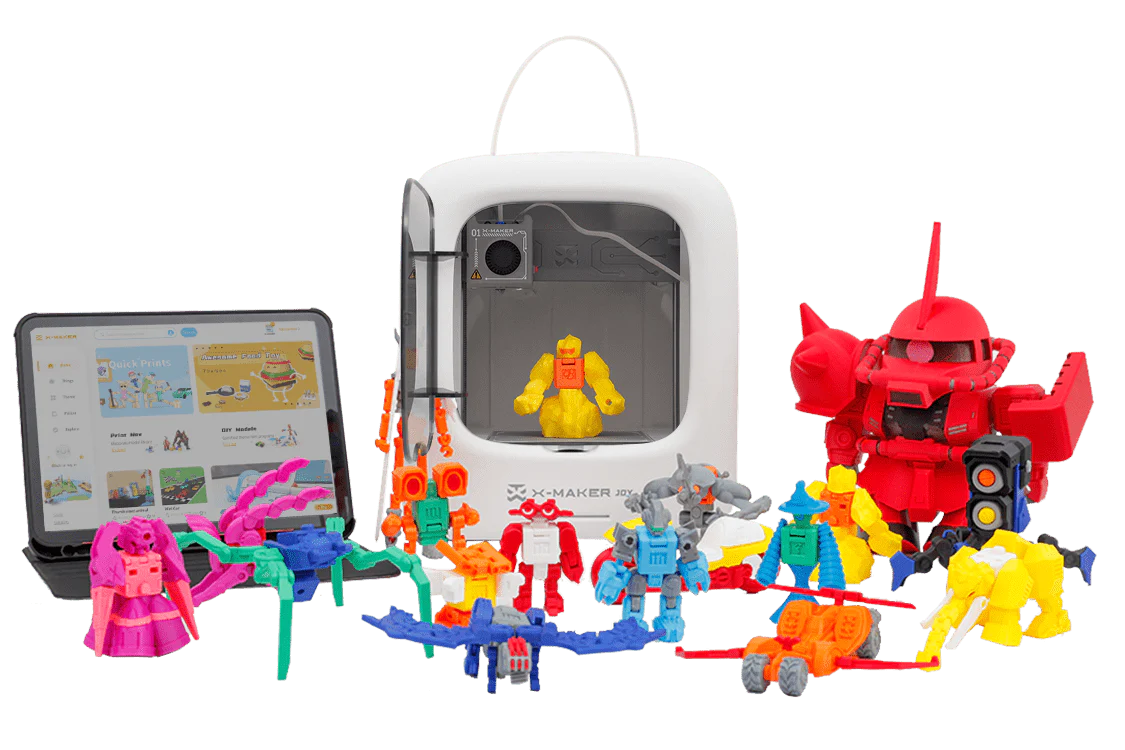
This guide covers seven STEM gift categories, an interest-to-gift match table for identifying exactly which gift fits your specific child, a full robotics kit comparison, a 3D printing project guide for builders and car fans, and guidance on where AOSEED's X-MAKER JOY fits in the builder's toolkit.
|
7 types
STEM gift categories covered
|
5 robots
Coding robot kits compared head-to-head
|
6 prints
3D project ideas for cars and robots
|
8 profiles
Interest-to-gift match guide — find the right one
|
Interest-to-Gift Match Table — Find the Right Gift for Your Specific Child
|
Child's primary interest
|
STEM skill being shown
|
Best gift match
|
Age sweet spot
|
|
Builds with any available parts — boxes, tape, LEGOs
|
Mechanical intuition and structural design thinking
|
Engineering kit: LEGO Technic or K'NEX large sets
|
8–14
|
|
Obsessed with how cars and engines work
|
Mechanical systems, motors, forces and motion
|
RC car build kit or LEGO Technic vehicle set
|
7–13
|
|
Wants to make things that move by themselves
|
Robotics, sequencing, cause and effect logic
|
Coding robot: Sphero, Dash, or LEGO Mindstorms
|
8–13
|
|
Loves designing — draws machines and vehicles constantly
|
Visual-spatial thinking and product design
|
3D printer: X-MAKER JOY — design becomes physical
|
8–14
|
|
Takes everything apart to see inside
|
Systems thinking — how components connect
|
Electronics kit: Snap Circuits or Arduino Starter
|
9–14
|
|
Builds tall structures and tests if they fall
|
Structural engineering and load distribution
|
Marble run or GraviTrax — physics in motion
|
7–13
|
|
Wants to program games or make things beep and light up
|
Computational thinking and programming logic
|
Micro:bit or Raspberry Pi Pico starter kit
|
10–14
|
1. Engineering Kits for Aspiring Builders

Wired's 33 Best STEM Toys for Kids (2025) identifies reconfigurable engineering systems as the highest-value STEM gift for children who demonstrate building interest — because the kit that can be rebuilt in multiple configurations produces exponentially more sessions than a single-build toy.
Why Engineering Kits Are Essential for Kids
An engineering kit at the right level does not just give a child something to build — it gives them a system they can use to test ideas. The child who finishes a LEGO Technic set in one configuration takes it apart and builds something different with the same components. That reconfiguration habit is the engineering instinct developing. The kit is the environment for it.
The most important buying decision: choose a kit that matches where the child is, not where you want them to be. A 7-year-old who has never used Technic does not start with the 1200-piece motorized set. A 10-year-old who has already mastered standard Technic is bored by the entry sets. Match the complexity to the demonstrated skill level.
Engineering Kit Comparison — STEM Concepts, Session Length, and Best Fit
|
Engineering kit
|
STEM concepts taught
|
Session length
|
Best for
|
|
LEGO Technic (vehicle sets)
|
Gears, axles, differentials, pistons, universal joints — real mechanical engineering
|
3–8 hours per build (single follow-through)
|
Child who wants a defined mechanical outcome — a working vehicle or machine
|
|
K'NEX large roller coaster set
|
Structural engineering: load arcs, centripetal force, motor integration
|
4–10 hours + reconfigurations
|
Child who prefers large-scale structures over compact precision builds
|
|
GraviTrax marble run
|
Physics: kinetic energy, momentum, height-to-speed conversion, routing logic
|
30–90 min per configuration
|
Child who prefers testing and reconfiguring over following instructions
|
|
Snap Circuits — circuits set
|
Electrical engineering: series and parallel circuits, sensors, switches, outputs
|
20–40 min per circuit project
|
Child who wants to see immediate electrical results — functional every time
|
|
Meccano engineering set
|
Mechanical assembly: real bolts, plates, gears, and motors
|
2–6 hours per model
|
Child who wants to use real tools — screwdriver and wrench are part of the kit
|
2. Robotics Kits for Young Innovators

The Importance of Robotics for STEM Learning
A robotics kit does something other STEM gifts do not: it makes the child's code visible in the physical world. When a child writes a loop and the robot repeats the action, the abstract concept of a programming loop becomes concrete and real. This connection between code and physical result is the most powerful learning mechanism in STEM education for this age group.
For children who love robots, the most important feature is not the robot's appearance — it is the programming ceiling. A robot the child masters in one weekend produces no further growth. A robot with a clear programming progression from block code to text code provides challenge across 2–3 years of growing skill.
Robotics Kit Comparison — Programming Style, Physical Output, STEM Level, and Age Fit
|
Robot kit
|
Programming style
|
Physical output
|
STEM level
|
Age fit
|
|
Sphero SPRK+
|
Scratch blocks → JavaScript
|
Rolling ball navigates obstacle courses and experiments
|
⭐⭐⭐
|
8–12
|
|
Dash (Wonder Workshop)
|
Blockly block coding via app
|
Moves, lights, plays sounds — responds to environment
|
⭐⭐
|
6–10
|
|
LEGO Mindstorms Robot Inventor
|
LEGO Scratch or Python (advanced)
|
Full autonomous robot with sensors, motors, and missions
|
⭐⭐⭐⭐⭐
|
10–15
|
|
Arduino Uno Starter Kit
|
C-based text programming
|
Working circuits: sensors, displays, motors, buzzers
|
⭐⭐⭐⭐
|
11–15
|
|
Micro:bit v2 + project cards
|
MicroPython or block code
|
Games, wearables, sensors, simple data displays
|
⭐⭐⭐
|
9–13
|
|
Choosing Between Robots: The Ceiling Test
Ask: what is the most complex thing this robot can do? A robot with a visible programming ceiling (one language, one type of movement) will be outgrown. A robot that supports multiple programming languages, has sensors the child discovers over time, and can be programmed for increasingly complex missions provides challenge that outlasts the initial excitement. LEGO Mindstorms and Arduino are ceiling-high kits. Dash and Sphero are excellent starters with moderate ceilings.
|
3. 3D Printing Projects for Young Designers

3D printing occupies a unique position in the STEM gift landscape for builder and car children: it is the only tool that converts their design ideas into physical objects. A child who draws vehicles and robots is already doing design work. A 3D printer gives that design work an output.
The X-MAKER JOY runs on non-toxic PLA filament inside a fully enclosed structure — no fumes, no exposed components. The child selects a model, chooses the filament color, and presses start. They come back to a physical object that did not exist before their session.
Why 3D Printing Is Perfect for STEM Gifts
|
What the builder child wants
|
How 3D printing delivers it
|
|
To make something that actually moves and works
|
Printed gear mechanisms, rolling car axles, and poseable robot joints all move and function after printing
|
|
To design their own version of something
|
The design app allows modification of models — scale, text, shape adjustments — before printing
|
|
To have more parts for their existing kits
|
Printed wheels, connectors, and chassis extensions work alongside LEGO, K'NEX, and Meccano
|
|
To show someone else what they built
|
Every session produces a physical object the child can hand to someone else — not a screenshot
|
|
To keep building sessions going every week
|
The Toy Library provides new models regularly — the child always has a next session available
|
3D Print Ideas for Kids Who Love Cars and Robots
The AOSEED X-MAKER JOY includes a Toy Library with vehicle and robot models organized by print time and complexity. The table below shows six project types specifically suited to children whose primary interests are cars, building, and robots.
3D Print Project Guide — Cars and Robots Focus
|
3D print model type
|
What the child makes
|
Why it fits the building and cars interest
|
|
Race car chassis with moving axles
|
A functional toy car that rolls — wheels snap onto printed axles
|
The car is engineered and produced by the child. Every printed car is slightly different based on design choices.
|
|
Robot figurine with poseable joints
|
An articulated figure that bends and poses — arms, legs, and head moveable
|
Print-in-place joints produce movement without assembly. The child sees engineering in the joint structure.
|
|
Gear mechanism creation kit
|
A set of gears that mesh together and spin when one is turned
|
The gear interaction teaches torque and ratio concepts physically. Child assembles and tests.
|
|
Custom vehicle wheel set
|
A set of wheels designed for a LEGO or Meccano vehicle project
|
Child prints parts that fit their existing kit — extends the kit rather than replacing it. Design thinking.
|
|
Working marble run track section
|
A curved or spiral track section that adds to a marble run setup
|
Child designs a track piece that connects to existing GraviTrax or custom marble run — problem-solving output.
|
|
Robot costume or minifig accessory
|
A wearable robot helmet or miniature figure accessory in chosen scale
|
Connects to character play — the robot or car the child designs is the character they invented.
|
For families with older children (10+) interested in designing original vehicles or robots ratherthan selecting pre-made models, the AOSEED Toy Library includes starter design templates that children can modify. The AOSEED X-MAKER supports custom file import for children ready to design from scratch using Tinkercad or similar free CAD tools.
4. Car Models and Vehicle Kits

Encouraging Interest in Cars Through Play
A child fascinated by cars and vehicles is a child asking the same question repeatedly: 'how does it go?' The best vehicle gifts for this child are not cars that move — they are cars the child builds so they understand why they move. The build process is the education.
The distinction that matters most in this category: is the kit a static build (the car looks like a car but does not function) or a functional build (the car has a working drivetrain, steering, or motor)? Functional builds produce significantly more engagement because the child can test their assembly by running the car.
Vehicle Kit Comparison — Mechanics Taught, Age Fit, and STEM Angle
|
Vehicle kit type
|
Mechanics taught
|
Age fit
|
STEM angle
|
|
LEGO Technic car set (large)
|
Gear transmission, steering mechanism, suspension springs, differential
|
9–14
|
Mechanical engineering — the drivetrain is the lesson
|
|
Meccano GT Supercar set
|
Metal frame construction, motor wiring, real moving parts with tool use
|
8–13
|
Materials science + mechanical assembly using real hardware
|
|
RC car build kit (Tamiya series)
|
Chassis assembly, motor installation, ESC wiring, body mounting
|
10–15
|
Electronics + mechanical engineering — the whole vehicle built from components
|
|
STEM car motor experiment kit
|
Basic DC motor, axle, and wheel assembly — minimal complexity
|
6–10
|
Physics: force, motion, and energy transfer — entry-level mechanics
|
|
3D printed car (X-MAKER JOY)
|
Child designs or selects a chassis, prints it, adds commercial wheels
|
8–13
|
Design thinking + materials — child's own vehicle concept made physical
|
Three questions to ask when choosing a vehicle kit:
-
Does the child want to build it once and race it, or take it apart and rebuild it? Single-build racers suit the first type. LEGO Technic and 3D printed cars suit the second.
-
Does the vehicle need to move under its own power? If yes, the kit must include a motor or an RC receiver. If the child wants to design rather than race, a static functional model is fine.
-
Is the child ready to use real tools? Meccano and RC build kits involve screwdrivers and wrench work. LEGO Technic and 3D printing do not. Tool-readiness is roughly age 10+.
5. Building and Construction Toys

Why Building Toys Are Important for Young Minds
Open-ended building sets are the foundational STEM gift because they have no endpoint. A LEGO Technic set is complete when the model is assembled. An open building system (Magna-Tiles, Keva planks, or a LEGO Classic collection) is never complete — the child is always mid-build.
For children who love building, the open system is more valuable than the instructional kit. The builder identity develops when the child invents their own design rather than following someone else's. The best construction gift is the one with the fewest instructions and the most pieces.
Open Construction System Comparison — STEM Concept, System Type, and Why It Works
|
Building set
|
System type
|
STEM concept
|
Why it works for the builder-car-robot child
|
|
Magna-Tiles (magnetic tiles)
|
Open — no instructions
|
3D spatial reasoning, structural form
|
Child builds vehicles and machines using flat tiles — tests structural stability through direct observation
|
|
LEGO Classic large open set
|
Open — child-directed
|
Creative engineering, spatial planning
|
No instruction box means pure design freedom. The builder child prefers invention over assembly.
|
|
Keva planks (precision wood planks)
|
Open — balance and structure focus
|
Physics: load distribution, balance, structural failure
|
Tall structures tested to collapse teach load tolerance and center of mass intuitively
|
|
Tegu magnetic wood blocks
|
Open — tactile and weighted
|
Spatial reasoning, force and magnetic interaction
|
Dense weighted blocks teach mass and structural balance — satisfying for children who like real materials
|
|
Zometool geometric set
|
Open — geometric structure focus
|
Geometry, crystalline and bridge structures, vectors
|
Used in real architectural and molecular research. The builder child can construct large geodesic structures.
|
|
The Combination Strategy
The most effective STEM gift for a serious builder is a combination of one structured kit (LEGO Technic or engineering kit — for learning mechanical concepts through guided build) and one open system (Magna-Tiles or LEGO Classic — for free design after the structured session). The structured kit teaches; the open system applies. Together, they produce more sessions than either alone.
|
6. Creative Building Sets — Open-Ended Design Freedom

Popular Mechanics' The 25 Best STEM Toy Gifts for Kids Who Love to Build identifies creative building systems — those without instructions — as the category most likely to be used daily across an extended period, because the play session is never technically finished.
Why Building Sets Are Great for Imaginative Play
A creative building set provides something instructional kits do not: the right to be wrong. The child who builds a tower and watches it fall has learned more about structural stability than the child who followed instructions and produced a structurally sound model. The failure is the lesson.
For builder and robot children, creative sets also produce social sessions. Two children building toward different designs from the same collection of pieces — negotiating who gets which components — is a negotiation and collaboration session running underneath the construction.
Popular Creative Building Set Ideas
Five creative building set characteristics that produce the most sessions:
-
High piece count over complex single pieces — 200 simple pieces produce more sessions than 20 complex components.
-
No included instructions — or instructions clearly marked as 'optional starting ideas.' The child should not feel they are doing it wrong.
-
Neutral colors or multi-color available — builder children want their creation to look like what they imagined, not just what was in the box.
-
Connects with or extends existing collections — Keva planks work alongside LEGO. Magna-Tiles work alongside any flat-surface build.
-
A storage system the child can maintain independently — a building set that is not organized gets abandoned. Include a sorting tray or stackable bins.
7. STEM Books and Learning Resources

Books That Foster STEM Interests
A STEM book for a child who loves building is not a school book. It is a reference tool they return to when they want to understand why something works, and an inspiration source when they are designing something new. The most-used STEM books for builder children are the ones with visual cutaways — they show the inside of machines, engines, and structures.
For children who prefer fiction or are resistant to non-fiction, graphic novel format and illustrated story-driven STEM books convert the interest into reading without the child noticing they are learning. Robot Dreams is read by children who do not consider themselves readers.
STEM Books for Builder, Car, and Robot Children — Age Fit and Why It Works
|
Book title
|
Age fit
|
Why it works for building, cars, and robot fans
|
|
The Way Things Work Now (Macaulay)
|
8–14
|
Visual cutaway illustrations of how machines, engines, cars, and electronics actually work inside. Reference book and reading book simultaneously.
|
|
How to Be an Engineer (DK)
|
7–11
|
Step-by-step project instructions for building real working things: bridges, motors, circuits. Each project teaches a named engineering concept.
|
|
Robot Dreams (graphic novel)
|
6–12
|
A graphic novel about a robot and a dog. Introduces emotional design thinking — what does a robot need? — in a format that non-text children will actually complete.
|
|
LEGO Idea Book: 200+ Ways to Build
|
8–14
|
200 LEGO building ideas organized by theme: vehicles, machines, city structures. Not a kit — a design reference the child uses with their existing LEGO.
|
|
Girls Who Code (series) — Starter Book
|
8–12
|
Introduces coding concepts through story. The main character builds robots and programs them. Designed to be read and then acted on.
|
|
Amazing Machines (Tony Mitton series)
|
4–8
|
Bright illustrated books about trucks, planes, ships, and trains. The youngest builders — ages 4–8 — read these before they can hold the engineering kits.
|
A note on pairing books with physical gifts:
-
The Way Things Work Now paired with a Meccano kit: the child reads how a gear works, then builds one. The book and the kit produce the same session.
-
How to Be an Engineer paired with a K'NEX set: each project in the book corresponds to a physical experiment the child can run with their existing kit.
-
The LEGO Idea Book paired with a LEGO Classic open set: the book provides 200 starting points for the open collection — removes blank-canvas paralysis.
STEM Gift Selector — Which Gift Fits Your Child's Specific Maker Profile

The interest-to-gift match table at the start of this article covers broad interest categories. The table below goes one level deeper — by specific maker behavior that parents observe at home:
|
If the child does this at home...
|
The STEM profile showing
|
The gift that fits
|
|
Arranges LEGO pieces by color and size before building anything
|
Systems thinker — pre-planning before execution
|
LEGO Technic large set — the gear system rewards organized sequential thinking
|
|
Builds one thing, destroys it, builds something different immediately
|
Iterative designer — process over product
|
Open system: LEGO Classic or Magna-Tiles — no finished product expectation
|
|
Explains in detail how a car engine works (whether accurately or not)
|
Mechanical interest — how things work inside
|
Meccano motorized set or RC car build kit — internal mechanism is the toy
|
|
Makes their character/figure talk and act out scenes while building
|
Narrative maker — story drives the creation
|
3D printer — they design characters, vehicles, and settings. Story becomes physical object.
|
|
Watches engineering YouTube videos and takes notes or sketches
|
Self-directed researcher — seeks depth
|
Advanced kit: Arduino, Raspberry Pi, or LEGO Mindstorms — ceiling-high complexity
|
|
Codes simple games or modifies existing ones
|
Programmer identity developing
|
Coding robot or Micro:bit — code becomes physical action
|
|
Asks for tools, not toys
|
Tool-user identity
|
Meccano set with real hardware, or 3D printer — both require tool thinking
|
Conclusion
The child who loves building, cars, and robots already knows what they need. They need something that gives them more domain to explore — more mechanical complexity, more programming depth, more design freedom, or more physical output from their creative decisions.
Match the gift to the behavior, not the age range. A 9-year-old who takes apart electronics is ready for Arduino. A 12-year-old who has never used Technic starts at the entry level of Technic. The interest and demonstrated skill level are the guide.
For families considering a 3D printer as the design-to-make STEM gift for their builder child, AOSEED 3D printers for kids shows the X-MAKER JOY and X-MAKER side by side with guidance on which fits which age and skill level.
FAQs
What are the best STEM gifts for kids who love building?
The highest-value STEM gifts for builder children are reconfigurable systems rather than single-build kits. In priority order: (1) LEGO Technic large sets with mechanical function — gears, differentials, and motors; (2) open construction systems — Magna-Tiles, LEGO Classic, or Keva planks for free design sessions; (3) a 3D printer for children who want to design original parts and vehicles; (4) Meccano for children ready to use real tools. The most important buying rule: choose the gift that can be used more than once in more than one configuration.
What are some 3D print ideas for kids who love cars and robots?
Six project types specifically suited to car and robot children: rolling car chassis with printed axles and commercial wheels; articulated robot figurine with poseable print-in-place joints; gear mechanism set where the child assembles interlocking gears; custom wheel set that extends an existing LEGO or Meccano build; custom track section that adds to a marble run setup; and a robot character or vehicle in the child's own design. The most engaging 3D print projects for this interest group are the ones that move or function after printing — not just display pieces.
How do STEM toys help kids learn?
STEM toys produce learning through physical cause-and-effect feedback that no screen-based tutorial replicates. When a child builds a gear system and turns it, they feel the resistance change as gear ratio increases. When they code a robot and it navigates an obstacle course, the logic of their code becomes visible in the robot's path. When they print a gear and it meshes with another printed gear, the geometry of their design choice has physical consequences. Each of these experiences produces intuitive understanding that transfers to formal STEM education. The child who has built a working gear system learns about torque in school as a named concept for something they already know.
Can kids use 3D printers?
Children aged 8 and older can operate an enclosed 3D printer like the X-MAKER JOY independently for most session steps. The app-led workflow means the child selects a model, chooses a filament color, and presses start — these steps are within independent capability from age 8. Parent involvement is useful for the initial setup session, first filament load, and first-layer monitoring. After the first two or three sessions, the child's session is largely self-directed. The enclosed design means the printing surface, hot end, and filament path are not accessible during the session.
What are the benefits of coding kits for kids?
Coding kits convert abstract programming concepts into physical actions the child can see and test. The loop that runs three times is visible as three robot movements. The conditional statement that checks distance is visible as the robot stopping before a wall. This physical visibility of code logic accelerates learning by providing immediate, unambiguous feedback — either the robot does what the code says, or it does not. Coding kits also produce a creative outlet: the child who programs a robot to dance to their favorite song has not just learned programming, they have used programming as an expressive tool.
What are good STEM gifts for 6–7 year olds who love building?
At ages 6–7, the best STEM gifts are high-piece-count open systems rather than mechanically complex instructional kits. Magnetic tiles (Magna-Tiles or similar) at this age produce the most sessions — the magnetic connection gives immediate structural feedback, there are no instructions, and the system scales up with expansion packs. Simple rolling vehicle sets with push-and-go mechanisms (not motorized) let younger children explore movement without the complexity of batteries and wiring. LEGO Duplo or LEGO Classic (not Technic) provides the right level of building challenge. The transition to Technic and more complex engineering kits typically starts at age 8–9.
How can remote control cars be educational?
An RC car becomes educational when the child is involved in its construction rather than just its operation. A pre-built RC car teaches hand-eye coordination and spatial awareness. An RC car that the child assembles — installing the motor, routing the wiring, mounting the receiver, and calibrating the ESC — teaches electronics, mechanical assembly, and basic troubleshooting. The Tamiya RC series and similar hobby-grade build kits produce genuine engineering learning because the child's assembly decisions directly affect how the car performs. A car that veers to one side after assembly has a misalignment the child needs to diagnose and correct.
Sources
- Wired — 33 Best STEM Toys for Kids (2025), 33 Best STEM Toys for Kids (2025), 2025.
- Popular Mechanics — The 25 Best STEM Toy Gifts for Kids Who Love to Build, The 25 Best STEM Toy Gifts for Kids Who Love to Build, 2025.
- Good Housekeeping — 20 Best STEM Toys That Make Science Fun For All Ages, 20 Best STEM Toys That Make Science Fun For All Ages, 2026.
- Smithsonian Magazine — Engineers Choose the Ten Best STEM Toys to Gift in 2024, Engineers Choose the Ten Best STEM Toys to Gift in 2024, 2024.
- Argos — STEM Toys for Kids: Spark Curiosity and Learning, STEM Toys for Kids: Spark Curiosity and Learning, 2026.
- Home Science Tools — STEM Toys by Interest, STEM Toys by Interest, 2026.








Further reading

Thanksgiving STEM Activities for Kids: Table Projects and Simple Engineering Challenges
Thanksgiving dinner takes hours to cook. Most kids are bored within the first one.
A bag of cranberries, a box of toothpicks, a roll of foil and a few balloons can change that. Give those supplies ...

Halloween STEM Activities for Kids: Spooky Builds That Teach Real Science
Halloween hands kids a stack of ready made science questions. Why does a pumpkin foam over? Why do ghosts melt faster with salt? How much candy can a cotton swab bridge hold?
The 16 activities belo...

STEM Crafts for Kids: Build, Decorate and Test
Pick crafts kids can test, not just finish. Build it, make it theirs, measure what it does, then change one thing and try again.
A paper helicopter takes five minutes to fold. Timing ten drops, tri...

STEM Games for Kids: Logic, Math and Building Games to Play Together
Give a seven year old a worksheet and you get ten minutes of sighing. Give the same kid 20 sticks of spaghetti, some tape and a marshmallow, then say the tallest tower wins. Different afternoon.
ST...


