

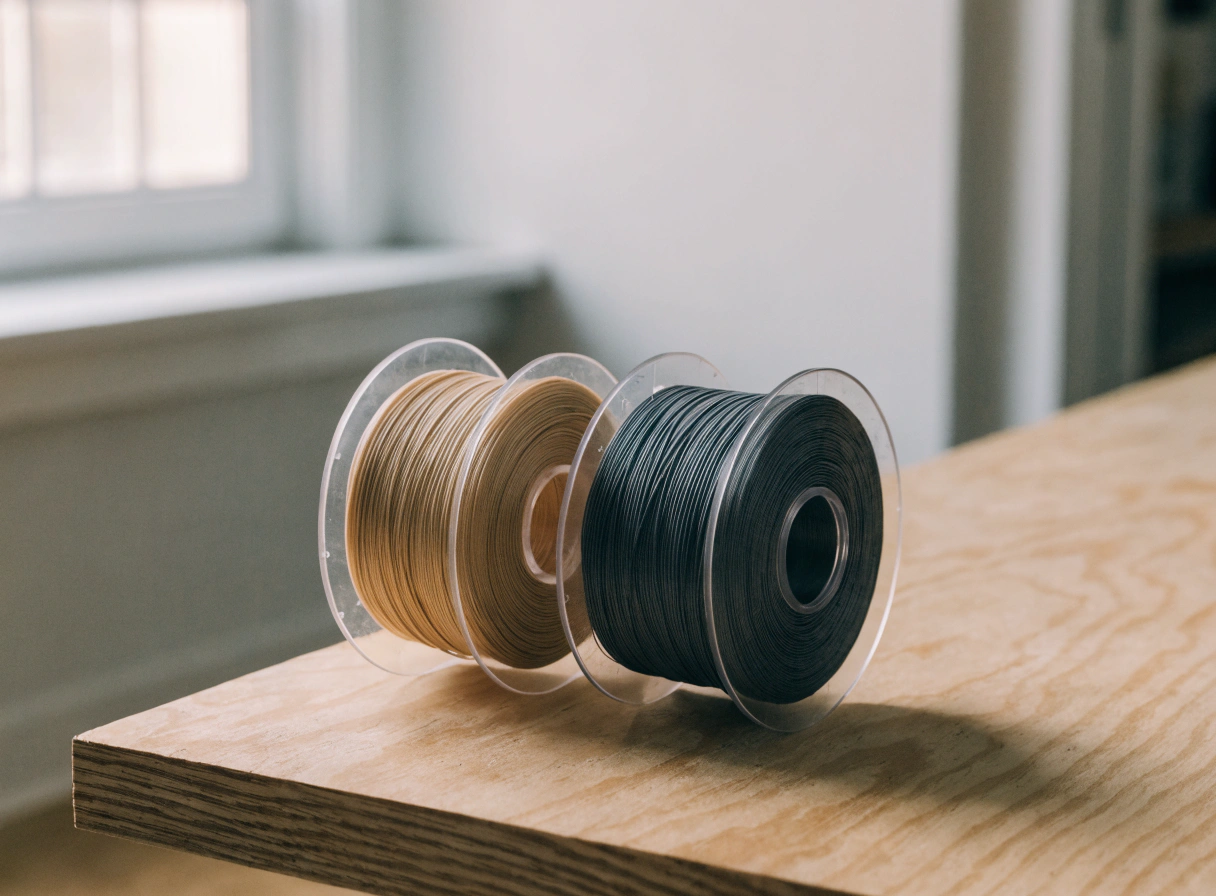
The Truth About PLA vs ABS Filament
Anyone who's just unboxed a 3D printer runs into the same question pretty quickly: PLA or ABS? It's a fair thing to get stuck on. The two cost about the same, load into the machine the same way, and run on the same hardware, so you'd think you could swap one for the other without much thought. You can't, really. Once they're hot they act like genuinely different materials. PLA prints clean on just about anything. ABS pushes back, and when it doesn't go your way you end up with a print peeling off the bed instead of a part you can use.
Most home printers come with a sample of one or the other in the box. PLA is the easygoing one. ABS is built to last, but it asks more of you and your setup. Neither wins outright. They're good at different things and they fail at different things, and working out which is which is what the rest of this comes down to.
|
SHORT ANSWER Go with PLA for anything decorative, detailed, or printed by someone still learning the ropes. It's forgiving, and it looks good with no extra work. Reach for ABS when the part has to take heat, survive a drop, or get used hard. Everything below is the detail behind that split. |
Introduction to PLA and ABS

Both are thermoplastics, which just means heat melts them and cooling sets them solid again. That cycle is the whole basis of how an FDM printer works. It's also about where the similarities end. The two are made from different things, and they cope with heat and stress in different ways. That's the real split.
What Is PLA Filament?
PLA is polylactic acid. What makes it stand out is the source: it's made from plant sugar, mostly corn starch and sugarcane, while nearly every other filament traces back to petroleum. It prints cool, somewhere in the 180 to 220°C range, gets by without a heated bed, and doesn't warp much. Basically, it just works even on a budget machine which is why there's almost always a sample spool tucked in the box. Where it falls down is heat and stress. Set a PLA part on a sunny windowsill and it'll slowly droop. Put real force on it and it cracks rather than bending. For figurines, models, or a prototype you mostly need to look at, none of that's a problem. That's its lane.
What Is ABS Filament?
ABS acrylonitrile butadiene styrene is what LEGO bricks and car dashboards are made of. So the "it's tough" reputation isn't marketing, it's just accurate. It runs hotter, 220 to 250°C, holds its shape up to around 105°C, and acetone vapor will smooth it to a glassy finish. The catch is that it's fussy. No enclosure, and it warps. It also gives off a smell while printing, not dangerous, but you'll notice it. If the printer's headed somewhere people actually live, that ventilation question is worth working out first, anda guide to 3D printing safety is a sensible place to start before you buy.
Mechanical Properties and Strength Comparison

Strength is where a lot of beginners get the wrong idea, because it isn't really one thing. There's how much steady load a part can hold, and there's how well it survives a sudden knock. Those aren't the same, and PLA and ABS don't win the same one.
Tensile Strength and Stiffness
Pull slowly on a PLA part and it holds up well, better than ABS, honestly. It's stiffer too, so under a constant load it keeps its shape instead of bowing. For something that just sits there and does its job, like a bracket or a jig, that's a real advantage. The stiffness only becomes a problem once the part has to move or take a hit.
Impact Resistance and Toughness
Drop a PLA print on a tile floor and there's a decent chance it cracks. Do the same with ABS and it usually just bounces. That's toughness, the ability to take a hit without breaking, and it's the reason ABS ends up in things that get handled roughly. Housings, snap-fit clips, enclosures. If a part is going to get dropped or twisted at some point, ABS is the safer bet.
Flexibility and Ductility
Neither one is flexible the way TPU is. But there's still a gap that matters. ABS gives a little before it fails. PLA mostly doesn't, and once you push it past its limit it just snaps. So for a living hinge, or a clip that has to flex to seat properly, that bit of ABS earns its place.
Which Material for Which Job?
Forget the chemistry for a second. What you really want to know is what the part has to do once it comes off the build plate.
|
Property |
PLA |
ABS |
|
Tensile strength |
Higher — resists steady pulling loads |
Lower, but still solid |
|
Impact resistance |
Brittle — snaps under sudden force |
Tough — absorbs hits without shattering |
|
Heat tolerance |
Softens around 60°C |
Holds shape to about 105°C |
|
Ease of printing |
Beginner-friendly, low warping |
Fussy — wants a heated bed and enclosure |
|
Best for |
Display models, detailed prototypes, indoor parts |
Clips, housings, outdoor and high-heat parts |
Heat Resistance and Environmental Suitability

Glass Transition and Melting Points
This is probably the one difference that'll actually decide a project for you. PLA goes soft at about 60°C. ABS hangs on to roughly 105°C before it starts to give that figure fromSimplify3D's materials guide. And 60°C isn't some lab-only number. A car left in the sun on a summer afternoon gets there easily, which is why a PLA print on the dashboard can turn into a sad little puddle while you're at the store. So if a part's going to sit anywhere warm near an engine, on a sunny sill, close to a light fixture, that's ABS work, not PLA.
Indoor vs Outdoor Use
PLA is an indoor plastic, basically. Warmth softens it and UV slowly chews through it, so a PLA part left outside won't have a long life. ABS does better with sun and weather. Although honestly, if something really has to live outdoors full-time, most people don't bother with ABS either; they go to ASA, which is more or less ABS rebuilt to shrug off UV. Either way the rule of thumb is easy: keep PLA indoors, and reach for something sturdier the moment a part has to go outside.
Biodegradability and Sustainability
PLA gets the "biodegradable" label, but that word's doing a lot of quiet work. It does break down in anindustrial composter, with the heat and humidity held high and steady. Your backyard compost heap won't cut it, and in a landfill it'll just sit there for years like any other plastic. ABS doesn't break down at all, though it is recyclable if there's a facility near you that'll take it. None of this makes one clearly greener than the other. PLA wins for quick or throwaway prints; ABS makes more sense when the part is meant to last.
Printability and Post-Processing

Ease of Printing and Printer Requirements
If PLA has one decisive advantage, this is it. It prints at low temperatures, runs fine on an open-frame machine, and barely warps. A basic printer with almost no tuning will get you a clean result. ABS wants more: a heated bed, a stable room temperature, and ideally an enclosure to hold the heat in and keep drafts out. That difference is exactly why most easy-to-use 3D printers for kids are dialed in for PLA straight from the factory.
|
BEGINNER TIP Begin with PLA. Learn bed leveling, first layers, and slicer settings on something forgiving before you take on ABS and its warping. The forty-segment articulated dragon can wait a few weeks. |
Surface Finish and Post-Processing
Fresh off the printer, PLA looks better. It comes out glossy and sharp, ready to show. ABS comes out matte and a little rough by comparison. But ABS rewards the extra effort. A few minutes in acetone vapor and the surface melts smooth and glassy, which is something PLA simply won't do. Both sand and paint well enough. So really it comes down to whether you want a good finish for nothing, or a great one for a bit of work.
Common Printing Issues and Solutions
Each one has a signature problem. PLA strings and oozes when the nozzle runs too hot, so the fix is dropping the temperature a little and tuning retraction. ABS warps, with corners peeling off the bed as the part cools unevenly. Bed adhesive, a brim or raft, and a draft-free spot will handle most of it.
|
VENTILATION MATTERS ABS gives off a noticeable smell while it prints. Keep it in a ventilated room, and ideally an enclosure. That one change helps the air and the print at the same time, since the enclosure also holds the temperature steady around the part. |

|
WHEN A KID IS THE ONE PRINTING A kid isn't thinking about glass transition temperatures. They want to design something, watch it print, and play with it afterward. For that, the material picks itself: PLA. It's low-temperature, low-odor, safe, and forgiving of the mistakes every beginner makes. Honestly, the printer matters more than the filament here. An open-frame budget kit running ABS usually ends with a parent doing tech support on a Saturday morning. A pre-assembled, enclosed machine built for ages 4 to 12 and tuned for PLA skips most of that headache. If a child is the main user, an easy starter 3D printer for younger kids beats a machine that demands ABS-level fuss. |
Use Cases for PLA and ABS
The cleanest way to decide is to put the spec sheet down and ask one thing: what is the part for?
PLA Applications
PLA is at its best where looks and detail matter more than durability. Figurines, architectural models, board game pieces, classroom projects, prototypes you just need in your hand. It gives you sharp corners and a smooth surface, and its plant-based origin makes it an easy sell for schools or anyone keeping an eye on their footprint. It's also the obvious choice for a kid's first prints.
ABS Applications
ABS belongs to parts that have a job to do. Phone cases, tool housings, a bracket bolted near something hot, an RC body that's going to crash sooner or later. All of that needs the impact resistance and heat tolerance PLA can't give you. Smooth it with acetone afterward and you've got a tough part that looks almost injection-molded.
Blends and Alternatives
When neither one fits cleanly, the middle ground is crowded:
- PLA-ABS blends — a little tougher than PLA, a little easier than ABS, not really great at either.
- PETG — the everyday all-rounder: tougher than PLA, far less fussy than ABS.
- ASA — ABS reworked to survive UV, made for outdoor parts.
- Tough PLA / PLA+ — PLA tweaked to take a hit, prints just like the regular stuff.
- Polycarbonate — stronger and more heat-resistant than ABS, but genuinely hard to print well.
|
QUICK BENCHMARK A small functional clip prints in about 25 minutes in PLA on an open-frame machine, no enclosure needed. The same clip in ABS wants a 95–110°C heated bed, an enclosure, and a slow first layer so it doesn't warp. Same part, completely different setup. For most home users, that gap is the real ABS-versus-PLA decision. |
Conclusion
So, ABS or PLA? There's no winner here, just a fit. PLA is the easy, good-looking, beginner-friendly option for indoor and decorative work, and at room temperature it actually beats ABS on raw tensile strength. ABS is what you reach for when the part has to take heat, impact, or years of use.
People tend to overthink this. They compare glass transition numbers, read up on the chemistry, and stall out. The shortcut is shorter than that. Look at the part, the printer you already own, and the room it'll run in. Decorative model, basic printer, normal room? PLA. Functional part headed for a hot garage? ABS. Match the material to the job and most of the confusion clears up on its own.

Whichever you pick, a setup built for guided, low-frustration printing, like AOSEED's family-friendly 3D printing platform, flattens the learning curve. Choose the project first. Then match the material and the machine to it, not the other way around.
FAQs
Can I use PLA and ABS on the same 3D printer?
Almost any FDM printer takes both. You just can't use the same settings. PLA runs at 180–220°C with barely any bed heat; ABS needs 220–250°C and usually an enclosure or it warps. Swap your slicer profile each time you change spools, and purge the nozzle in between so the old filament doesn't clog the next print. AOSEED'sbeginner-friendly 3D printing tutorials have the exact numbers if you're doing it for the first time.
Can PLA and ABS be mixed in a single print?
Don't count on it. The two cool at different rates, so anywhere they touch you'll get warping and layers that won't bond. If you need a multi-material part, use filament sold as a PLA-ABS blend, or print the PLA and ABS sections separately and join them afterward.
How strong are PLA and ABS filaments?
There are really two kinds of strength in play here. PLA resists a steady pull better, since it has the higher tensile strength. ABS handles impact better, flexing instead of cracking when something hits it. Layer direction and how well your printer is calibrated move the numbers around too. As a rule of thumb, go ABS for parts that get dropped or stressed, and PLA for parts that just need to hold their shape.
Does PLA require a heated bed?
Not strictly. PLA barely shrinks as it cools, so it'll grip an unheated bed well enough to get the job done. That said, if you do have a heated bed, running it at 50–60°C makes a real difference to the first layer, and the first layer is usually where prints go wrong. On a machine with no heated bed at all, painter's tape, a swipe of glue stick, or a PEI sheet will each give the print something to hold onto. If you're still shopping for a machine, this guide on how to choose a kid-friendly 3D printer goes through what actually matters.
Which filament is better for outdoor use?
ABS, fairly clearly. It copes with heat and sunlight a lot better than PLA does. PLA starts going soft once it gets past 60°C, and sun and moisture wear it down over time, so it just won't survive long outdoors. Anything that's going to live outside, like an enclosure or a garden fixture or some kind of tool part, is better off in ABS, or in ASA, which is essentially ABS reformulated to stand up to UV. The only real outdoor case for PLA is something decorative, or something you only need to last a little while.
Are PLA and ABS biodegradable?
PLA technically is, but there's a catch most people miss. It only really breaks down in an industrial composting setup, where the heat and humidity stay high and steady. Toss it in a home compost bin or a landfill and it'll basically just sit there for years. ABS doesn't biodegrade at all, though it can be recycled if you've got a facility nearby that takes it. So it comes down to what you're making: PLA suits things with a short life, while ABS makes more sense when you want the part to stick around.
How do I post-process PLA and ABS for a smooth finish?
The two take different routes here. ABS works really well with acetone vapor, which melts the outer surface just enough to leave it glossy and almost seamless. PLA doesn't react to acetone at all, so with PLA you're looking at sanding, or one of the specialty solvents made for it. Either filament can be painted, polished, or machined once you're past that stage. Whatever you do, start with fine-grit wet sandpaper before reaching for any solvent. It knocks down the layer lines without chewing up the detail. And once you've got the hang of finishing prints, these easy 3D printing project ideas for kids are a good place to find your next one.
What filament is best for high-temperature applications?
Between these two, it's not close: ABS. It holds its shape up to around 105°C, while PLA is already starting to sag somewhere near 60°C. So for something like an engine-bay part, or a fixture that sits in direct sun all day, ABS is the one that won't let you down. Just plan on a heated bed and an enclosure to get a clean print out of it. And if your part is going to see heat even ABS can't handle, that's the point where you stop looking at these two and start looking at polycarbonate or nylon.
Sources
- NatureWorks, “Composting Ingeo — Where It Goes.”
- Encyclopedia Britannica, “Acrylonitrile-butadiene-styrene copolymer (ABS).”
- Simplify3D, “Ultimate Materials Guide — Tips for 3D Printing with ABS.”
- Bioplastics News, “Polylactic Acid or Polylactide (PLA).”



Further reading

Graduation Gifts for Kids: Keepsakes for Kindergarten to Fifth Grade

How to Clean a 3D Printer: A Routine for Families

3D Printer Filament Holder: Options, Setup and a Version You Can Print


