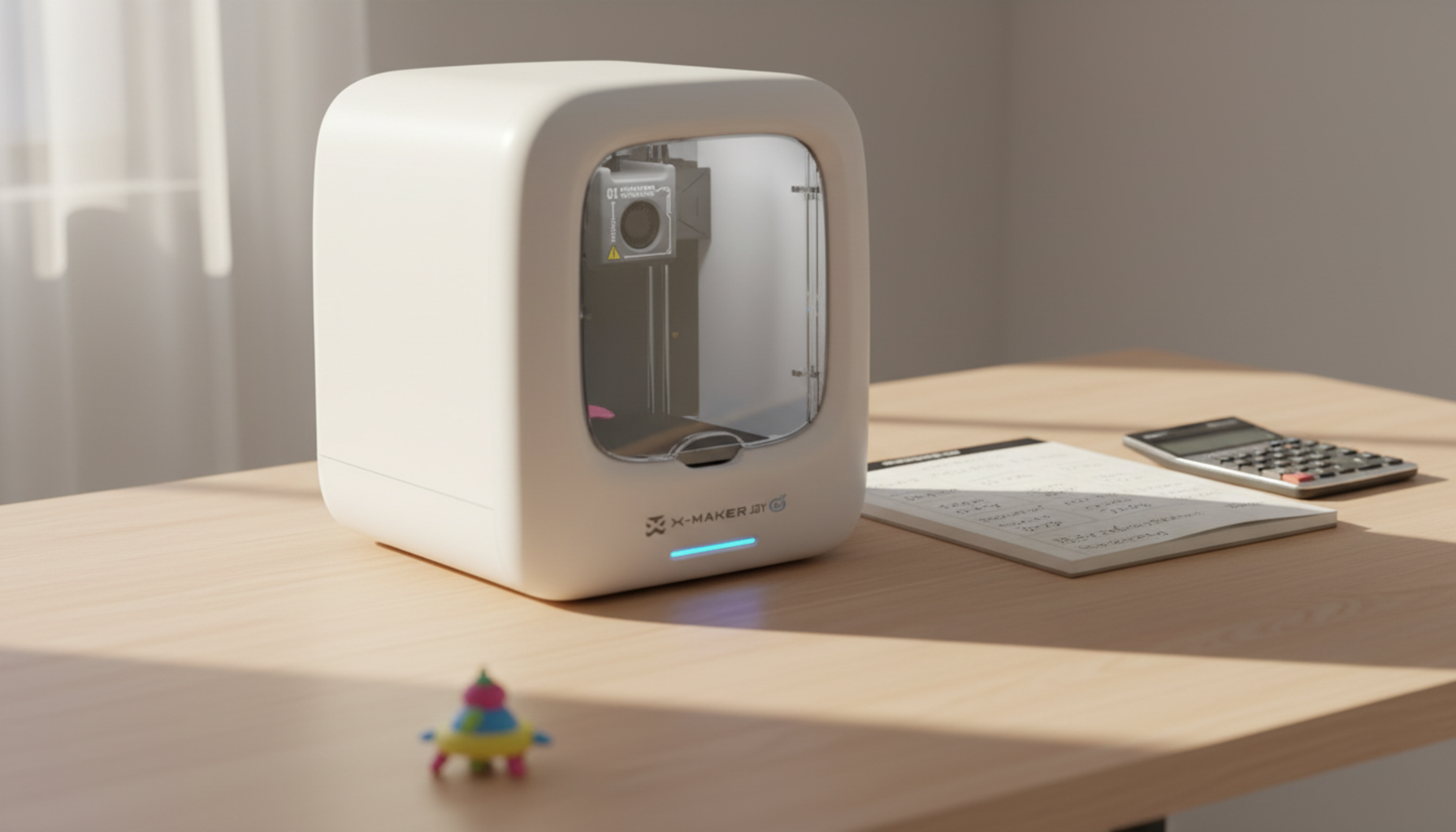
How Much Does a 3D Printer Cost? (Total Ownership Cost)
A 3D printer doesn't end at the box. Spend $300 on the machine and a year later you've also spent on filament — a few rolls of PLA add up fast. Plus a replacement nozzle when the first one clogged. A new build plate at some point. A couple of bucks on the electricity bill, monthly. None of it's much. All of it adds up.
The question worth asking isn't what the printer costs. It's what owning one costs across three years.
TL;DR
Entry FDM printers: $200–$500. Hobbyist: $500–$1,500. Professional: $2,000–$6,000. Add another $150–$300 a year for filament, $50–$150 for parts, under $30 for electricity. Year one for a family setup runs $500–$800 all in. Years two and three drop to $200–$300. Cheap on the box doesn't always mean cheap to own.
How Much Does a 3D Printer Cost?

Honest answer: it breaks into tiers. Each one fits a different kind of buyer.
Entry-level prints sit at $200–$500. Hobbyist machines, $500–$1,500. Professional desktop printers start around $2,000 and stretch to $6,000 before specialty pricing kicks in. Industrial machines go past $10,000, but nobody buying their first printer is in that conversation.
Most printer makers bracket pricing the same way. Formlabs splits consumer machines into entry, hobbyist, and professional bands, and Fusion3's 2025 cost guide lands on nearly identical numbers. The tiers are an industry consensus, not a marketing invention.
Most family setups land in entry or hobbyist and stay there. A six-year-old printing animals for show-and-tell needs different hardware than a teenager designing drone parts. Price scales with build volume, speed, materials supported, and how much of the workflow runs without you.
What Goes Into the Total Cost of a 3D Printer?
Four costs decide what owning a printer actually feels like over a year. The sticker's just the first one.
- Printer hardware — one-time, year one.
- Filament or resin — the recurring one. $80–$250 a year for most homes.
- Maintenance and parts — $50–$150 a year covers most setups.
- Electricity — under $30 a year for a kid-friendly machine.
Add those four across a year and a family setup lands $500–$800 in year one and $200–$300 after that. The printer that sits unused costs the same and returns nothing. Use determines whether ownership earns out.
The Four Real Costs of Owning a 3D Printer

Each cost line behaves differently across the life of the printer.
1. The Printer Itself
The big one-time hit. Entry: $200–$500. Hobbyist: $500–$1,500. Professional: $2,000+. It doesn't repeat — year two is filament and parts only.
The value gap inside the entry tier matters more than the gap between tiers. A $250 open-frame kit needs assembly, manual leveling, patience. A $400 enclosed kid-friendly machine prints out of the box. That $150 difference earns itself back in saved setup time within a month.
2. Filament (the recurring biggie)
Most home users spend $80–$250 a year. Standard PLA runs $20–$30 per kilogram. One kilo prints further than people expect: a month of small toys, two weeks of bigger projects. Specialty filaments climb from there. PETG $25–$40. TPU $35–$50. Wood-fill and silk PLA $40–$60.
Resin printers run higher. Plan $150–$400 a year once bottle prices and cleaning supplies are in the picture.
3. Maintenance and Parts
Less than people fear. Nozzles wear out — $5–$15 each, swapped in minutes. Build plates lose grip after a few hundred prints — $20–$40 for a new sheet. Belts, fans, and motor drivers can fail, but most home printers run years before any major part replacement. Budget $50–$150 a year and you're covered.
Professional printers cost more here because parts run pricier and some need firmware-paired servicing.
4. Electricity
Smaller than expected. A kid-friendly FDM printer pulls 50–150 watts during a print. Desk lamp territory, not microwave. The U.S. residential electricity rate sits around 17.65¢ per kilowatt-hour in 2026, so an hour of printing costs 1–3 cents. Run the printer 30 hours a month and the bill barely notices — $5–$10.
States with higher rates feel it more. Hawaii and California push past 28¢ per kWh. North Dakota and Idaho stay under 12¢. At typical home print volumes, the difference still lands under $20 a year either way.
Budget vs Hobbyist vs Professional: What's the Difference?

Three tiers. Three buyers. The labels describe the same hardware category from different angles.
|
Tier |
Price Range |
Best For |
Setup Effort |
|
Budget / Entry-level |
$100–$500 |
Kids, first-time families, light hobbyists |
Low (kid-friendly) to High (open kits) |
|
Hobbyist |
$500–$1,500 |
Weekly family use, older kids, school projects |
Low to moderate |
|
Professional |
$2,000–$6,000 |
STEM labs, small studios, makerspaces |
Pre-calibrated, near-zero |
"Budget" and "entry-level" mean the same thing in US shops. "Hobbyist" describes the middle band — more capable, less hand-holding. "Professional" doesn't always mean industrial; it usually means engineering filament support, larger build volumes, and a print head that runs unsupervised for hours. UltiMaker frames the professional tier the same way, and Flashforge's 2025 price breakdown tracks the entry and hobbyist bands closely.
Walk into any 3D printing shop and ask for any of these. Staff knows what you mean. Specs matter more than the marketing label.
Are 3D Printers Worth the Money?
Short answer: depends on use.
A printer that runs every weekend pays for itself within six months for most households. Compare a $400 printer used 40 times in a year against the cost of equivalent toys, decor, gifts, props, and school projects. The printer wins by month six and keeps winning.
A printer that runs four times in fifty weekends is a souvenir, not an investment. The honest test isn't specs — it's behavior. Will someone in the house actually run it?
The 3D printing community lands in the same place. A long-running r/3dprinter thread on cost-effective beginner printers keeps circling back to one point — mid-tier reliability beats rock-bottom pricing, because a printer you fight with is a printer you stop using.
Where 3D printers earn their keep:
- Custom toys, decor, and gifts on demand
- Small replacement parts (drawer pulls, clips, brackets)
- School and STEM projects
- Hobbies that need custom parts — model trains, RC, cosplay
- Anything where outsourcing fees feel silly
Why Would You Buy a 3D Printer Today?
A 3D printer earns a spot in the house when:
- You want custom items without the shipping wait
- A kid in the house is old enough to design or pick their own prints
- You hobby in ways that need small custom parts
- STEM projects matter and the classroom budget doesn't apply
- $0.50 in filament beats $15 for a six-pack on Amazon
- Outsourcing at $20 per item feels wasteful
The honest reason most owners stick with it: making something physical from a digital file is genuinely satisfying. That doesn't show up on any cost spreadsheet. It's also the reason printers keep running long after the novelty wears off.
WHERE BUDGET PRINTERS START FALLING SHORT

The moment a cheap printer stops earning its place is when reliability matters more than the sticker. A $200 open-frame kit that needs an hour of fiddling before each print costs more in wasted weekends than a $400 enclosed machine that just runs.
Families feel this fastest. A printer that fails halfway through a project, leaves filament spaghetti across the bed, or refuses to level eats the patience that should be going into the next print. AOSEED's kid-friendly 3D printers built around enclosed bodies skip most of that — auto-leveling, one-press workflows, and tuned filament profiles handle what frustrates first-time users on cheaper hardware. For families, reliability decides whether the printer keeps getting used.
Home Printing vs Outsourcing vs Subscription Services
Three options. Three break-even points.
|
Option |
Best For |
Watch Out For |
|
Home 3D printer |
Weekly use, kid-led creativity, small custom parts |
Upfront cost, learning curve, occasional failed prints |
|
Print-on-demand service |
One-off large prints, industrial materials, no setup |
$15–$60 per item + shipping. Adds up fast at weekly volumes. |
|
Subscription print service |
Rare use, occasional access without owning a machine |
Monthly fee whether you print or not |
Choose a home printer when
- You'll print weekly or more
- You want custom items on demand without a shipping wait
- The household has space and someone willing to learn
Choose outsourcing when
- You need one large print and won't need another for months
- The job needs industrial materials no home printer handles
- You want the print done by a pro without the setup
Choose a subscription service when
- You print rarely but want occasional access
- You don't want to own a machine
- A monthly fee fits the budget better than a one-time spend
For most families that print regularly, owning beats outsourcing by month four. A $20-per-print service adds up fast once a kid starts asking for weekly projects.
How Much Filament Will You Actually Use?
PLA spool sizes you'll see on a shelf:
|
Spool Size |
Realistic Use |
Cost (PLA) |
|
250g |
Sample size, single small print |
$8–$15 |
|
500g |
Beginner trial, single project |
$15–$22 |
|
1kg (standard) |
Several projects, most common |
$20–$30 |
|
2kg+ |
Bulk users, frequent printing |
$35–$50 |
A 1kg PLA spool roughly prints:
- 350–400 small toys (10–30g each)
- 30–40 medium decor pieces (25–50g each)
- 4–6 large display items (200g+ each)
Most beginners overbuy filament. One 1kg spool first beats stocking five colors that sit in a drawer absorbing moisture.
How Long Does a Print Take?
Print time scales with size and complexity, not just raw speed.
|
Print Size |
Typical Print Time |
Material Cost |
|
Small toy (10–30g) |
30–90 min |
$0.30–$1.00 |
|
Medium decor (25–100g) |
2–6 hours |
$0.75–$3.00 |
|
Large display (200g+) |
12–24 hours |
$5.00–$15.00 |
|
Multi-day project (500g+) |
30+ hours |
$12.00+ |
Modern fast printers in the 400–600mm/s class cut these times by 30–50%. Budget machines stay near 50–150mm/s. For most family use, reliability beats raw speed — a fast printer that fails halfway through is slower than a slow printer that finishes the first time.
QUICK BENCHMARK
A $400 kid-friendly enclosed printer used twice a week for a year prints around 100 small toys. Material: $100. Electricity: $15. Maintenance: $50. Total cost per finished toy across year one — including the printer itself — about $5.65. By year two, when the upfront cost falls away, it drops to $1.65 per toy. Year three, closer to a dollar.
How to Buy a 3D Printer for Beginners

Five steps. That's the whole thing.
- Decide who's using it. Match the printer to the actual user — not to who you wish would use it.
- Set a real budget. Add 30% to the printer price for first-year extras: filament, a spare nozzle, a build sheet. A $300 printer is a $400 first-year commitment.
- Pick FDM over SLA for first-time households. Filament is forgiving and kid-safer. SLA brings resin chemistry into the house.
- Prioritize enclosure and auto-leveling. Enclosed bodies physically block the hot nozzle. Auto-leveling skips the most common first-print failure.
- Buy one good 1kg spool of PLA in a neutral color. Skip cheap multi-color packs until the printer prints clean.
Most kid-friendly setups reduce step 4 to "just unbox it" — pre-leveled, auto-loading, one-press profiles already loaded in the app. If you want a second reference before deciding, JLC3DP's budget guide walks through the same tiers from a print-service angle.
Are There Reasons to Avoid Cheap 3D Printers?

Not as a category. Specific situations, yes.
1. They often need assembly.
Open-frame kits at $200–$300 need building. Fine if you enjoy the process. Frustrating if you wanted to print this weekend.
2. Manual leveling eats time.
Every print on a manual-level machine starts with a few minutes of bed adjustment. Multiply across a year of weekend use and that's a full workday gone.
3. Reliability beats specs.
A $200 printer that fails on one print in three loses more in wasted filament than the $200 it saved over a $400 reliable machine.
4. Cheap nozzles wear faster.
Brass nozzles on budget printers can need replacing every few months under heavy use. Hardened steel costs slightly more upfront and lasts years.
Better framing: match the printer to how often it'll actually run. A $200 machine used twice a year is fine. The same machine running every weekend turns into a part-replacement project.
How Long Does a 3D Printer Last?
Three to seven years for a well-maintained home machine. Some lighter-use printers run past a decade.
What affects it:
- How often the printer runs
- What materials it prints (abrasive composites wear hardware fast)
- Whether wear parts get replaced on schedule
- Storage conditions — dust, temperature, humidity
- Build quality of the printer itself
Entry-tier printers wear faster because of lighter-duty frames and motors. Software longevity matters too — a printer with regular app updates keeps gaining features past purchase. A neglected printer in a dusty garage might not make three years. A maintained one in a clean room runs past seven.
Is a 3D Printer Safe Around Kids?
The printer itself can be — with the right choices.
What parents should know:
- The print head reaches 200–280°C during printing. Hot enough for a serious burn.
- Enclosed bodies physically block access to the nozzle.
- PLA — the default kid-friendly filament — prints with no notable fumes.
- ABS and similar high-temperature materials release styrene and need ventilation.
- Resin printers handle liquid chemicals — adult supervision every step.
- Small printed parts are choking hazards for very young kids. Standard small-toy rules apply.
For families starting out, the safe default is an enclosed FDM printer tuned for PLA. AOSEED builds a beginner-friendly 3D printer designed for younger kids around exactly that — fully enclosed body, kid-safe PLA workflow, and project libraries built for lightly-supervised family use.
How to Choose the Right 3D Printer

Five things to weigh:
|
Criteria |
What to Look For |
|
Who's using it |
Younger kids → enclosed kid-tier. Older kids/teens → hobbyists. Engineers → professionals. |
|
Build volume |
Most family projects fit a 200×200×200mm bed. Bigger gets expensive fast. |
|
Enclosure |
Enclosed bodies = safer, quieter, fewer warping issues. Worth the premium. |
|
App and model library |
A guided app with weekly model updates beats raw specs for keeping the printer in active use. |
|
Noise level |
Under 50 dB if it'll share space with homework, naps, or a living room. |
Biggest isn't best. Most expensive isn't best either. The printer that matches who'll actually use it, how often, and what they want to make is the one you'll still be using in three years. A $400 enclosed kid-friendly machine that runs every weekend beats a $200 open-frame kit that sits in a closet. It also beats a $2,000 professional printer nobody in the house feels comfortable touching.
Conclusion
A 3D printer doesn't end at the box price. Year one runs $500–$800 for a family setup once filament, maintenance, and electricity get added. Years two and three drop to $200–$300 because the printer itself stops repeating.
Cloud-based printing handles edge cases. Outsourcing handles one-off industrial jobs. Home 3D printers still own the lane that matters: custom items on demand at filament-only cost, no shipping, no subscription, no wait. The cheapest printer in the room is always the one that actually gets used.
For families starting out, AOSEED's family-ready 3D printer lineup is built around that test — enclosed bodies, app-guided workflows, and project ecosystems built to keep the machine running long after the novelty wears off.
FAQs
What's the average cost for a 3D printer?
Most consumer 3D printers run between $200 and $1,500. Kid-friendly and beginner models cluster in the $300–$700 range. Entry FDM machines start near $200. Hobbyist printers run $500–$1,500. Professional desktop printers begin around $2,000 and reach $6,000. The "average" depends heavily on who's using it — a small child doesn't need the same machine as a teen building functional parts. Tip: don't shop by sticker alone. Add 30% to the printer price for first-year filament, parts, and a spare nozzle. That's the real number.
Why are 3D printers so expensive?
They aren't, by historical standards — consumer prices have dropped roughly 80% since 2015. What feels expensive is the gap between the box price and the real first-year cost. A $300 printer means $300 for the machine plus $150–$300 in filament, parts, and electricity within twelve months. Harder cost: time spent assembling and troubleshooting a budget machine versus an enclosed kid-friendly one. Tip: a slightly more expensive printer that ships pre-assembled and pre-leveled often costs less to own than the cheapest option on the shelf.
How much does it cost to run a 3D printer per hour?
About 1–3 cents an hour in electricity for a typical kid-friendly FDM printer. Add material and it climbs — a small toy uses around $0.30–$1.00 in PLA, and a medium decor piece runs $0.75–$3.00. Larger prints at 200g+ can hit $5–$15 in filament alone. Tip: most people overestimate electricity cost and underestimate filament. Track a few prints with slicer software and a month of data gives a clean per-project number.
Is owning a 3D printer worth it?
Depends entirely on how often it gets used. A printer that runs every weekend pays for itself inside six months for most households — compare a $400 printer plus a year of filament against the cost of equivalent toys, decor, gifts, and small parts. A printer that runs four weekends out of fifty is a souvenir, not an investment. Tip: before buying, write down the first ten things someone in the house actually wants to print. If the list comes easily, it's worth it. If it doesn't, hold off.
How much electricity does a 3D printer use?
A typical kid-friendly FDM printer draws 50–150 watts during a print, similar to a small desk lamp. At the U.S. residential average of 17.65¢ per kilowatt-hour in 2026, an hour costs 1–3 cents. Even at 30 hours of printing a month, electricity adds $5–$10 to the bill. Larger heated enclosures and resin printers with curing stations use more — sometimes double. Tip: in states with time-of-use pricing like California, schedule longer prints overnight when off-peak rates can be a third of peak.
What's the cheapest 3D printer worth buying?
The sweet spot starts around $300–$400 — enough to skip the $200-tier hassles (manual leveling, open frames, assembly) without paying hobbyist-tier prices. Below $250, you're paying for the kit experience more than the print experience. Some kid-friendly models hit that $200 mark and work fine for very young first-time users. Tip: read return policies before buying. A printer with a 30-day satisfaction window costs the same as one without, and lets you confirm the household actually uses it.
How long do 3D printers last?
A well-maintained home 3D printer typically lasts 3–7 years. Lighter-use machines can run past a decade. Lifespan depends on print frequency, what materials are used, whether wear parts are replaced on schedule, and storage conditions between prints. Entry-tier machines wear faster because of lighter-duty frames. Software longevity matters too — a printer connected to a regularly updated app keeps gaining features past purchase. Tip: replace nozzles every 6–12 months of active use and keep the printer covered between sessions. Both moves easily double the printer's working life.
Can you make money with a 3D printer?
Yes — but the printer that makes money looks different from the one that prints kids' toys. Etsy sellers, custom-gift makers, model-train hobbyists running side businesses, props makers, and small product designers all use 3D printers profitably. A $2,000 professional printer producing items at $25 each with $5 in materials breaks even at 120 prints — about 12 a week for ten weeks. Tip: home-printer-for-fun and home-printer-for-profit are different setups. Don't try to start a business with a $300 entry kit. The reliability won't carry the workload.
Sources
- Formlabs, "How Much Does a 3D Printer Cost? Process Cost Comparison and 3D Printer Pricing."
- Fusion3, "How Much Does a 3D Printer Cost?" Updated September 2025.
- Flashforge, "How Much Is a 3D Printer? 2025 Prices Explained."
- UltiMaker, "How much does a 3D printer cost?" May 13, 2023.
- JLC3DP, How Much is a 3D Printer? A Comprehensive Guide for Every Budget.
- Reddit r/3dprinter, "What are some good cost-effective 3D printers for beginners?" Community discussion thread.


You may also like
Further reading

How to Turn Passive Screen Time Into a Make-and-Play Routine

Visual Project Plan for Kids: Make Creative Time Predictable

Routine Activities for Kids: Simple 3D Printing Projects